Axios Future of Defense

February 12, 2025

Hey, hey. It's Wednesday. Again.
- I'm on the hunt for Q&A candidates. Send recommendations my way, and thanks to everyone who sent along their Iron Dome thoughts. More soon.
🚨Breaking: Defense Secretary Pete Hegseth plans to welcome "the keen eye of DOGE" to scrutinize Pentagon spending "very soon," my colleague Zachary Basu reports from the SecDef's trip to Europe. Go deeper.
🏰 Situational awareness: Fort Liberty will again be Fort Bragg — but with a twist. Hegseth on Monday ordered the name change in honor of Pfc. Roland L. Bragg (involved in the Battle of the Bulge), not Confederate Gen. Braxton Bragg.
What's happening: A 2035 crystal ball, drone swarm software and a sit-down with Mr. Moneymaker.
Today's newsletter is 1,747 words, a 6.5-minute read.
1 big thing: An exclusive look at 3D-printed weaponry
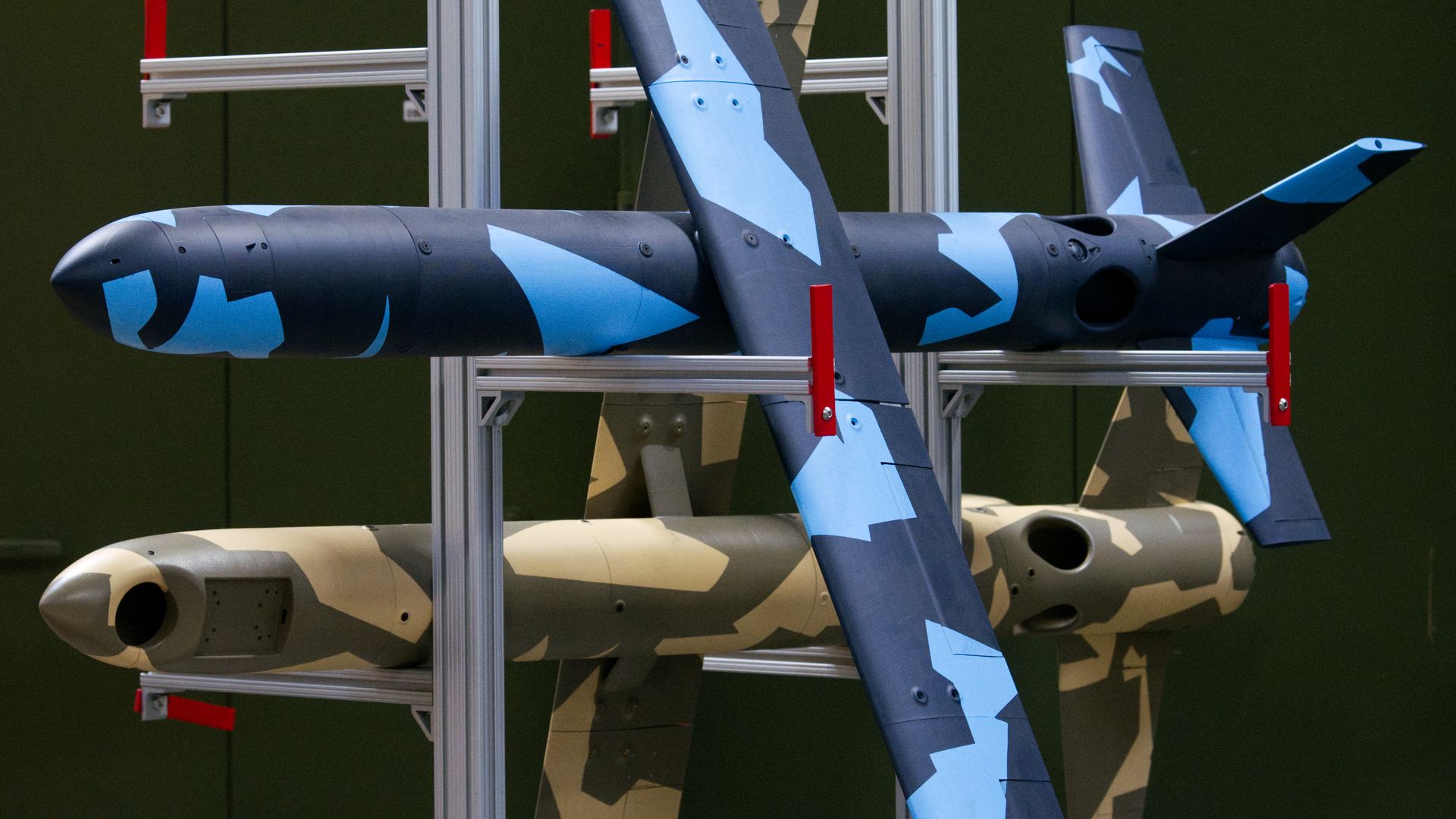
On the tail end of a San Diego trip, after days covering the WEST naval conference, I linked up with Firestorm Labs CEO Dan Magy.
- He gave me an intimate look at how the company is 3D printing drones in spaces tighter than your average Washington, D.C., apartment and how contested logistics colors it all.
Why it matters: Additive manufacturing is incredibly attractive at a time when capacity — so often held hostage by specialty parts, single producers and backorders — is king.
- Supplies win wars. It's a numbers game, and winners have size and speed. (There's a reason why folks are worried about China's shipbuilding cadence.)
Driving the news: We whipped around Firestorm facilities that skirt Marine Corps Air Station Miramar. The roads were lined with cactus and palms; an Osprey flew overhead.
- Magy showed me how the drones are made in a matter of hours, how finished sections snap together by hand and the assembly-line guts of xCell, the company's air-liftable containers.
- "We can go build in a jungle," he told me, "or we can just build in a factory in San Diego or Texas or Ohio."
Zoom out: The California company isn't the first to 3D print for militaries. It won't be the last, either.
- GE Aerospace's powerful T901 engine, which just completed ground runs aboard a Black Hawk helicopter, has 11 printed parts. That includes a front frame that consolidates 200 pieces.
- Northrop Grumman used additive manufacturing for the experimental Model 437 aircraft, in partnership with Scaled Composites. The company boasts flying such parts since 2005.
- HII's Newport News Shipbuilding and General Dynamics Electric Boat partnered in 2023 to push 3D printing into the nuclear-powered submarine sector. The U.S. Navy has said work at the Additive Manufacturing Center of Excellence in Virginia is vital to its shipbuilding plans.
- The 101st Airborne Division at its Fort Campbell EagleWerx facility produced a mortar sight to improve direct-fire accuracy and user safety. (The Army in 2019 publicly recounted an 81 mm mortar mishap that split a soldier's hand "like a hoagie sandwich bun.")
Zoom in: Firestorm will soon move into a third warehouse, after outgrowing thousands of square feet elsewhere.
- The company raised millions of dollars and got buy-in from Lockheed Martin's investment arm.
- It also inked a $100 million contract with the Air Force, which is interested in its reconfigurable Tempest drone and manufacturing methods. A second aircraft, El Niño, is in the works.
- The deal, Magy said, "makes everything easier" for the "lean and mean" crew of mostly engineers. It ranked 57th in the Silicon Valley Defense Group's NATSEC100 report published over the summer.
State of play: Unmanned aircraft played a critical role in the global war on terror, but it is in Eastern Europe where Pandora's box opened. From ambushes to surveillance to defoliation to airstrikes, there's no going back.
- Firestorm has worked with Ukrainian troops. Magy wouldn't divulge much else.
What we're watching: How the U.S. military's appetite for weapons morphs over time, and how players like Firestorm contend. Wishy-washy thinking inside the government can doom small companies.
- The Pentagon not so long ago favored expensive and exquisite over cheap and plentiful.
- But three, four, five years is too long to wait when tech leaps ahead every other month. (This thinking is at the heart of the Army's "transforming in contact" initiative.)
The bottom line: "We believe that decentralized manufacturing is how we're going to win," Magy said.
2. What 2035 may look like

An Atlantic Council survey of hundreds of experts reveals a somber outlook: Most believe the world will be worse off in 2035 than it is today.
Why it matters: That single finding, contextualized by more than a dozen other prompts, reflects widespread concern about feuding world powers, nuclear proliferation and climate change, which is already upending governance, military might and daily life.
What's inside: Here's what else jumped out from Global Foresight 2025:
- Almost three-quarters of respondents think Iran will have nuclear weapons in the next decade. Nearly half believe a nuke will be used within the same window.
- Only 4% think the Russia-Ukraine war will end on terms favorable to Kyiv.
- Two-thirds of those surveyed at least somewhat agree China will attempt to seize Taiwan, which it regards as a runaway province, within the next 10 years. Almost half believe the world will fragment into U.S.- and China-aligned blocs.
Yes, but: It's not all doom and gloom.
- A majority feel artificial intelligence will, on balance, positively impact international affairs.
Context: Of the 357 people polled, most were from the U.S. Others hailed from Germany, Brazil, India, Australia and more.
- Participants skewed older and male.
Go deeper: Nearly all Americans use AI, though most dislike it, poll shows
3. A change of the IVAS guard
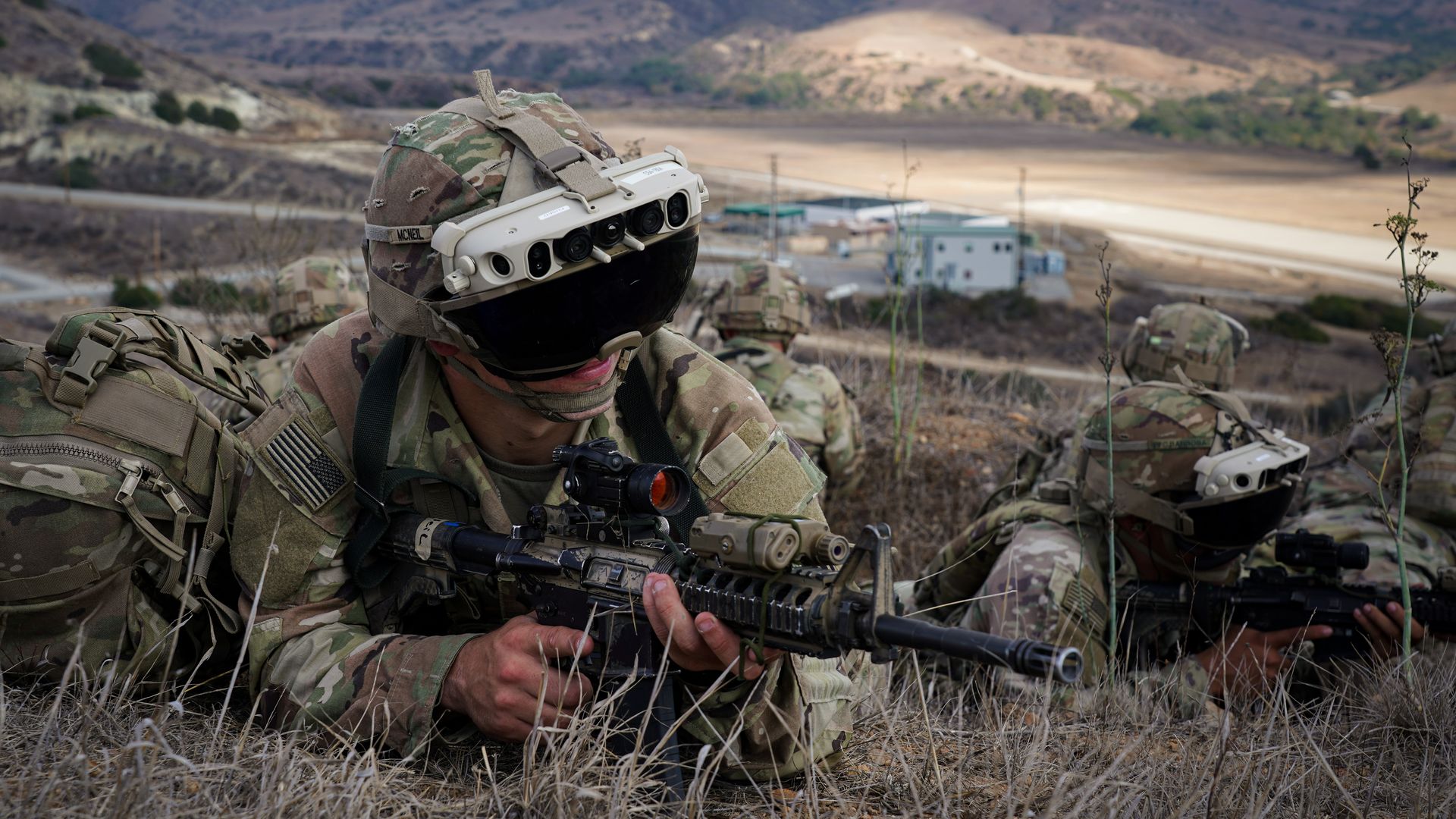
Should Anduril Industries founder Palmer Luckey have his way, the U.S. Army's effort to arm troops with futuristic, mixed-reality headsets will involve a consortium of companies pumping out "glasses that look a lot like the Oakleys you wear every day all the way up to things that look like an Iron Man helmet."
Why it matters: Anduril is taking over Microsoft's $22 billion Integrated Visual Augmentation System project, pending government approval.
- The former will assume responsibility for production, future hardware and software, and delivery. The latter's cloud and artificial intelligence offerings will serve as the digital backbone.
- The companies buddied up last year to fold into IVAS the Lattice software suite.
Context: Luckey hit it big with virtual reality and Oculus, which sold to Facebook for $2 billion.
- "I have long said ... that you were going to see a headset on the head of every soldier long before you see a headset on the head of every civilian," Luckey told reporters this week.
- "And the reason for that is simple," he added. "The stakes are much higher on the battlefield."
Flashback: Microsoft employees years ago protested the company's work with the military, saying they did not want to be "war profiteers."
Fun fact: Luckey has spoken at length — and passionately — about the anime series "Sword Art Online" and its hyperrealistic NerveGear devices.
- "I think that we are about a decade away from VR systems that, on a subconscious level, are indistinguishable from reality," he told me.
What's next: The Army is seeking industry feedback on IVAS Next. It published a request for information late last month.
4. Quick hits

🎮 L3Harris Technologies introduced Amorphous to the public. It's software it says gives a person the ability to direct thousands of autonomous vehicles and weapons, including those made by other companies.
- Why it matters: "This is a manifestation of Combined Joint All-Domain Command and Control," Toby Magsig, an L3Harris vice president and former leader of the U.S. Army's Project Convergence, told reporters.
- 💭 My thought bubble: The question about robot-on-robot warfare in the Q&A section (more below!) doesn't feel so silly now, huh?
📕 Expect a future defense strategy that looks "far down the line, tries to make disruptive changes to how we acquire and rapidly field" equipment and shrugs off congressional districts, Defense Secretary Pete Hegseth said in his first town-hall meeting.
- Why it matters: The long game is China's specialty.
- 💭 My thought bubble: Good luck fighting a lawmaker on a project that employs thousands in his or her backyard. That's blood sport.
🛜 Applied Intuition bought EpiSci, bringing together commercial and defense portfolios spanning air, land, sea and space. The companies did not disclose terms of the deal.
- Why it matters: "The EpiSci technology is amazing. I mean, it's like science-fiction level," Applied Intuition CEO Qasar Younis told me. "We're engineers, and it just tickles a very particular interest."
- 💭 My thought bubble: Check out my conversation with Jason Brown, the general manager of Applied Intuition Defense, here.
🧮 Microsoft and PsiQuantum are advancing to the next phase of the Defense Advanced Research Projects Agency's Quantum Benchmarking Initiative.
- Why it matters: DARPA is figuring out if it's possible to build a useful quantum computer sooner than previously thought.
- 💭 My thought bubble: Quantum is incredibly arcane. Getting smart on it now — difficult, yes — will pay dividends down the road.
5. Axios interview: Jonathan Moneymaker

This week's conversation is with Jonathan Moneymaker, the chief executive at BlueHalo.
- We linked up at the company's headquarters in Arlington. It was brutally cold that day.
- His office is decorated with at least two football helmets — Eagles and University of Southern California (the wrong USC; go Gamecocks) — and a model of Ferrari's F1 car.
Why he matters: BlueHalo works on everything from laser weapons to space communications. Its arms are used across the globe. And AeroVironment, maker of the Switchblade drone, is buying it for billions.
Q: When you hear "future of defense," what comes to mind?
A: The future of defense is going to be autonomous, and hopefully that means preservation of life.
Q: When will wars be waged solely by robots?
A: I don't think they'll ever be waged by robots; man will always wage war.
- I do think now they're being fought robotically, and I think that will continue.
Q: What's the biggest challenge the defense industry faces at the moment? What can be done to alleviate it?
A: I think it's budgetary. I think it's prioritization. There's a lot to be done.
- We've got to stop doing things that aren't working.
Q: What region of the world should we be watching? Why?
A: China. It's probably been said before. But I think when leaders make bold statements — like China has — you should listen.
Q: What's your secret to a successful overnight flight?
A: There are no time zones. You have to live in the moment. You land. It's 7am? It doesn't matter where you came from.
Q: What's a piece of gear or tech you can't go without?
A: I have this phenomenal charger that I got from Amazon.
- It was like $39, and it has all the cords built into it. It's amazing.
6. Check this out
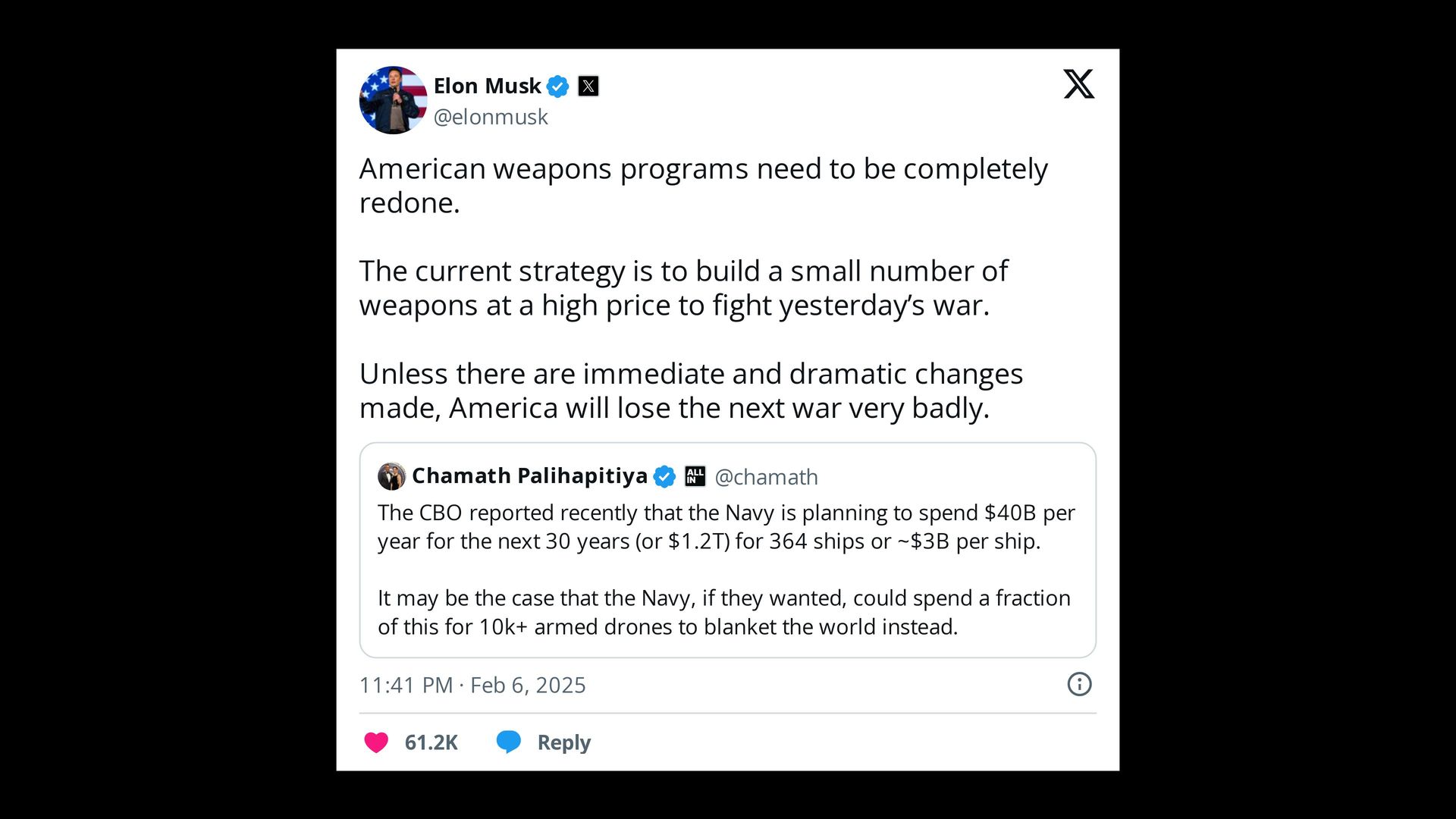
The U.S. will badly lose its next war if the Defense Department doesn't radically change, according to Elon Musk.
Why it matters: The man is a defense contractor, public pot-stirrer, presidential tech whisperer and head of the Department of Government Efficiency.
- He generated headlines late last year when he criticized the F-35 in favor of smaller, cheaper drones.
Zoom out: Time Magazine plopped him behind the Resolute desk for an article on the "war on Washington."
📩 What do you make of this? Hit reply and let me know. I might go deeper in a future newsletter.
Shoutout to Nicholas Johnston for editing and Matt Piper for copy editing.
👋🏼 Thanks, as always, for reading and sharing. Tell your friends to subscribe, here.
Sign up for Axios Future of Defense