Axios Future of Defense
February 05, 2025

Hey, y'all. I'm back on the East Coast.
🇺🇸 Situational awareness: The Missile Defense Agency is jumping on President Trump's "Iron Dome for America." It's pinging industry to see what's possible on the ground, in space and along the supply chain.
- My thought bubble: This is a straightforward interpretation of Trump's executive order. Making it real, though, will be expensive. What sticks out to you? Send me an email.
The forecast: A lot from WEST, a Seasats exclusive and a burger spot you don't want to miss.
Today's newsletter is 1,291 words, a 5-minute read.
1 big thing: "Embrace the robots"

The cross-country chatter these past weeks, at the Surface Navy Association conference and at WEST, proved for me one thing: The unmanned obsession is very real inside the U.S. Navy.
Why it matters: Look at Ukraine and the Black Sea beatings it hands out. Look at the Red Sea and Houthi persistence. Look at the Pentagon's J-books, the online think pieces and where elite units are splurging.
- The future — mechanical, intelligent, overwhelming — is today smacking us in the face.
Driving the news: U.S. Navy Special Warfare Command boss Rear Adm. Milton Sands told crowds in San Diego the military must "embrace the robots," as "machine-on-machine fighting" rages and humans stick to safer margins.
- "Manned-unmanned teaming is the future," he said.
Zoom in: The Navigation Plans of Adm. Lisa Franchetti and her predecessor, retired Adm. Michael Gilday, back this up.
On the water, drone boats and robo-subs are augmenting the firepower of more traditional, more expensive ships. They are also monitoring around the clock far-flung places otherwise ignored.
- L3Harris Technologies is mounting onto vessels its Vampire weapon used in Ukraine. Live-fire trials are expected by April.
- "If you can take out one-third or two-thirds or three-quarters of threats with a $25,000 missile — versus a million-dollar missile — that's helpful," Jon Rambeau, president of integrated mission systems, told me on the conference sidelines.
- Saab is working with Microsoft, Hidden Level, Second Front and others on maritime autonomy and the Enforcer 3, a souped-up Combat Boat 90.
- During an exclusive tour of the ship, docked outside the San Diego Convention Center, Second Front chief revenue officer TJ Rowe told me: "We need an ability to push software capabilities to the edge, whether that is a maritime platform or airborne platform."
- Saildrone, meanwhile, is supplying 20 Voyager unmanned surface vessels for Operation Southern Spear, to monitor illegal activity in the Caribbean and Pacific Ocean. It's the single largest deployment yet.
In the air, drones have proven their prowess. From deadly strikes to stealthy surveillance to remote resupply, their applications abound.
- "We will fly MQ-25 in '25. You can quote me on that," Vice Adm. Daniel Cheever, commander of Naval Air Forces, said at WEST.
- Boeing years ago won an $805 million contract to design, build and deliver the MQ-25 Stingray, an unmanned tanker. The Navy in August said the first control room was installed aboard the aircraft carrier George H.W. Bush.
- "We will fly that platform in '25, get that thing on the carrier in '26 and start integrating that thing," Cheever added. "That unlocks the future of manned-unmanned teaming."
- Separately, the Marine Corps' updated aviation plan hails unmanned aircraft as essential.
What they're saying: "Twenty years ago, there were articles [saying] precision might be the new mass," 7th Fleet commander Vice Adm. Fred Kacher said. "Well, I think mass is the new mass, to be quite honest with you."
Yes, but: All these systems must work together, in sync with tech from other militaries and in places flooded with jamming and spoofing.
- That's no easy feat, and is motivation to get right Combined Joint All-Domain Command and Control.
What we're watching: How everything unmanned aids Taiwan's defense — or scares off a Chinese invasion in the first place.
- "You've heard my boss' boss, Adm. [Samuel] Paparo, speak to Hellscape," Kacher said. "I'll let his comments stand on their own, because I could not say them better."
Flashback: The Navy last year rolled out the robotics warfare specialist rating, dubbing it "a major milestone" in the "relentless march to achieve a truly hybrid fleet."
- Those who go that route are expected to be computer vision, navigation autonomy, artificial intelligence and machine learning gurus.
The bottom line: We are at a tech tipping point, according to Adm. Stephen Koehler, commander of the Pacific Fleet.
- And the service, he said at WEST, is already "laying the keel for the hybrid fleet."
2. Exclusive: Seasats scores
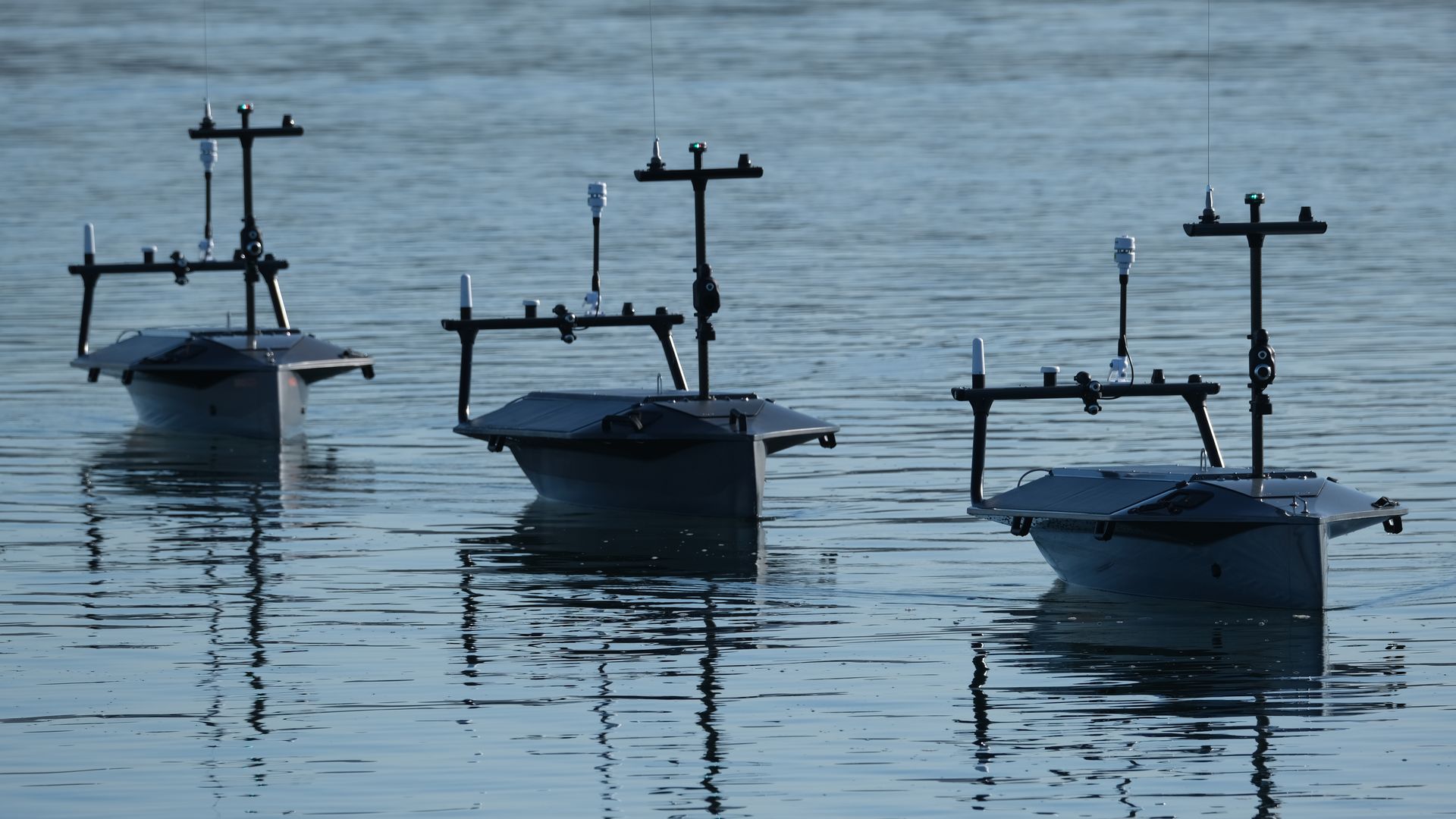
Drone-boat maker Seasats plans to hire more people and expand its overseas sales on the heels of a $10 million funding round.
Why it matters: From monitoring U.S. borders to mapping oil spills to sinking Russian ships in the Black Sea, demand for autonomous vessels is soaring.
Follow the money: The round was led by Silicon Valley's Shield Capital, specializing in dual-use tech. Aero X Ventures, Techstars, and other investors participated.
- L3Harris Technologies previously invested in the San Diego-based company.
- Seasats started as a commercial company. But its defense business is ramping up as militaries are increasingly interested in ready-to-go gear, not sluggish research and development.
The latest: A Seasats Lightfish vessel — solar-powered, 11 feet long and weighing about 350 pounds — is making its way to Japan right now.
- You can track its progress (video feed included) on the company's website.
- A California-to-Hawaii voyage was completed last year.
Fun fact: Small drones launched off Seasats' boats during testing in San Diego Bay.
The bottom line: "This stuff is reliable — it works," Seasats CEO Mike Flanigan told me on the sidelines of the WEST naval conference. "Buy it. Use it."
3. Quick hits
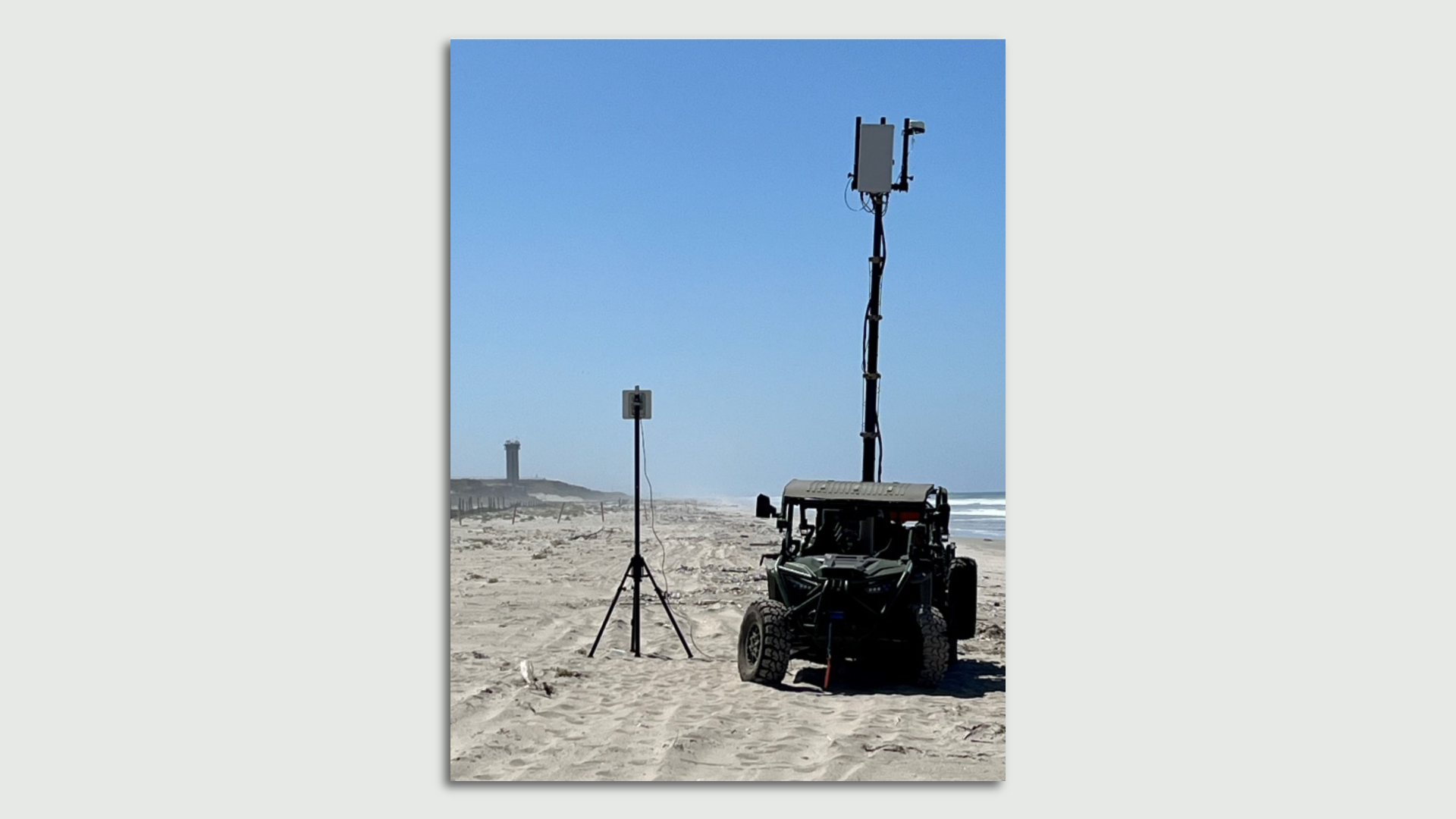
📶 The Lockheed Martin-made Open Systems Interoperable and Reconfigurable Infrastructure Solution wirelessly connected Marines to multiple drones and a Northrop Grumman-made Ground/Air Task-Oriented Radar at Steel Knight 2024.
- Why it matters: The exercise and OSIRIS trials offer a peek at expeditionary advanced base operations.
- 💭 My thought bubble: 5G isn't just hype; it's making factories smarter and battlefield data-sharing better. The Pentagon was right to pour hundreds of millions of dollars into experimentation.
🚁 The U.S. Army completed initial ground runs of GE Aerospace's powerful T901 engine aboard a Black Hawk helicopter.
- Why it matters: It validated the performance of critical systems, including fuel, electrical, hydraulic, engine, flight controls and engine bay flow. Testing in the factory continues in parallel.
- 💭 My thought bubble: Who doesn't love testing footage? Check it out.
💰 Castelion, a hypersonic weapons startup, raised $100 million. Lightspeed Venture Partners led.
- Why it matters: "This funding allows Castelion to scale our manufacturing operations, increase our testing cadence and demonstrate our first product's full capability," CEO Bryon Hargis said in a statement.
- 💭 My thought bubble: The U.S. Army, Navy and Air Force are already interested in the company's work. But the missile arena is long dominated by defense-contracting behemoths.
🌍 The U.S. killed "multiple" ISIS operatives in airstrikes last week in Somalia, according to Africa Command. No civilians were hurt.
- Why it matters: This is the first military action President Trump ordered since returning as commander in chief, my colleague Barak Ravid wrote.
- 💭 My thought bubble: A message was sent and a new precedent set when Trump shared the combat footage on X.
4. Check this (exclusive) out
/2025/02/04/1738684700188.gif?w=3840)
Rep. John Carter, a Texas Republican, blasted a drone during a demonstration of the Allen Control Systems Bullfrog, an autonomous turret.
The big picture: The U.S. military needs more counter-drone weaponry, and Congress knows it.
- Current countermeasures run the gamut: missiles, bullets, directed energy, nets and more.
Zoom in: Footage first shared with me shows the Bullfrog locking on and firing a few rounds. You can see the drone disintegrating, above.
- The tests were done in Texas.
- Lt. Gen. Edmond Brown, the deputy commanding general at Army Futures Command, also attended.
Go deeper: Steven Simoni: U.S. military needs more "smaller, cheaper" weapons
5. Bonus round

The WEST conference, hosted by AFCEA and the U.S. Naval Institute, is my favorite on the circuit.
The big picture: Warships, tacos, information-warfare briefs and beer are all within walking distance. And you needn't pack a parka.
Behind the scenes: Thanks, everyone, for the awesome recommendations.
- Let me return the favor: Hit Balboa Bar and Grill. (It's worth the hike up the hill. Get a burger and the salt-and-pepper fries.)
Context: Above, an aircraft carrier silhouetted during sunset.
Shoutout to Nicholas Johnston for editing and Matt Piper for copy editing.
👋🏼 Thanks, as always, for reading and sharing. Tell your friends to subscribe, here.
Sign up for Axios Future of Defense