Axios China

March 07, 2023
Welcome back to Axios China. Today we're looking at business risk in Hong Kong, China's new economic target, the return of Chinese tourists, and lots more.
- New here? You can subscribe here to receive Axios China in your inbox every Tuesday.
Today's newsletter is 2,031 words, a 7½-minute read.
1 big thing: Hong Kong's global financial status at risk
Illustration: Sarah Grillo/Axios
Beijing is changing Hong Kong's political norms, raising new concerns about the institutions underlying the city's previous prosperity and potentially putting its status as a global financial hub at risk, according to a new report.
The big picture: The business community should begin a collective lobbying campaign to convey their concerns directly to Hong Kong authorities, the report recommends, because legal and bureaucratic recourse is now less likely to help the business community protect their interests in the city.
- "The most fundamental change in Hong Kong over the past three years has been a shift from legal and institutional constraints on government actions to political and normative constraints," the report by the Atlantic Council states.
- "The National Security Law created a parallel system of authority operating both behind and above Hong Kong’s system of government."
Details: The report outlines new risks to Hong Kong's status created by the national security law, including:
- Risks to the Hong Kong dollar's peg to the U.S. dollar, which was established in 1983 and paved the way for open capital flows in and out of the city. It's very unusual for one country to have two separate currencies, and the end of "one country, two systems" raises new questions about the long-term future of Hong Kong's currency.
- Though still unlikely, removing the U.S. peg and replacing it with a peg to the renminbi could result in capital controls being placed on Hong Kong, reducing its viability as a financial center.
- New compliance risks, as both the U.S. and Beijing implement sometimes-contradictory sanctions that apply to Hong Kong businesses. For example, China's new anti-foreign sanctions law could in theory punish businesses for abiding by U.S. sanctions.
- A weakening in the perceived independence of the judiciary raises questions about the rule of law in the city, though Hong Kong authorities have repeatedly emphasized that the rule of law remains strong. But Beijing clearly views economic and business decisions as an important component of national security, and the political control that Beijing wields over businesses in China suggests Hong Kong businesses may one day face similar political directives affecting individual business decisions.
- Data security, since the national security law grants law enforcement sweeping powers to seize data.
What to watch: The report recommends the Hong Kong business community use collective lobbying to communicate their concerns to Hong Kong authorities (and thus to Beijing).
- Companies should make clear that the very existence of these concerns, whether or not they come to fruition, can negatively affect the future of Hong Kong, the report states.
2. Semafor's China problem
Illustration: Aïda Amer/Axios
News startup Semafor is drawing criticism in the U.S. for partnering with a think tank in China that is known to have close ties to the Chinese Communist Party. The group has in the past obscured those ties to Western audiences, Axios media reporter Sara Fischer and I report.
Why it matters: The collaboration is notable because the organization Semafor is partnering with and its leader have a track record of misleading Western audiences about its affiliation with the CCP.
What's happening: Semafor last week announced a new initiative called “China and Global Business” to serve as a platform for business leaders to discuss U.S.-China relations.
- The partnership has been developed with a group called the Center for China and Globalization (CCG). The center's founder and director, Wang Huiyao, sits on the board of Semafor's initiative.
- The platform "will be exclusively underwritten by corporate partnerships with no financial contributions from our local Chinese partners or the Chinese government," CEO Justin Smith wrote in a blog post on Sunday evening. Smith is the former CEO of Bloomberg Media. Under his tenure, Bloomberg struck a partnership with another Chinese think tank that helped the company put on a marquee event in China.
- Smith said Semafor "deliberately and explicitly structured" its agreements with partners of the initiative to protect its journalistic independence. "We have 100% editorial and commercial control and the project is fully owned and operated by Semafor," he wrote.
Catch up quick: CCG claims to be independent, but it was founded under the auspices of the Western Returned Scholars Organization.
- That group is directed by the United Front Work Department (UFWD), a bureau of the CCP focused on amplifying support for the party and marginalizing dissent, both inside and outside China's borders.
- Australian expert on UFWD Alex Joske wrote in a June 2018 report that Wang is an "adviser to the UFWD, a member of several united front groups and an important figure in the development of China’s talent recruitment strategy."
- In the past, CCG and Wang have denied any affiliation with the UFWD. In 2018, he bowed out of appearing on a panel discussion about the UFWD after his affiliation with that department became public.
Between the lines: Wang is well-connected in China and according to Semafor, CCG will "secure required approvals, and issue formal invitations to Chinese speakers and audience members. CCG will take on local administrative responsibilities and coordinate with local sponsors, and Semafor will pay CCG for their services."
- Other members of Semafor's initiative board include former People's Bank of China governor Zhou Xiaochuan and Chen Deming, the former minister of commerce.
What to watch: Semafor has not detailed how it plans to disclose to its audiences during live events or via digital coverage details about the group's affiliation to the CCP.
- "We’re entering this endeavor with our eyes wide open and we welcome the scrutiny that comes with it," Smith said in the blog post explaining the partnership. "We aren’t under the illusion that Chinese business leaders or other local groups operate independently of the Chinese Communist Party."
- While national security agencies have developed protocols for how they deal with CCP-linked groups, any transparency standards set by Semafor in its dealings with the center would be noteworthy.
3. Catch up quick
1. The annual meeting of China's two rubber-stamp representative bodies kicked off this week in Beijing, the New York Times reports.
- This year’s two sessions will see the implementation of a bureaucratic restructuring that will further tilt power toward CCP institutions and away from the mechanisms of the state.
2. Chinese President Xi Jinping criticized the U.S. and Western countries for "containment, encirclement and suppression" in a speech on Monday, the Wall Street Journal reports.
3. Canadian Prime Minister Justin Trudeau said he'll appoint an independent special rapporteur to investigate allegations of a recent election interference campaign by China's ruling Communist Party. Go deeper.
4. The House select committee on China debuted last week with a prime-time hearing focused on the "overall threat" posed by the CCP. Go deeper.
- The legacy of the 118th Congress — even amid its high-profile divisions — is set to be defined by an unprecedented focus on the threat emanating from the Chinese government.
5. U.S. climate envoy John Kerry said in an interview with Axios that his work with China has stalled amid wider tensions between the world's two largest greenhouse gas emitters. Go deeper.
4. What China's underwhelming economic growth target means for the world
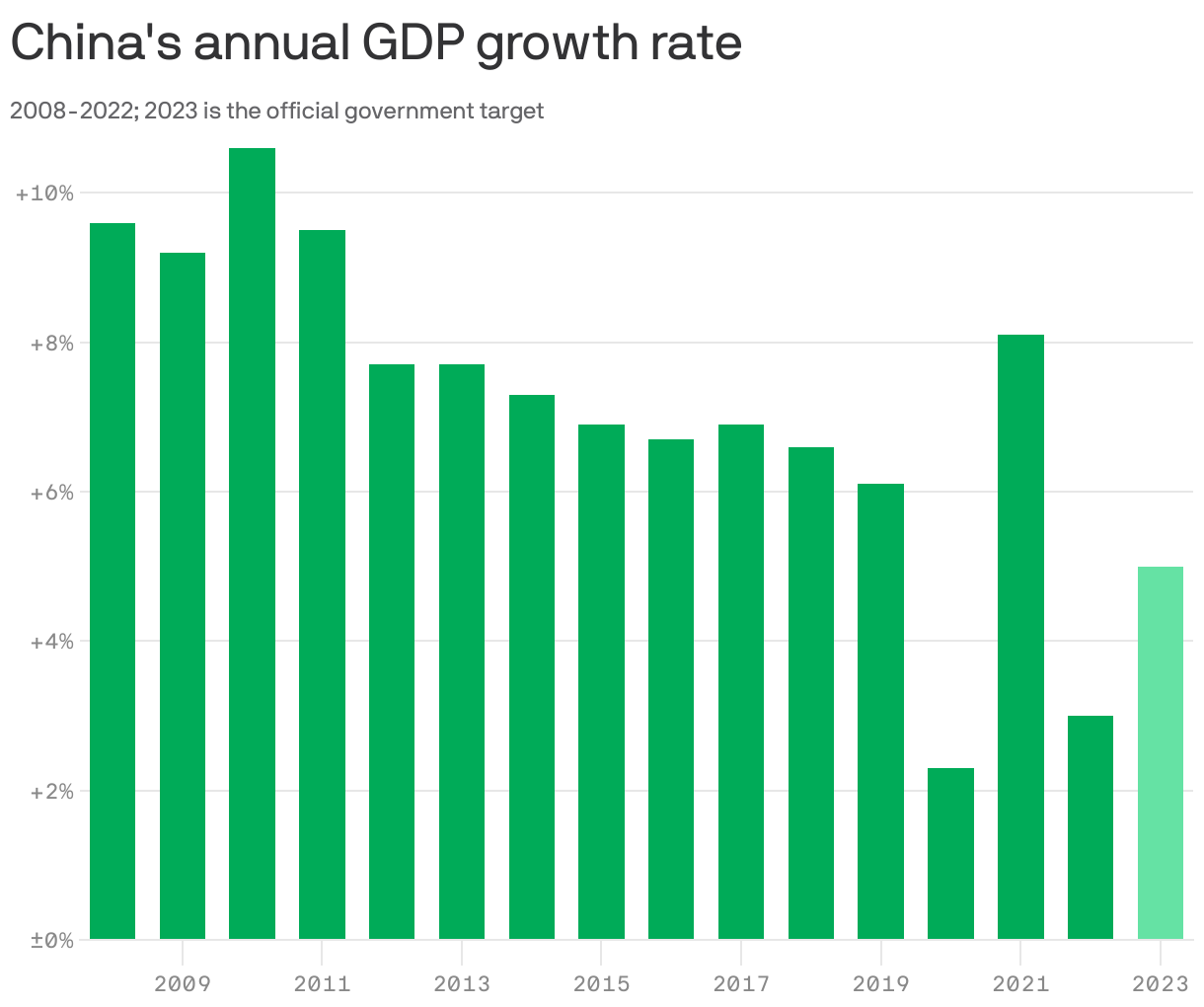
China's growth target for 2023 underwhelmed investors, economists and analysts looking for clues about how President Xi Jinping's officials will run the world's second-largest economy, Axios' Matt Phillips writes.
- Why it matters: The modest growth goals suggest China's economy may continue to weigh on global GDP this year, as the nation tries to put its COVID-related slowdown behind it.
Driving the news: During the weekend's opening of the largely ceremonial annual session of the National People's Congress, party officials set their target for 2023 GDP growth at "around 5%," and they failed to introduce large stimulus plans as some had expected.
Background: In 2022, China fell far short of its target of 5.5% economic growth.
- Hampered by the impact of the government's strict zero-COVID policies, its economy expanded by just 3% in 2022, its slowest rate of growth since 1976.
Between the lines: The news set off a slump in some China-sensitive commodities, suggesting investors had expected a stronger commitment from policymakers to use traditional tools like big spending on infrastructure projects to boost growth.
What they're saying: "The fact that policymakers missed the 'around 5.5%' growth target in 2022 might be one consideration behind the relatively unambitious growth target this year," Goldman Sachs analysts wrote.
- "Non-boom China growth won’t be enough to keep the global economy from sliding into recession this year," wrote analysts with Piper Sandler.
- "The growth target suggests the authorities will not go hell-for-leather to boost the economy after a long period of weakness during the zero-COVID policy era," wrote Capital Economics analysts.
The big picture: How much China’s growth will slow in the coming years is a key question related to the direction of the country under the increasingly centralized leadership of Xi — whose precedent-shattering tenure been marked by a focus on restoring China to so-called "great power status" in the face of persistent economic headwinds.
- This week's National People's Congress marks the departure of Premier Li Keqiang, a pro-market technocrat who was China's top economic official for the last decade.
- Li Qiang, the former Communist Party secretary of Shanghai best known for his close ties to Xi, is expected to succeed him. He's just one of a number of new faces Xi has put in charge of the economy.
The bottom line: China is in a period of flux, as geopolitical tensions with the West, domestic economic issues — like the struggling housing market — and declining demographics act as stiff headwinds to its economic recovery.
5. Tourism industry prepares for influx of Chinese travelers looking for experience

Chinese tourists visited the Grand Palace in Bangkok, Thailand, three years after the COVID-19 pandemic. Photo: Wang Teng/Xinhua via Getty Images
Tourism companies around the world are planning for the return of Chinese tourists by offering packages and services tailored to unique experiences, capitalizing on a trend that began before China locked down in 2020, Axios' Han Chen reports.
The big picture: Experiences that were once exclusive to the wealthy are now sought by middle-class travelers as the Chinese outbound tourism market has become more activity-oriented.
- "[We are seeing] more spending on experiences — upgrading hotels, eating fancier meals, riding a hot air balloon, [and] going on a safari," Sienna Parulis-Cook, director of marketing and communications at research firm Dragon Trail International, told Axios.
What's happening: Airbnb has redoubled its efforts to capture the Chinese outbound tourism market after shutting down its local business in China last year.
- The company recently sorted its more than 4 million global listings into dozens of categories for its Chinese-language website, including niche interests like "Moroccan traditional courtyard," "Cuban homestay" and "Mongolian yurt."
- European cruise line Viking Cruises recently resumed offering Rhine River cruises to Chinese tourists, with its first trips starting in June. Battered by the COVID-19 pandemic, Viking had temporarily canceled its sailings in 2020, including six ships dedicated to China with Chinese-speaking crew and all-Chinese chefs.
Background: Before the pandemic, China was the world's largest outbound travel market. In 2019, Chinese tourists took 155 million outbound trips, spending $255 billion abroad.
- The number of Chinese outbound travelers plummeted over the last three years due to travel restrictions, but analysts predict Chinese outbound travel will reach pre-pandemic levels in 2024.
Between the lines: "As travelers become more experienced and knowledgeable about different types of destinations, they tend to go from more superficial type of travel experiences to places and experiences that can be transformative," Isabella Ye, a lecturer in tourism at the University of Greenwich, told Axios.
6. 1 fun thing: Huge outdoor banquet
Photo: Bethany Allen-Ebrahimian/Axios
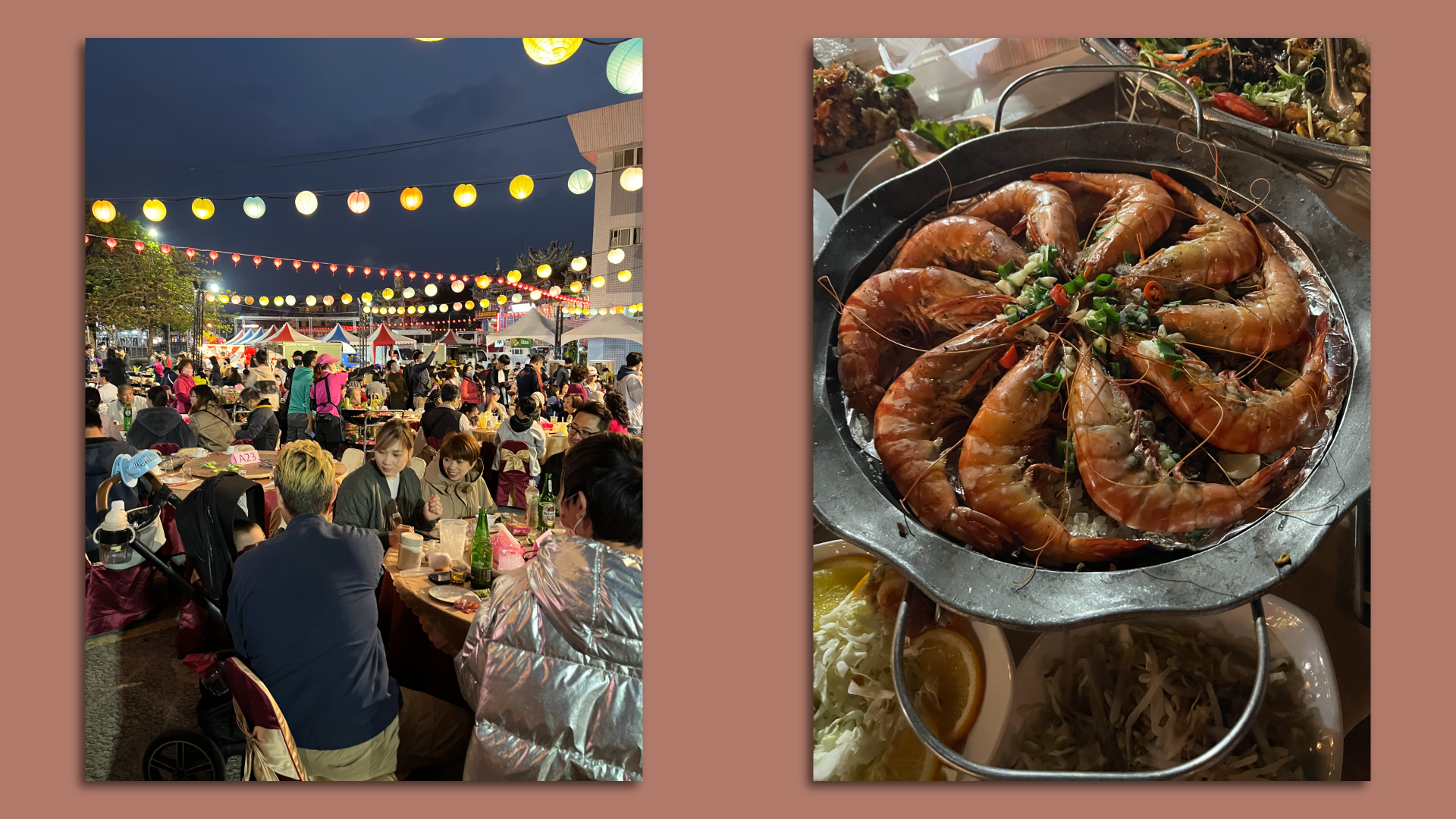
Over the weekend, I attended an outdoor 10-course banquet that is a traditional but increasingly rare feature of culinary life in Taiwan.
- The event was attended by hundreds of people on the outskirts of Kaohsiung in southern Taiwan.
- Courses included fresh sushi made onsite, a chicken-turtle-pork belly soup, and the largest shrimp I've ever seen.
What they're saying: "A fading art form, roadside banquets are one of the most special food experiences in Taiwan and unique to temple holidays, weddings and funerals," Clarissa Wei, co-author of the forthcoming book "Made in Taiwan: Recipes and Stories from the Island Nation," told me.
- "All the food is whipped up onsite in giant woks by experienced chefs who are able to conjure up over 10 dishes at a time."
Despite the fancy fare, these banquets are also known for being affordable.
- The price per seat at the banquet I attended was about $30.
Sign up for Axios China

Analysis and intel from Bethany Allen-Ebrahimian, authority on Beijing intrigue and intentions.