Axios China

August 23, 2022
Welcome back to Axios China. Today I'm looking at foreign government support for Taiwan, drought across China, a warning from Beijing to Israel, and lots more.
- If you're not an Axios China subscriber, you can sign up here.
Today's newsletter is 1,539 words, a 6-minute read.
1 big thing: International show of support for Taiwan grows

Illustration: Aïda Amer/Axios
Some countries are showing stronger support for Taiwan in response to China's growing pressure on the self-governing island.
Why it matters: Beijing's show of force against Taiwan in the wake of House Speaker Nancy Pelosi's visit shocked many democratic governments and seems to have backfired — at least for now — by pushing some countries closer to the island.
What's happening: The U.S. announced last week that it would hold trade talks with Taiwan in the fall, a major step toward a bilateral trade deal that proponents for closer U.S.-Taiwan ties have long advocated.
- A congressional delegation led by Democratic Sen. Ed Markey followed closely on Pelosi's heels, and a third group of U.S. officials, led by Indiana Gov. Eric Holcomb (R), is visiting the island this week.
- Other countries are offering public support as well after Pelosi's visit. A Japanese parliamentary delegation is expected to visit Taiwan this week, Danish lawmakers are planning a visit in October, and a group of Canadian lawmakers is expected sometime in the fall.
The big picture: The Chinese government's massive military drills in response to Pelosi's visit, and the additional set of drills it announced ahead of Markey's visit, suggest that Beijing is trying to establish a new normal of more restricted international access to Taiwan, analysts say.
- "Military drills that simulate actual battles have become the new normal. China can now decide whether a future exercise will seamlessly be turned into actual combat," Chinese commentator Chen Feng wrote for Guancha, a nationalist Chinese website.
Yes, but: China's pressure on foreign governments to limit ties with Taiwan has sometimes made those ties stronger instead, most recently in the case of Lithuania.
- After Lithuania allowed Taiwan to open a representative office in its capital city Vilnius last year, China began rejecting imports made with Lithuanian components, causing some Western suppliers to avoid Lithuanian-made goods in their supply chains.
- But "China’s actions have not pushed Lithuania away from Taiwan, but had the opposite effect," researchers with the Alliance for Securing Democracy wrote in a recent report. "The controversy has brought both parties closer and serves as a catalyst for deeper cooperation in a multitude of areas."
- Case in point: Lithuania also just announced its first representative to Taiwan.
Between the lines: Though Beijing's isolation of Taiwan worked for decades, China's hardline authoritarian turn under Chinese president Xi Jinping — and Russia's invasion of Ukraine — has renewed a sense of solidarity among democratic nations.
- Leaders in some democratic nations believe that Taiwan, as a healthy democracy surviving under China's shadow, can no longer be overlooked.
2. China issues nationwide drought alert amid extreme heat
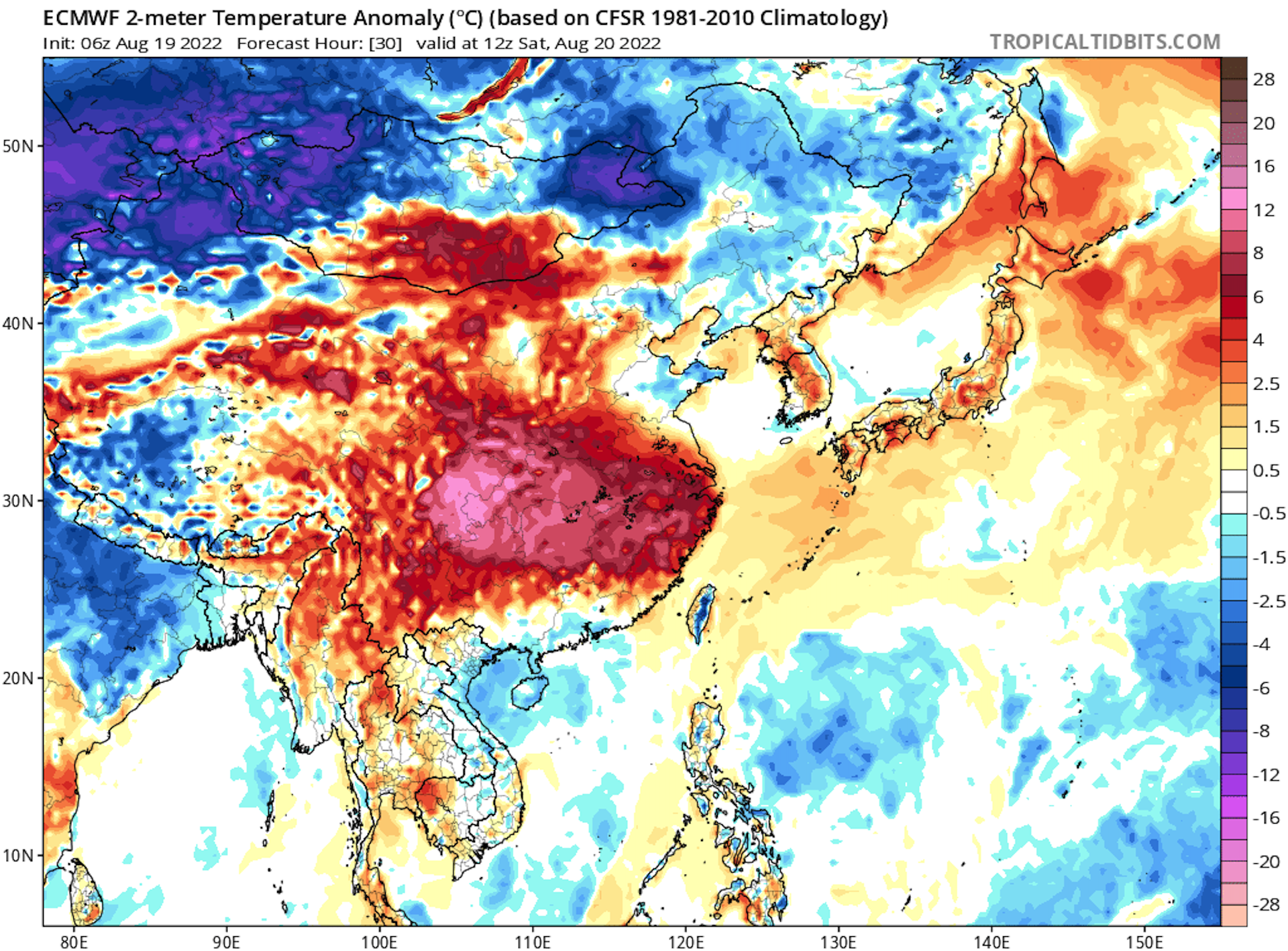
China issued its first national drought alert of the year amid more than two months of record-breaking temperatures and below-average rainfall, Axios' Erin Doherty and Andrew Freedman write.
The big picture: The extreme heat and drought are affecting global supply chains, as factories shut down after the Chinese government ordered more electricity to flow to residential areas. Hydropower production has been cut due to low water levels.
By the numbers: A record-breaking 262 weather stations tied or broke their highest temperatures on record during the long-running heat wave, which has increased in intensity during the past week, per China News.
- At least 244 cities across China could experience temperatures above 104°F (40°C) on Friday and more than 400 additional cities could see temperatures above 98°F (37°C), CNN reports.
- Some 66 rivers in 34 counties in southwestern China have dried up, Reuters reports, citing state media.
- Poyang Lake, China's largest freshwater lake, has shrunk by 75% amid drought and soaring temperatures this summer.
Threat level: This heat wave has set records for its geographic footprint, with the largest-ever area with high temperatures above 104°F — 527,029 square miles, beating the old record of 299,615 square miles, according to state media.
- The new record is equivalent to the states of Texas, Colorado and California combined.
- Numerous cities exceeded 111.2°F (44°C), China News reported. Temperatures this high are an acute public health threat.
What to watch: Dry weather and low rainfall are expected to continue for the next several days, and forecasters expect the extreme heat to continue for another week, according to state media and computer model projections.
3. Catch up quick
1. Russia has jumped to third in the world in using yuan payments, behind only Hong Kong and Britain, Reuters reports.
- "Russia's sudden leap up the list will support the argument that sanctions are working and squeezing it out of the U.S. dollar-based global banking system. But it will also back those who say it will bring Moscow and Beijing closer."
2. A group of 29 pro-democracy activists in Hong Kong, including Joshua Wong and Benny Tai, pleaded guilty to charges of secession under the city's national security law, The Guardian reports.
3. The Solomon Islands secured a loan from China allowing Huawei to build 161 communications towers there, The Guardian reports.
- The Pacific nation's prime minister also just unveiled a bid to delay elections scheduled for next year, raising the prospect of democratic backsliding there — and concerns that China's training and equipping of police there might enable crackdowns on any potential protests.
4. China's President Xi Jinping and Russia's leader Vladimir Putin plan to attend the G20 summit in Bali later this year. Go deeper.
4. "Mortgage slave": Chinese homeowners struggle amid housing crisis

Illustration: Brendan Lynch/Axios
Falling real estate prices and a struggling economy have locked many Chinese homeowners into debt they can't repay, The Australian reports.
Why it matters: The property industry comprises about a quarter of China's GDP, and around 70% of household wealth is stored in real estate.
Driving the news: Yesterday, China's central bank cut the five-year mortgage rate by 1.5 percentage points, its largest cut ever, per the BBC.
- The reduced rate will lower mortgage payments and help struggling homebuyers.
Details: Home sales have dropped for 11 straight months and housing prices have tumbled, placing particular pressure on people who took out mortgages on homes not yet completed by developers, a common practice in China.
- Facing financing difficulties, some developers halted construction, prompting tens of thousands of people to turn to mortgage boycotts to pressure developers to continue work on the homes they are already paying for.
What they're saying: One homeowner, Li Daqing, told The Australian that he purchased a one-bedroom apartment for 1.4 million yuan in 2017, but he can no longer afford the payments. He has now listed the property for 800,000 yuan but has no offers.
- “Even at this price, nobody wants to buy it," Li said. “I can only go back to my hometown in northwest China and find a job, and continue to pay back my loans."
Go deeper: China moves to contain property defaults
5. China warns Israel not to let U.S. pressure hurt relations
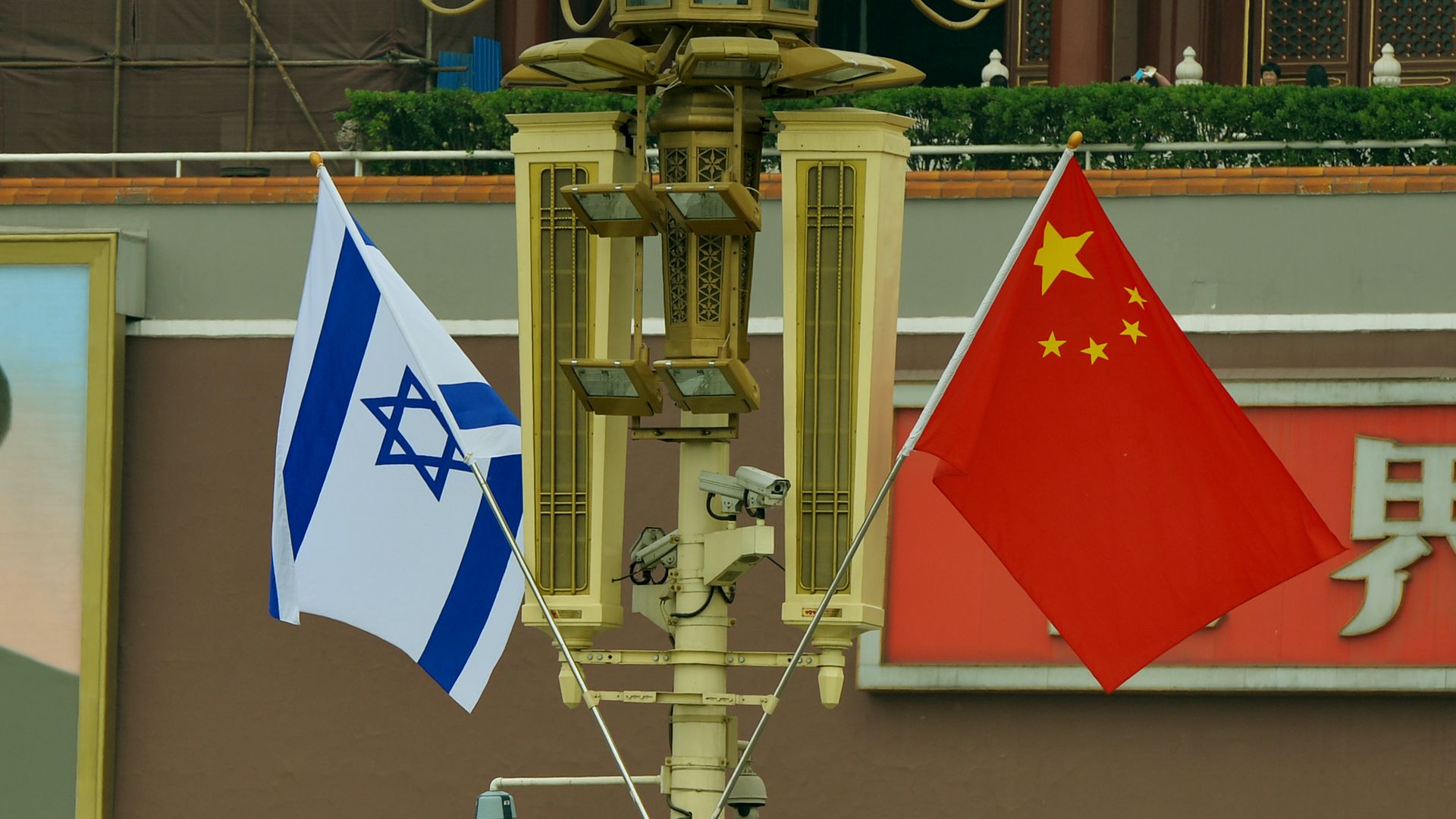
Photo: Mark Ralston/AFP via Getty Images
One of China's top diplomats warned Israel not to allow U.S. pressure to damage its relations with Beijing, according to senior Israeli Foreign Ministry officials with direct knowledge of the issue, Axios in Tel Aviv author Barak Ravid reports.
Why it matters: The message from Liu Jianchao, who heads the Chinese Communist Party's international affairs department, to Israeli Ambassador to Beijing Irit Ben-Abba was the most unequivocal and direct message Israel has received from Beijing about the U.S.-Israel-China triangle.
According to Israeli officials, Liu said that while China understands the special relationship between Israel and the U.S., it is nevertheless closely following Israel’s policies toward China.
- “This is a critical test point for the relations between China and Israel," Liu said, according to the Israeli officials, adding that he hopes Israel won't compromise the positive future of Israel-China relations by aligning itself with U.S. policy toward Beijing.
- Liu specifically urged Israel not to get "dragged" into the U.S. position that China is committing genocide in Xinjiang. Under U.S. pressure, Israel signed a declaration at the UN Human Rights Council in June denouncing China's actions there.
- He also said the Chinese people understand the pain of the Jewish people because the Chinese had been persecuted by the West.
Between the lines: Israeli officials say they don't know what triggered the unusually strong Chinese message, except perhaps the recent U.S.-China tensions over Taiwan.
- But Israel has also significantly cooled its relations with China since former Prime Minister Benjamin Netanyahu left office last year.
- While Netanyahu worked for a decade to build closer ties to China and court Chinese investments, the new Israeli government has taken U.S. concerns more seriously and started to view China more through a national security lens.
6. What I'm reading
Yes-man: U.S. approves nearly all tech exports to China, data shows (Wall Street Journal)
- "Of the U.S.’s total $125 billion in exports to China in 2020, officials required a license for less than half a percent, Commerce Department data shows. Of that fraction, the agency approved 94%, or 2,652, applications for technology exports to China," Kate O'Keeffe writes in this lengthy data-based investigation.
- "The result: The U.S. continues to send to China an array of semiconductors, aerospace components, artificial-intelligence technology and other items."
7. 1 photo to go: Luoxing Island emerges amid drought
Luoxing Island on August 23. Photo: Noel Celis/AFP via Getty Images
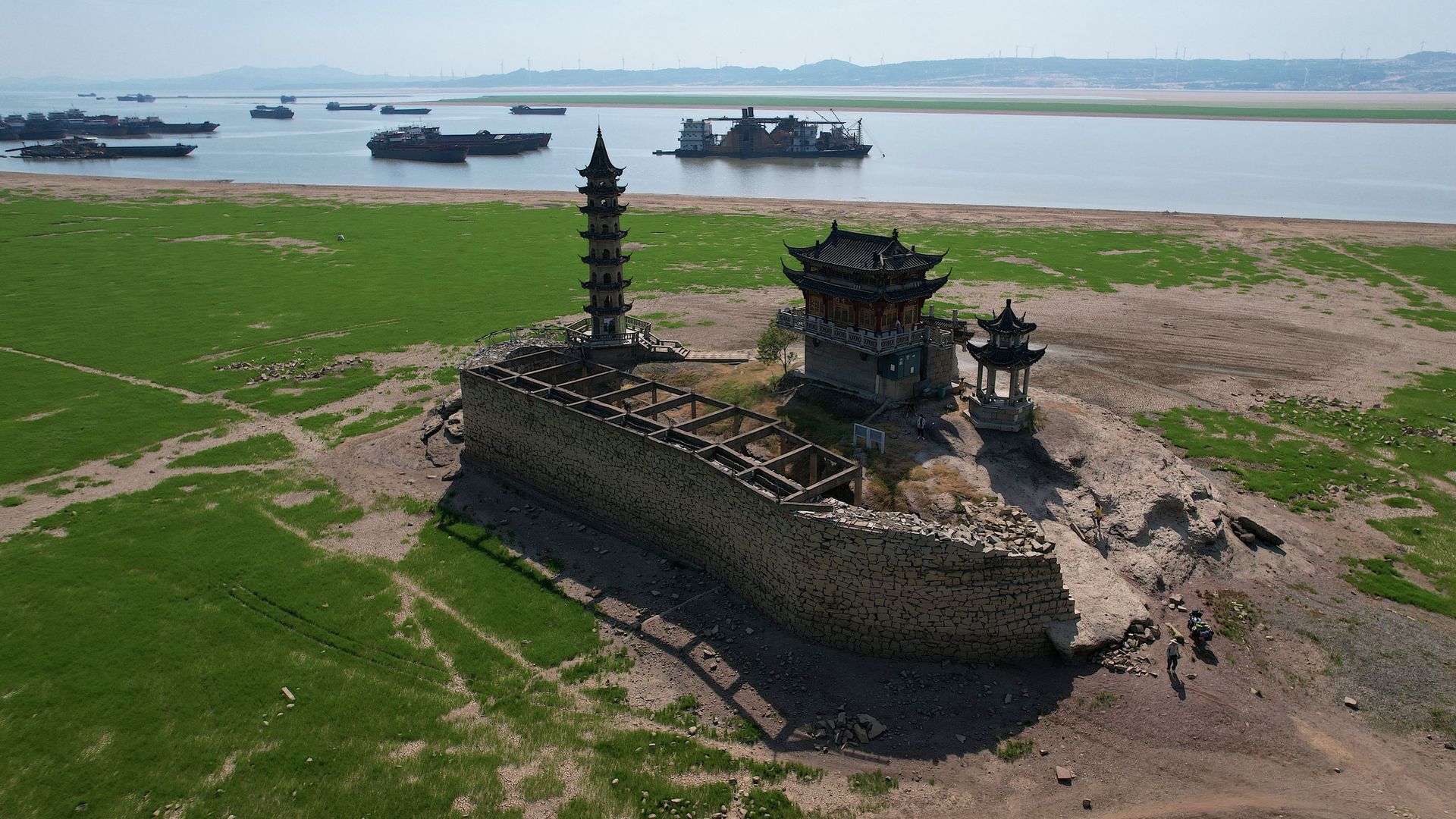
A stone island with an ancient pier and temples, usually partially submerged in China's Poyang Lake, has fully emerged amid the severe drought.
- Luoxing Island, or "Falling Star Pier," dates back more than 1,000 years.
- The region where Poyang Lake is located goes through a dry season each year, though this year is the longest dry season recorded in decades.
Sign up for Axios China

Analysis and intel from Bethany Allen-Ebrahimian, authority on Beijing intrigue and intentions.


