Axios AM

September 18, 2024

☀️ Happy Wednesday! Smart Brevity™ count: 1,906 words ... 7 mins. Thanks to Noah Bressner for orchestrating. Copy edited by Bryan McBournie.
🏛️ If you're in D.C. tomorrow: Please join us at 8 a.m. for an event on crypto and Capitol Hill. Speakers include Sen. Kirsten Gillibrand (D-N.Y.), Rep. Tom Emmer (R-Minn.) and Coinbase chief policy officer Faryar Shirzad. RSVP here.
1 big thing: Death by device
We've entered a new era of futuristic warfare: Any device connected to the internet can be turned into a deadly weapon.
- Israel did it yesterday with deadly and cinematic precision — booby-trapping thousands of pagers with explosives that detonated near-simultaneously across Lebanon, killing nine people and wounding nearly 3,000.
Why it matters: The attack "signals the beginning of a new and very dangerous era in cyberwarfare," Washington Post foreign-affairs columnist David Ignatius writes.
- The same technique theoretically could be applied to any connected device, including your phone.
⚡What happened: Israel's Mossad spy agency planted explosives inside 5,000 pagers imported months ago by the militant Lebanese group Hezbollah, which is backed by Iran, Reuters reports.
- Taiwanese company Gold Apollo said today that it authorized its brand on the AR-924 pagers, which were manufactured by BAC Consulting KFT, based in Hungary's capital, Budapest.
At about 3:30 p.m. yesterday, as people shopped for groceries, sat in cafés or drove cars and motorcycles, the pagers in their hands or pockets started heating up and then exploding, per AP.
- Many of those hit were members of Hezbollah. The militants had seen the pagers as a way to sidestep what's believed to be intensive Israeli electronic surveillance on mobile phone networks in Lebanon.
🔭 The big picture: The blasts came at a time of mounting tensions between Israel and Hezbollah, locked in cross-border clashes during the war in Gaza.
- A U.S. official said Israel briefed the U.S. after the conclusion of the operation. But Israel didn't inform the Biden administration in advance, Axios' Barak Ravid reports.
- Iran accused Israel of a "terrorist act." Hezbollah vowed to retaliate against Israel for the unprecedented security breach.
💡 How it worked: "The explosive material, as little as one to two ounces, was implanted next to the battery in each pager," the N.Y. Times reports. "A switch was also embedded that could be triggered remotely to detonate the explosives."
- "[T]he pagers received a message that appeared as though it was coming from Hezbollah's leadership. ... The devices were programmed to beep for several seconds before exploding."
🔎 Behind the scenes: A former Israeli official with knowledge of the operation tells Axios that Israeli intelligence services planned to use the booby-trapped pagers, which had been planted in Hezbollah's ranks, as a surprise opening blow in an all-out war to try to cripple Hezbollah.
- But in recent days, Israeli leaders became concerned Hezbollah might discover the pagers. Israeli Prime Minister Benjamin Netanyahu, his top ministers and the heads of the Israel Defense Forces and the intelligence agencies decided to use the system now rather than take the risk of it being detected by Hezbollah, a U.S. official said.
Read Ignatius' column (gift link no paywall) ... Read Barak's latest.
2. 🧱 Border could split left in '25
Dozens of immigration and progressive groups believe Vice President Harris' recent hawkish immigration policy pledges are "harmful" and part of a "MAGA anti-immigrant agenda" — but many are backing her anyway, Axios' Alex Thompson writes.
- Why it matters: Democrats are temporarily uniting to stop a second Donald Trump presidency. But immigration could splinter the party if Harris wins in November.
Immigration is likely to be a central focus for the White House and Congress next year regardless of how the election turns out, given the historic migration crises across the globe.
- Some progressive groups are quietly hoping that Harris would govern closer to the more liberal stances she held during the 2020 Democratic primary.
🎨 The big picture: After more than 3½ years in the Biden administration, Harris has largely shifted from framing herself as a longtime immigrant advocate to a tough border hawk.
- She has pledged to sign a White House-backed bipartisan bill that failed during the current Congress. It would significantly restrict asylum, continue building a border wall, and dedicate historic levels of funding to detain undocumented immigrants.
It's a contrast to the stance she had as a U.S. senator from California.
- In her first speech on the Senate floor in 2017, Harris said she'd prosecuted "everything from low-level offenses to homicides. I know what a crime looks like. I will tell you: an undocumented immigrant is not a criminal."
- While running for president in 2019, she pledged to make illegally crossing the border a civil rather than a criminal offense.
Several major organizations — including Immigration Hub, Human Rights Campaign and Oxfam America — made clear they would oppose Harris if she tried to pass the border bill next year, as president.
- Immigration Hub executive director Kerri Talbot said she still supports Harris: "We all know and trust Harris to make the right decisions when she's in office. I don't think this bill will ever come up again, as is."
🥊 Reality check: Many Democrats are pushing aside their disagreements with Harris' recent positions at a time when Trump is pledging the largest deportation operation in U.S. history, sweeping domestic raids, and other far more hawkish policies.
3. 📉 Exclusive: CEOs see hiring chill
Backward-looking economic data shows America's job market is slowing. Plans at some of the nation's biggest corporations show the slowdown might continue, according to survey results shared first with Axios Macro authors Courtenay Brown and Neil Irwin.
- Why it matters: Once the labor market starts cooling, it typically continues to do so. The central question for the economy is whether this time will be different.
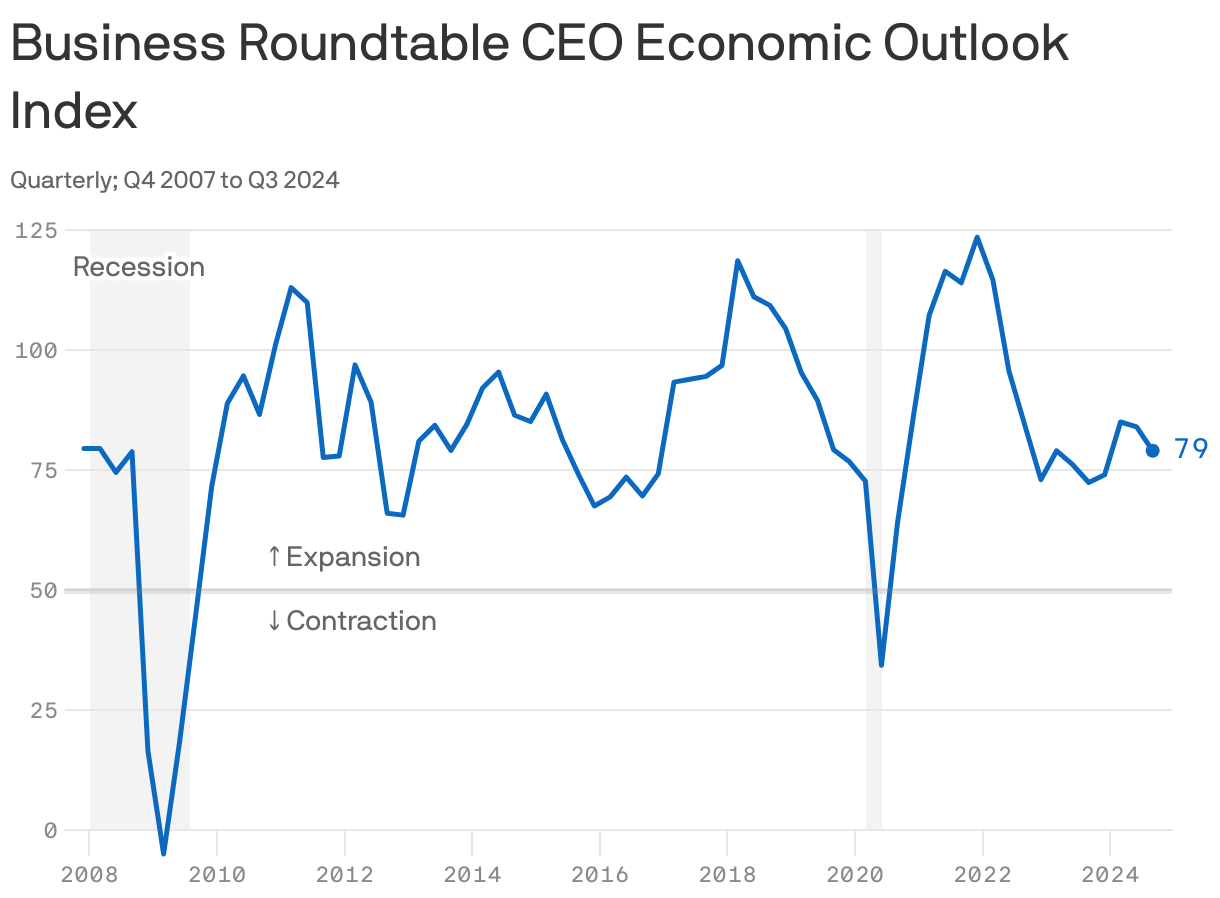
The latest hint comes from a new Business Roundtable survey of 145 top business leaders that points to muted economic confidence.
- The lobbying group's index that tracks CEO confidence fell four points in the third quarter and dipped below the historical average for the first time this year.
- Among the factors that pulled the index down: A smaller share of executives are planning to increase headcount.
- Joshua Bolten, CEO of the Business Roundtable, said it's "the second consecutive quarter in which CEOs have reported they are moderating their hiring plans."
- Still, fewer than 30% of executives plan to decrease hiring — not too much lower than the historical average.
The bottom line: CEO expectations don't point to a recession. But they confirm the concerns about the labor market that are pushing the Fed to cut interest rates this afternoon.
Editor's note: This story has been corrected to show the index fell five points (not four) in the third quarter.
4. 🤖 AI's parent-teen gap


Generative AI is demonstrating one of the most enduring laws in tech: Teenagers are always a lap ahead of their elders, Axios' Megan Morrone writes.
- Why it matters: Efforts to keep kids safe from potentially harmful or dangerous technology regularly falter because adults don't understand what youngsters are actually doing.
Case in point: Many teens use generative AI tools like ChatGPT, but less than half (37%) of their parents think they do, according to a report released yesterday from Common Sense Media.
- Another 40% are not sure whether their teens had used genAI or not.
- Almost half (49%) say they have not talked to their teens about their AI use.
🖼️ The big picture: Educators, parents and legislators today are still struggling to place appropriate boundaries around young people's use of social media, which has been at the center of many teen lives for nearly two decades.
- Now AI is racing into homes and schools faster than parents can keep up.
The bottom line: Since teens are going to use generative AI no matter what, the adults around them need to understand and educate themselves and their kids about the technology's flaws and biases.
💰 P.S. The rise of AI will boost the global economy by a cumulative $19.9 trillion by 2030, according to a new study by marketing research giant IDC.
5. 🍑 AJC poll: Georgia neck-and-neck
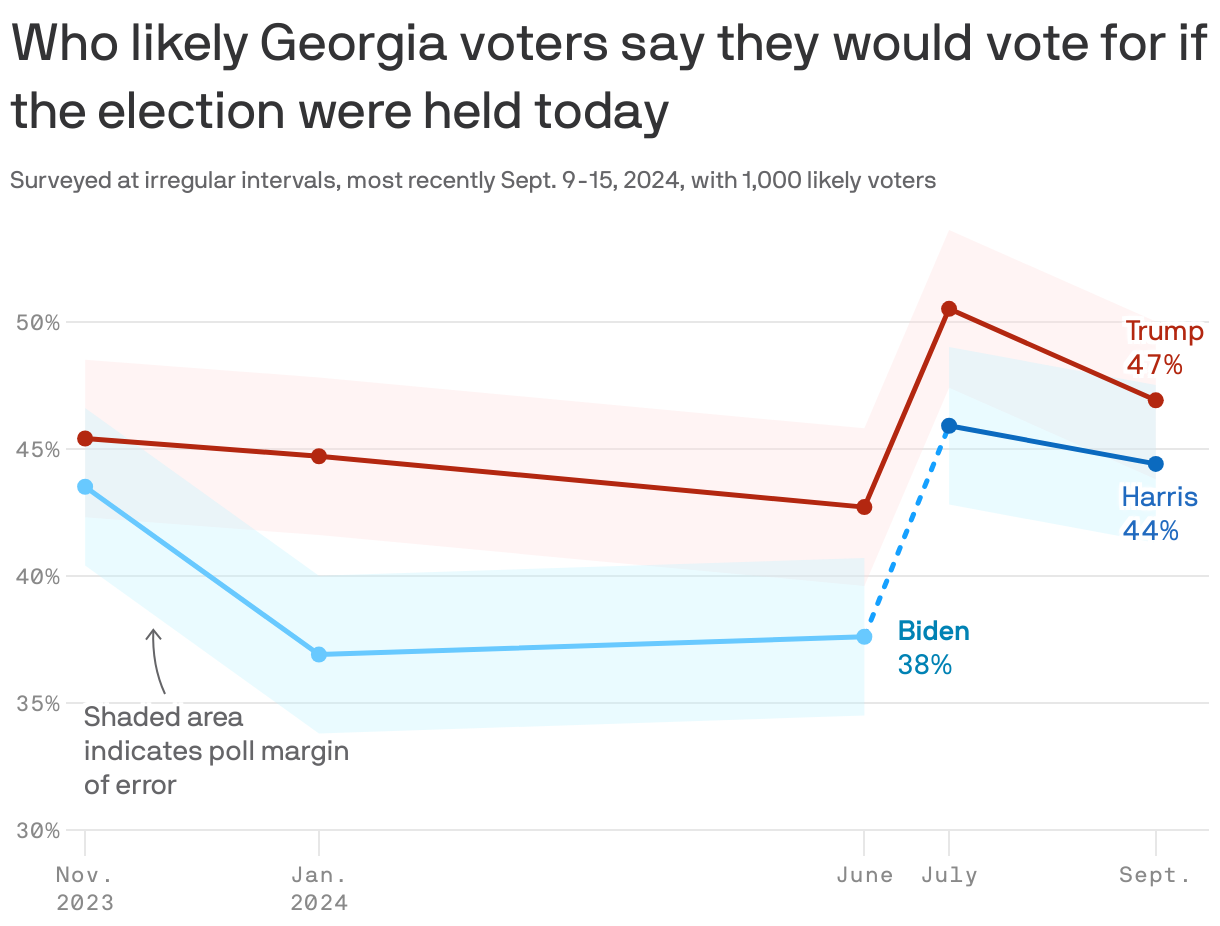
The battle between former President Trump and Vice President Kamala Harris to win Georgia is within the margin of error, according to a new Atlanta Journal-Constitution poll, conducted by the University of Georgia's School of Public and International Affairs.
- Why it matters: The poll of likely Georgia voters, released Wednesday, shows Trump leading Harris 47% to 44% with less than 50 days until Election Day.
By the numbers: Roughly 7% of voters say they are undecided, and third-party candidates received below 1%, Axios Atlanta's Kristal Dixon writes.
- 12% of Black voters — a crucial group for Democrats — say they are undecided.
6. 📦 Employer power surge

Amazon's hard-core move to push employees back into the office five days a week beginning in January is a big signal that — in the tech sector at least — employers have regained leverage over workers, Axios' Emily Peck writes.
- Why it matters: The labor market has weakened. The rank-and-file mostly don't want to be in the office for a full work week — but in a looser labor market, their opinions matter less.
The tech sector has been through a lot of layoffs over the past few years. It's not as easy to find a new job, leaving many feeling stuck.
- In other sectors, such as manufacturing, the labor market is still pretty tight — and workers have some leverage. Boeing workers, for example, felt confident enough that they went out on strike last week.
Zoom out: Amazon's change, which starts in January, sets a new standard and may give companies cover to restrict work-from-home a bit more — while still looking generous, says Brian Elliott, a former executive at Slack who is now a work consultant.
7. 🌎 Axios interview: Gore's new fear

Al Gore tells Axios that many CEOs are walking away from past climate promises after realizing how hard it would be to meet ambitious emissions reduction and deforestation targets.
- Speaking to Axios' Andrew Freedman ahead of next week's Climate Week NYC, Gore said that "some of the ballyhooed climate promises are beginning to resemble New Year's resolutions: easy to make and hard to keep."
- "And the reality is, as we note candidly, the world is not on track at present, to reach the goal of net zero emissions by 2050."
Why it matters: Corporate giants and some countries are backsliding on their climate commitments — a worrying sign in a year that otherwise saw hopeful growth in renewables, Gore and his investment colleagues say in a new report.
- Oil and gas companies that were leaning into the renewables side of their businesses have gone in the other direction, chasing shareholder returns.
- Major financial firms with sustainability targets have been fleeing groups of like-minded corporations.
- Part of this is coming from political pressure, Gore says, with a campaign against ESG investing and so-called "woke capital" stoking fears of potential legal liability for companies.
The other side: Renewable electricity generation has made major gains in the past year, Gore says, with solar power as the big standout.
8. 🔭 1 fun thing: Double lunar spectacle

Last night's double space spectacle gave stargazers a partial lunar eclipse and supermoon, all rolled into one.
- A partial lunar eclipse happens when the Earth passes between the sun and the moon, casting a shadow that darkens a sliver of the moon.
Since the moon will inch closer to Earth than usual, it'll appear a bit larger in the sky.
📬 Please invite your friends to join AM.
Sign up for Axios AM