Axios AM

August 17, 2023

1 big thing: Why it's all happening now

Photo illustration: Lindsey Bailey/Axios. Photo: Jeff Swenson/Getty Images
2. 😷 Signs of late-summer COVID wave
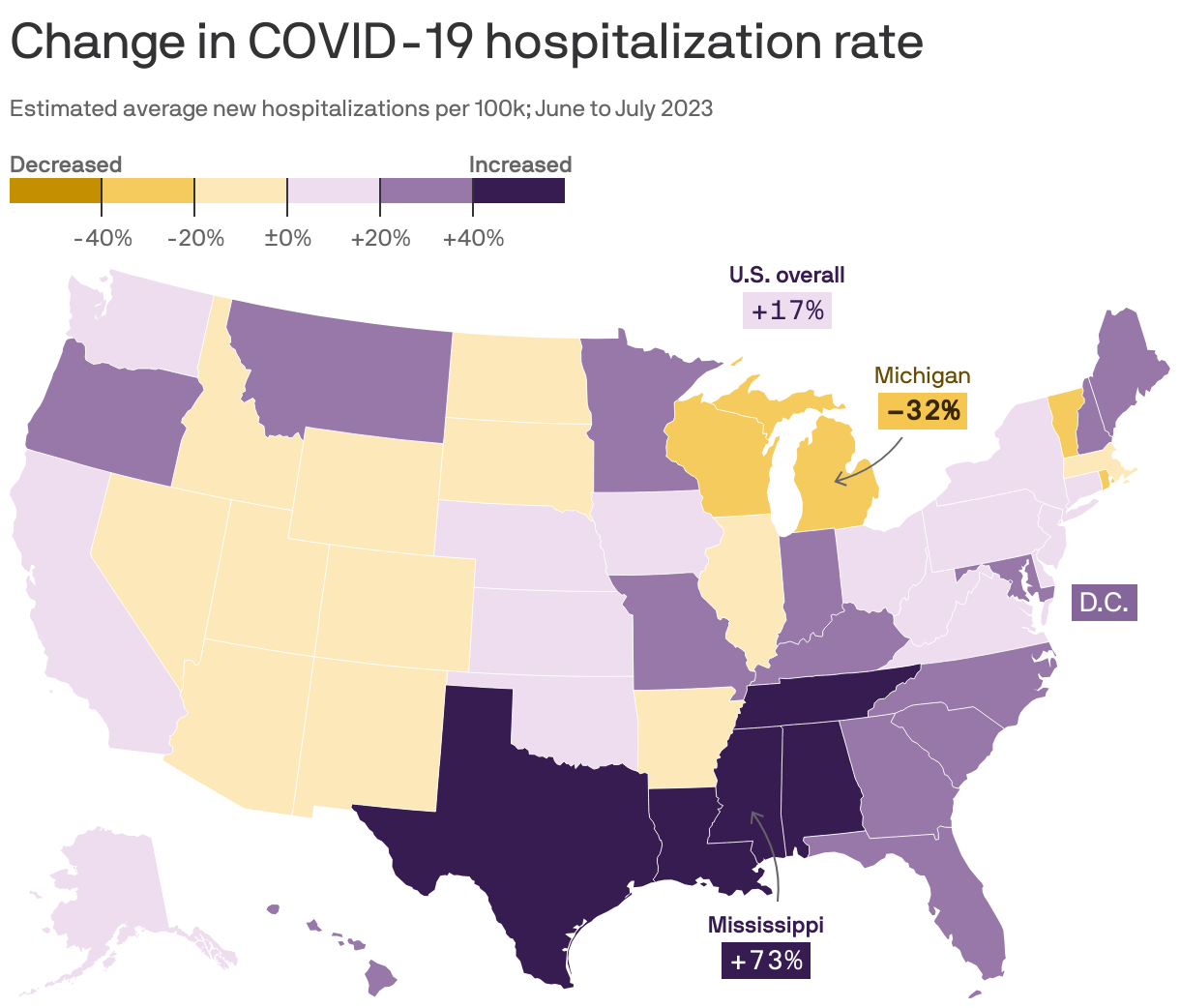
If you've noticed a sudden rise in the number of people wearing masks while you're out and about lately, here's why: COVID is on the upswing again, Axios' Alex Fitzpatrick and Kavya Beheraj report.
- Why it matters: Simply put, our guard is down.
🧮 By the numbers: The average COVID hospitalization rate nationwide rose about 17% between June and July, per the latest available CDC data.
- With so little testing happening these days compared to the height of the pandemic, hospitalization rates are now one of the best proxies for estimating broader viral spread.
Interactive version of this map, with state-by-state data.
3. 📊 Axios-Ipsos: What we fear


Gun violence, which ranked as the top threat to public health when we asked the question in our May Axios-Ipsos American Health Index, has dropped to No. 3 behind opioids and obesity, Axios senior health care editor Adriel Bettelheim writes.
- Why it matters: Fears of gun violence appear to be tied to specific events, including mass shootings. Opioid misuse is more of a constant worry.
Where you live is a big factor: Substantially more people in rural areas rank opioids and fentanyl as a top concern than those in urban and suburban areas, who tend to rank firearms higher.
4. 🏘️ Mortgages hit 22-year high


The rate on 30-year mortgages ticked up to 7.16% this week — back to the high last reached in October. Before that you'd have to go back to 2001 to find mortgage rates this high, Axios' Emily Peck writes.
Case in point: A calculation from ING's chief international economist, James Knightley, illustrates the consequences for housing affordability.
- With a 7.16% mortgage rate, the monthly payment on a $417,200 loan (the average mortgage amount taken out last week) works out to $2,820.
- But at the prevailing mortgage rate back in 2021, you'd pay that amount for a $670,000 loan.
5. 🎓 Hangover: Student-loan payments higher than mortgages

Illustration: Maura Losch/Axios
6. 🦾 AI now big on the résumé

Illustration: Sarah Grillo/Axios
7. 🗞️ Raided weekly to get gear back

Marion County (Kan.) Record editor and publisher Eric Meyer says the county sheriff's office — which had been storing computers seized by police in a raid on the weekly paper — returned the gear yesterday following a favorable ruling from the county prosecutor.
- Why it matters: Last week's police raid put the 4,000-circulation paper at the center of a national debate about press freedom. Meyer claims the raid was carried out because the newspaper was investigating why the police chief left his previous post as an officer in Kansas City, Mo.
Meyer says the sheriff released the equipment to a computer forensics firm hired by the newspaper's attorney, AP reports.
- The forensics firm is reviewing the files and programs to see whether they were copied.
"You cannot let bullies win," Meyer said. "We have a staff that's very experienced, including myself, and we're not going to take crap."
- Meyer has said that the stress from the ordeal caused the death of his 98-year-old mother, Joan — the paper's co-owner — on Saturday, the day after the raid.
Behind the scenes: Rewriting lost stories and reproducing ads from scratch, the four-person newsroom used old computers to put out yesterday's edition (photo above), with the defiant front-page headline: "SEIZED … but not silenced."
- "There were literally index cards going back and forth," said the newspaper's attorney, Bernie Rhodes of Kansas City. "They had all the classified ads, all the legal notices that they had to re-create."
The newspaper's press run is normally 4,000 papers. Since the raids, the paper has received more than 2,000 new subscriptions.
8. 🔭 1 for the road: New in New York

The Beyond the Light Exhibition, an immersive-art experience that includes overwhelming visuals from the James Webb Space Telescope, is open in Manhattan and will come to D.C. next month.
- ARTECHOUSE, a pioneer in experiential art, says it collaborated with NASA astrophysicists and used AI-aided visual production, with "an original musical score created from galactic data."
Axios AM
Catch up with the most important news of the day