Axios AI+
August 23, 2023

Ina here. Today's AI+ is 1,254 words, a 5-minute read.
1 big thing: Nutrition labels aim to boost trust in AI
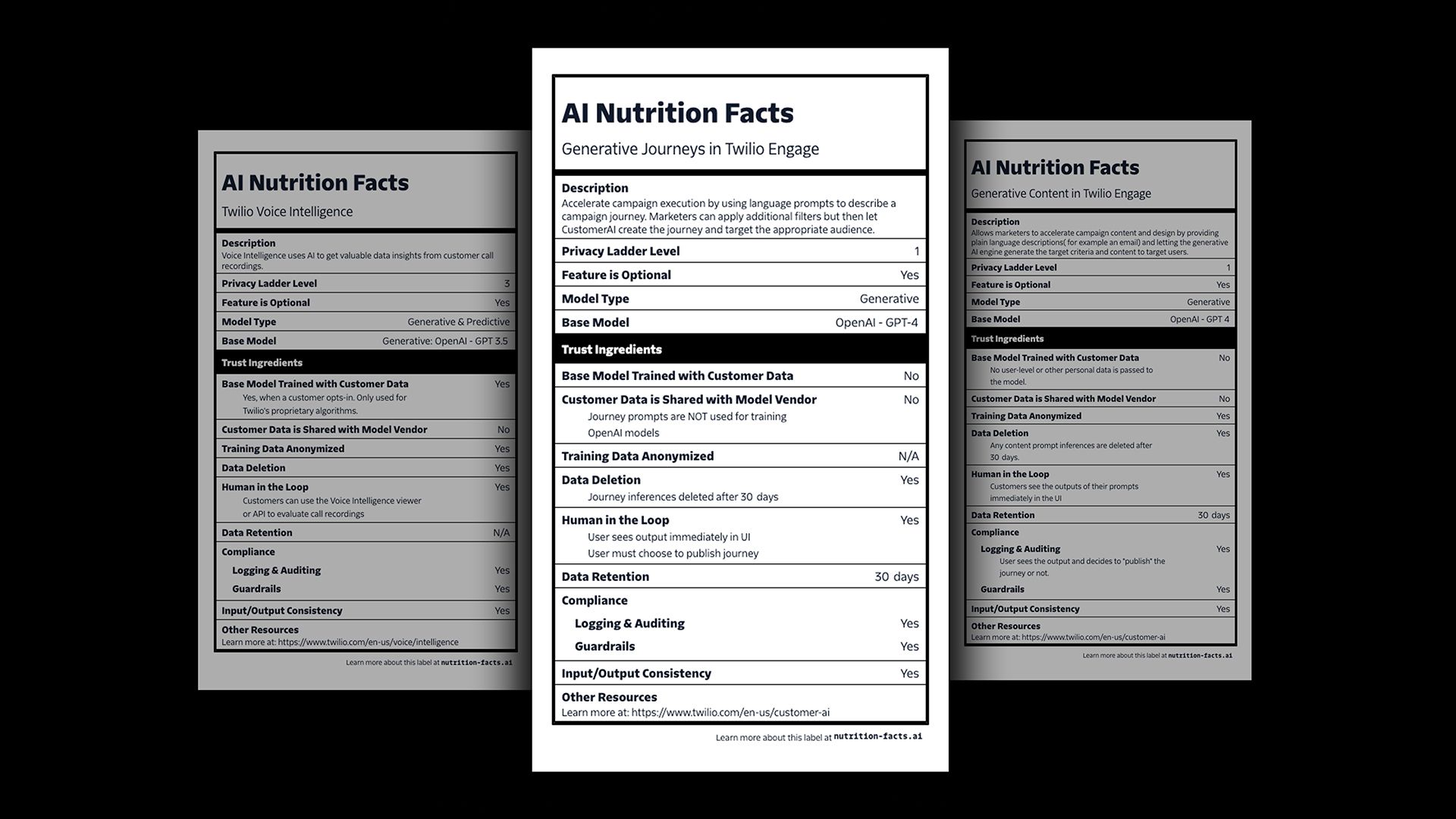
Twilio has created "nutrition labels" to show how data will be used for AI training. Image: Twilio
As adoption of generative AI grows, providers are hoping that greater transparency about how they do and don't use customers' data will increase those clients' trust in the technology.
Why it matters: There's a mad scramble to add AI features across the board in the software world — but worries about privacy and security are prompting some businesses to discourage employees from using the new features.
Driving the news: Twilio, which helps businesses automate communications with their customers, announced today it will place "nutrition labels" on the AI services it offers those businesses, clearly outlining how their data will be used.
- The labels report what AI models Twilio is using, whether those models are being trained on customer data, whether features are optional and whether there is a "human in the loop."
- A "privacy ladder" distinguishes between company data that is used only for customers' internal projects and data that is also being used to train models used by other customers, as well as whether personally identifiable information is included in the data.
- In addition to offering such labels with its own data collection, Twilio is providing an online tool that other companies can use to generate similar AI nutrition labels for their own products.
Meanwhile, Salesforce is unveiling an acceptable use policy today that governs what companies can and can't do with its generative AI technologies.
- Among the practices banned are using the technology to generate weapons, pornography or political campaigns, according to a copy of the policy shared first with Axios.
- Salesforce also prohibits using AI to offer individualized advice that would normally require a licensed professional, such as a lawyer or financial adviser.
- Salesforce customers must also disclose when people are interacting directly with a bot and are forbidden from providing AI-generated content to users under the pretense that it is human-made.
Between the lines: While there is still an air of excitement around the potential of generative AI to improve productivity, many companies have been taking a cautious approach, warning employees not to put company data into tools like ChatGPT.
Transparency is key to increasing trust, both Salesforce and Twilio say.
- And so far trust is low, Twilio says, citing research it conducted that shows more than 9 in 10 businesses are offering AI-based personalization but only 41% of customers are comfortable with such practices and only half of consumers trust brands to keep their data secure and to use it responsibly.
- "Against this backdrop, Twilio is calling on technology leaders and peers everywhere to more proactively display and disclose exactly how data is being trained and deployed in AI products," the company says.
The big picture: Paula Goldman, Salesforce's chief ethical and humane use officer, told Axios that establishing the acceptable use policy is important but not enough on its own to ensure that powerful AI technologies aren't misused.
- Other steps that Salesforce has taken include adversarial testing of both its models and the AI features it builds, as well as incorporating filters that try to stop generative AI systems from sharing toxic content or personal information.
Goldman also notes there's a big difference between AI services that a company delivers directly to longstanding business customers and free services offered direct to consumers online or made broadly available via open source releases.
- Salesforce, Microsoft and others, for example, have started commercially testing their generative AI tools in close collaboration with small groups of known customers.
- Facebook parent Meta, on the other hand, broadly released its Llama 2 model for commercial use by anyone — although it, too, says it requires users of the tool to abide by an acceptable use policy.
2. Space is the next cybersecurity frontier
Illustration: Annelise Capossela/Axios
U.S. officials are increasingly turning their attention to how best to keep spies and hackers out of the country's space systems — especially with private industry playing a bigger role in their development, Axios Codebook author Sam Sabin reports.
Driving the news: Intelligence officials issued a warning Friday that foreign spies could be targeting commercial space firms.
- The advisory — which came from the National Counterintelligence and Security Center, the FBI and the U.S. Air Force — says adversaries could target these companies to siphon intellectual property, collect sensitive data related to satellite payloads, or exploit supply chain dependences.
- However, the two-page advisory doesn't identify what inspired the warning or which countries are likely to be behind these attacks.
The big picture: U.S. officials have long worried about how to properly secure the growing space industry, especially as more private space companies take on missions of national significance.
- The space business — which is set to become a $1 trillion industry by 2030 — is about more than just the flashy, headline-grabbing trips that bring humans out of Earth's orbit.
- Many fields, including agriculture, health care, transportation and energy, rely on satellites to provide crucial GPS coordinates, relay critical communications, predict the weather and more.
Threat level: Securing these companies and their infrastructure is a multifaceted problem that involves keeping hackers not only out of satellites in orbit, but also out of base stations and internal company networks.
- Government officials' visibility into these networks has gotten cloudier as the industry privatizes — giving executives like Elon Musk, who founded SpaceX, an outsize role in national security.
- Meanwhile, U.S. prosecutors and companies have already identified suspected space-related espionage campaigns from Russian and Chinese nationals in recent years.
Zoom in: Much of Washington's interest in space security notched up after Russian hackers targeted American satellite company Viasat an hour before invading Ukraine in early 2022.
3. San Francisco's robotaxi expansion hits bumps
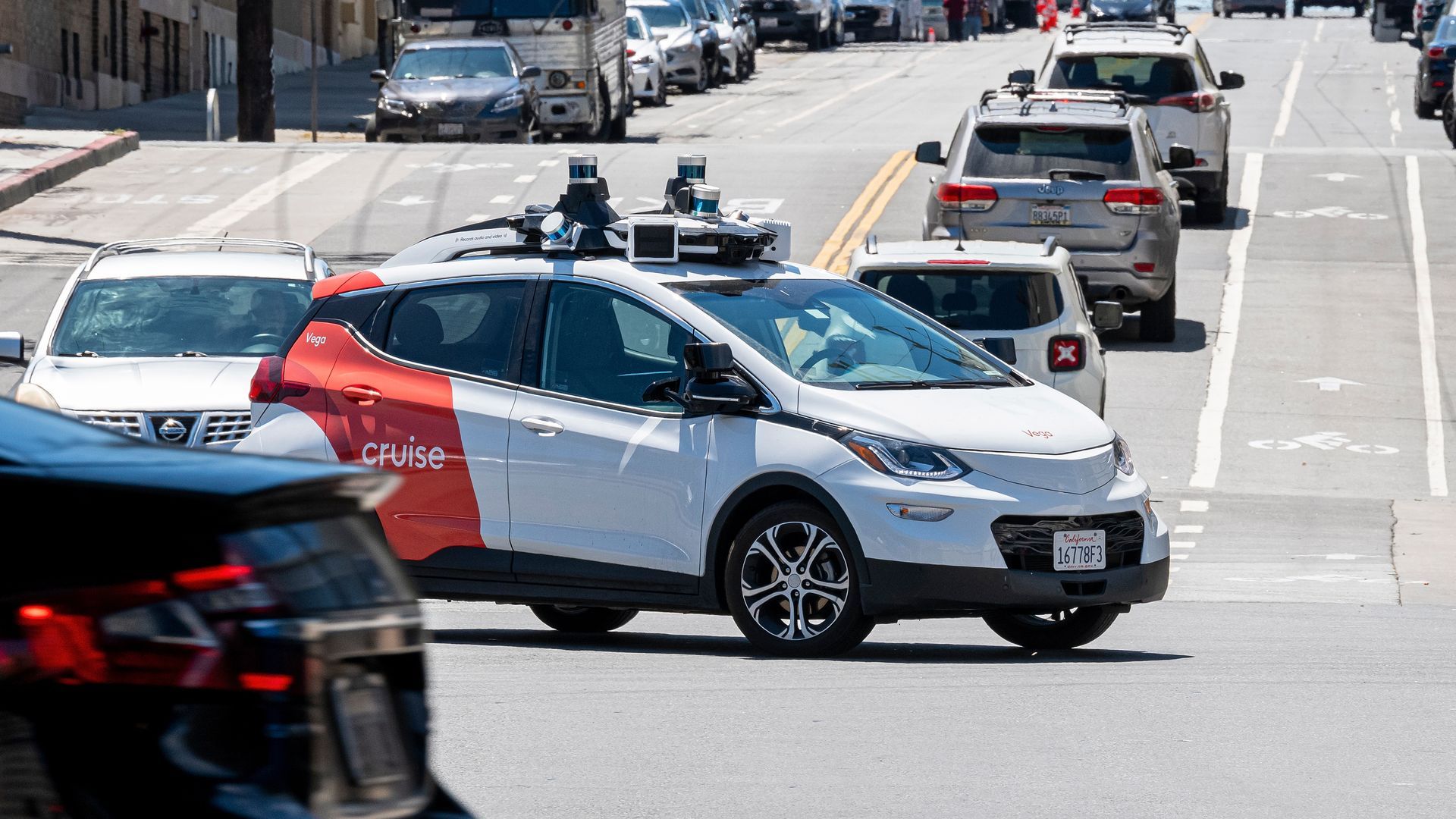
A Cruise autonomous vehicle in San Francisco this month. Photo: David Paul Morris/Bloomberg via Getty Images
Self-driving car companies Waymo and Cruise got the expansion they sought when a state regulatory approved their respective permits for full commercialization this month, but complications have already arisen, Axios San Francisco's Megan Rose Dickey reports.
Why it matters: Recent incidents involving Cruise vehicles, including two car accidents, have led to increased scrutiny around the already-controversial approval of robotaxis in San Francisco.
Catch up quick: On Aug. 10, the California Public Utilities Commission granted permits to allow both Cruise and Waymo to charge for rides around the clock in San Francisco.
- Since then, a Cruise vehicle got stuck in wet concrete and two separate Cruise vehicles were in car accidents, including one that involved a fire truck.
- In response to the crashes, on Friday the California Department of Motor Vehicles asked Cruise to cut its vehicle fleet size in half as the department conducts an investigation, the DMV said in a statement to Axios via email.
- Cruise spokesperson Drew Pusateri told Axios via email that the company, which agreed to reduce its fleet size in San Francisco, will work with the DMV "to make any improvements and provide any data they need to reinforce the safety and efficiency of our fleet."
Meanwhile, San Francisco city officials are urging the CPUC to reconsider its most recent decision that granted Cruise and Waymo the expanded permits.
By the numbers: The San Francisco Municipal Transportation Agency (SFMTA) reported nearly 600 known incidents involving driverless vehicles in San Francisco since June 2022.
4. Training data
- On tap: Nvidia, whose chips power many of today's advanced AI services, reports earnings today after markets close.
- Salesforce's venture arm is leading a funding round that values AI startup HuggingFace at $4 billion. (The Information)
- IBM is using AI to help translate COBOL code to Java as the number of programmers proficient in the once-popular mainframe language continues to wane. (TechCrunch)
5. + This
I'm not a huge fan of traffic circles, but I am a huge fan of this one in Switzerland that is shaped like a turntable.
Thanks to Scott Rosenberg for editing and Bryan McBournie for copy editing this newsletter.
Sign up for Axios AI+

Scoops on the AI revolution and transformative tech, from Ina Fried, Madison Mills, Ashley Gold and Maria Curi.