Axios AI+
December 01, 2023

Ina here, back in San Francisco after an illuminating, if chilly, visit to D.C. Today's AI+ is 1,299 words, a 5-minute read.
1 big thing: Copyright law will shape how we use generative AI
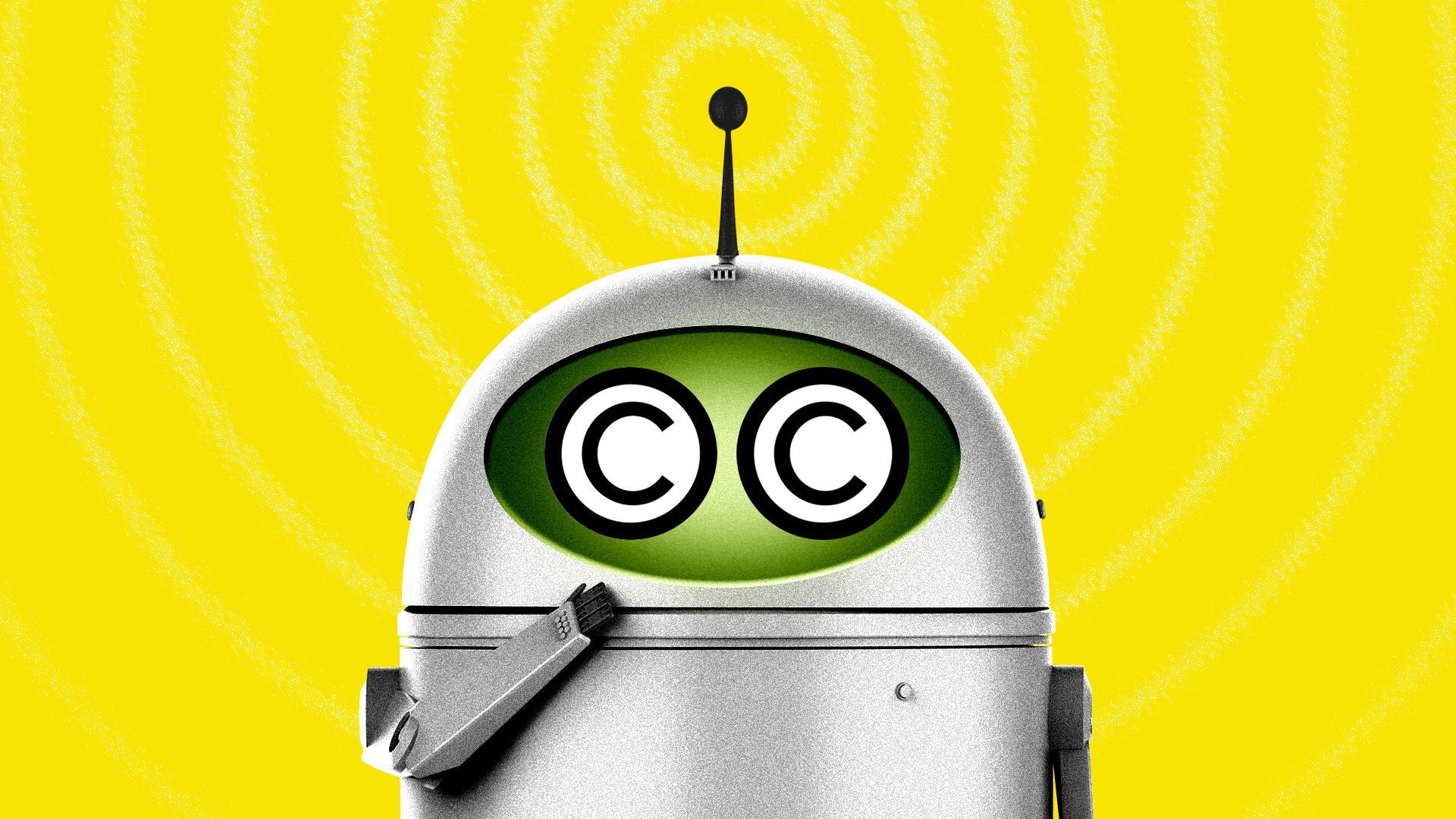
Illustration: Sarah Grillo/Axios
In the year since the release of ChatGPT, generative AI has been moving fast and breaking things — and copyright law is only beginning to catch up, as Axios' Megan Morrone reports.
Why it matters: From Section 230 to the Digital Millennium Copyright Act (DMCA) to domain name squatting protections, intellectual property law has shaped the internet for three decades. Now, it will shape the way we use generative AI.
Driving the news: The Biden administration's recent executive order contained no initial guidance on copyright law and AI, which means these decisions will largely be left up to the courts.
Between the lines: In August 2023 a federal court in Washington, D.C. ruled that copyright law only extends to humans, meaning that any work of art created with AI and without human input can't be copyrighted.
- Once humans alter that AI-created material in any way, the legal waters get murky — and we still have no idea how the law will handle disputes over attribution and disclosure.
- "Copyright is incredibly broad and all-encompassing," technology lawyer and podcaster Denise Howell tells Axios. "We're in the wild west days of this, as far as how it's going to shake out legally."
Flashback: When search engines first launched, litigants sued them, too.
- "Search does a lot of copying. And it's necessary to copy and index web pages in order to be able to search them," says Howell.
Erica Han, intellectual property partner at Ropes & Gray, disputes the claim that existing copyright rules don't answer novel questions about originality and authorship posed by AI.
- "U.S. copyright law has proven quite versatile to adapting to new technologies," Han told Axios. "Similar sentiments arose throughout history after the creation of technologies such as cameras and VCRs."
What they're saying: "I think with respect to copyright law, you will see people with legitimate claims financing lawsuits and litigation," former President Barack Obama told The Verge.
The latest: Last month, a group of nonfiction writers brought a class action complaint against OpenAI and Microsoft, accusing the companies of using copyrighted materials to train ChatGPT without authors' permission.
- This is only one of a number of lawsuits brought by artists or intellectual property owners — and the fight will play out for years to come.
- The nonfiction writers' lawsuit is the first to name Microsoft in its complaint and it came at a time when OpenAI and Microsoft were navigating a a chaotic boardroom crisis.
The big picture: Last month, a federal court dismissed the copyright infringement claims against Midjourney and DeviantArt, calling them "defective in numerous respects."
- The class action lawsuit deals with copyright issues over the art used to train generative AI tools (input) and the art they produce (output).
The intrigue: The judge who ruled in that case, William Orrick, also ruled in 2016's "monkey selfie" case that copyright can be granted only to humans and not to animals.
- That decision could serve as a precedent in determining how the law should deal with copyright claims for AI-generated works.
Yes, but: Enforcing an artist's copyright doesn't guarantee the artist will profit from their work.
Author and activist Cory Doctorow argues that copyright law isn't the answer to the generative AI problem.
- "We've spent 40 years expanding copyright. We've made it last longer; expanded it to cover more works, hiked the statutory damages for infringements and made it easier to prove violations," Doctorow writes.
- "This has made the entertainment industry larger and more profitable," Doctorow argues, "but the share of those profits going to creators has declined, both in real terms and proportionately."
The U.S. Copyright Office posted a notice of inquiry and recently published submitted comments on AI-related questions.
One battle to watch is over people's likenesses.
- Celebrity impersonators are nothing new, but generative AI now makes it easy to impersonate with realistic detail on a massive scale.
- According to Variety, Scarlett Johansson has "taken legal action" against an AI company that used a deepfake version of her to advertise its product.
- At the recent Axios AI+ summit in DC, Tom Graham, CEO of Metaphysic told Axios that creation of a new intellectual property right to one's likeness could offer people the chance to seek remedies if a third party tried to profit from realistic, artificially generated images that substantially resembled them.
What's next: We're about to enter a golden age for copyright trolls, legal experts say.
2. Startups think Altman drama will slow OpenAI

Illustration: Brendan Lynch/Axios
The AI universe was not just shaken but altered by the decision to fire Sam Altman from OpenAI, according to a new survey of nearly 200 AI startup founders and investors, Ryan reports.
By the numbers: 52% of the 166 professionals surveyed by the Startup Snapshot predicted that the firing and reinstatement of Altman would "slow down the success of OpenAI," and a further 24% predicted the events would "open up the AI market for new players."
- 35% of respondents said that the drama created uncertainty in their organization about using OpenAI tech.
- The online survey fielded responses from 166 AI startup founders, executives and investors globally.
The details: Startups are more enthusiastic about Altman than OpenAI, with respondents rating Altman at 8 out of 10 as a good spokesperson for the AI industry.
- Startups also tend to agree with Altman's assessment of AI risks.
- Asked if Altman had exaggerated risks around AI development, respondents delivered an average score of 4 out of 10, with 1 being "not at all" and 10 meaning they agreed he had "exaggerated" risks.
What to watch: Altman maintains OpenAI has lost no customers through the ordeal, while CNBC reported that some startups are looking to reduce their exposure to OpenAI products given the uncertainty around the company.
3. How Altman’s comms touch helped win CEO fight
After an executive is fired, they typically go underground — and when they do resurface, it's with legal representation or defensive messaging. Sam Altman took the opposite approach, as Axios Communicators author Eleanor Hawkins reports.
Why it matters: By being very vocal and striking the right tone, Altman bolstered OpenAI's reputation and his own.
What they're saying: "It's really impressive that he very much kept his wits about him and really thought about communicating in a smart and strategic way," says one Altman adviser who requested to speak on background.
Zoom in: He maintained open communication and reached investors, former employees and the media in a way the board didn't.
- His communication also provided runway for his former employees and his founder friends — like Airbnb's Brian Chesky and Coinbase's Brian Armstrong — to be vocal as well.
- They formed a social media army, which rallied around the ousted founder and in turn shaped the public narrative.
Of note, Microsoft CEO Satya Nadella was also highly visible throughout the transition and conducted several media interviews in which he sought to provide context and instill confidence.
Reality check: Board coups happen, but rarely do you see employees rising up in defense of the outgoing executive.
- Much of this can be attributed to Altman's communication style, which remained very positive and at times humorous. Not once did he disparage the board — instead he focused on the mission and people of OpenAI.
- "Sam's open, non-defensive way of representing himself made folks very skeptical of the board's decision. His communication reinforced how [employees] were feeling and filled a void left by the board's silence," said the adviser.
4. Training data
- A federal judge has blocked a Montana ban on TikTok that was due to take effect on Jan. 1.
- Facebook and Instagram parent Meta said in a report Thursday that it has shut down at least five China-based influence campaigns on its platforms this year which sought to exploit U.S. political divisions. (Axios)
- Meta plans to launch Threads in Europe sometime in December, sources told the Wall Street Journal.
- Trading places: The AI-powered Human Immunome Project has added 23andMe co-founder and former co-president Linda Avey to its board.
5. + This
I really want to see the Northern Lights at some point. But now I also want to see Steve.
Thanks to Megan Morrone and Scott Rosenberg for editing this newsletter.
Sign up for Axios AI+

Scoops on the AI revolution and transformative tech, from Ina Fried, Madison Mills, Ashley Gold and Maria Curi.