Axios AI+

February 09, 2024

Ina here. Today's AI+ is 1,223 words, a 5-minute read.
1 big thing: Test-driving Meta's Ray-Bans — now with AI
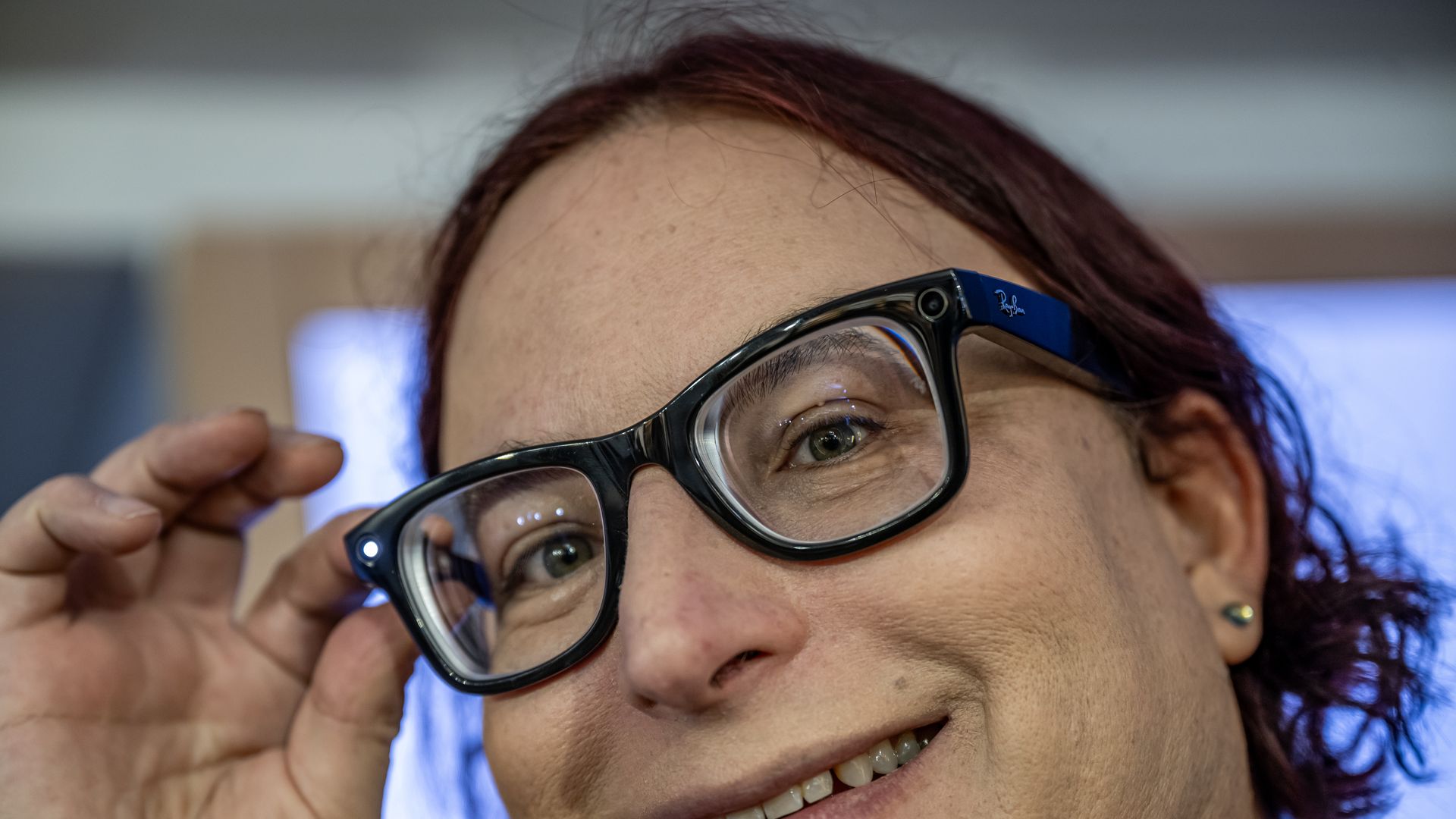
Axios chief technology correspondent Ina Fried taking a picture with Meta's Ray-Ban glasses. Photo: Dani Ammann/Axios
I used Meta's second-generation Ray-Ban smart glasses to broadcast my interview with Sam Altman at Davos live on Instagram, and Altman called the experience "a little weird" — but I think the glasses pack some neat tricks for a device that doesn't feel much bigger or heavier than standard eyewear.
Why it matters: The design of many cutting edge devices, like Apple's Vision Pro, starts with a long list of tech features and then tries to make everything smaller and lighter. With the Ray-Bans, Meta is taking a different approach — choosing a size, weight and price that people actually want, then seeing what you can do with it.
What's happening: The new glasses launched in October, and I've been using them (with my prescription) on and off for a few months. While they're largely a refinement of the initial version, they also include the ability to livestream and a built-in, if nascent, AI assistant.
Of note: My favorite use of the second generation of these specs is the same as the first time around: They let me capture first-person photos and videos without having to pull out my phone.
- This is especially great for sports. During my recent trip to Switzerland, for example, I used the glasses to capture video of me skating on ice, shooting the puck at a hockey net outdoors with snow-covered mountains in the background.
Details: The new model's main addition is access to Meta AI, a chatbot that resembles a less capable ChatGPT. The bot can also provide some real-time data — such as weather and sports scores — via Microsoft's Bing.
- Simply saying, "Hey, Meta" summons the bot's voice in your ear. It's still pretty hit or miss in terms of which queries it will answer and how well.
Another feature, currently only available to a small group of testers, is the ability to ask the AI chatbot questions based on what's in a user's field of view.
- Saying "Hey Meta, look at this" brings up this capability and prompts the glasses to take a picture, which it then analyzes to answer the question asked. It can write fun captions, translate a menu or just describe what it sees.
As for that Sam Altman interview live-stream: I'll admit it — it was a bit weird for me, too.
- I was conscious that anything I looked at — including my notes — could end up in the broadcast.
- Also, I wasn't sure if I had properly turned off the setting that enables a recital of live comments from viewers through the speakers by my ear.
Zoom in: I took the glasses on an hour-long walk through San Francisco's Mission Thursday, enjoying a Tracy Chapman playlist on Spotify, at least when I wasn't taking pictures or peppering the AI with questions.
- The AI assistant accurately told me that I didn't need to worry about rain, but struggled to tell me when the Warriors or Sharks play next. It also correctly answered who won the 2020 presidential election, but the answer did have some extraneous information.
- The experimental multimodal feature was able to translate a sign in Spanish for me and correctly deduce that I needed to pay if I wanted to park at a meter. It also wrote some amusing captions for the photos I took with the glasses.
- When I got home a little over an hour after I left, the glasses were at 49 percent battery, though I had been using them fairly heavily.
Between the lines: The glasses have also gotten much better at carrying out the key features from the first version.
- Pictures are sharper and more detailed, while the audio is louder and clearer than the first go-around.
One troubling aspect that persists from the first version is that many people, especially in a large group or crowd, have no idea I'm wearing glasses capable of recording photos and video until I tell them.
- Meta has a white LED that shows up when the glasses are taking a picture or recording video. While it's now brighter than the last version, it's still not super clear.
The big picture: A number of companies are betting on AI wearables — including Humane, with its AI Pin and Brilliant Labs, with its just-announced Frame glasses.
- Unlike some rivals, the Meta glasses don't require a separate wireless account, but you need an iPhone or Android smartphone for retrieving photos and providing the connectivity needed for the AI features.
The bottom line: Even this second version of the Meta Ray-Ban glasses still feels like early days, especially for the AI capabilities.
- I think of Meta's glasses as more of a hint at the types of hardware coming than a device fully ready for the mass market.
- At the same time, they aren't super pricey (they start at $299), feel like the glasses I already wear and do a few interesting things relatively well.
Go deeper: Check out my video review of the Meta Ray-Bans — made while wearing the glasses.
2. FCC outlaws AI voices in robocall fraud
Illustration: Aïda Amer/Axios
The Federal Communications Commission (FCC) has declared the use of AI-generated voices in scam robocalls illegal — with immediate effect, as Ryan reports.
Why it matters: Generative AI is making voice scams easier to believe and unsolicited robocalls have been used to "extort vulnerable family members, imitate celebrities and misinform voters," per the FCC.
Details: In a unanimous ruling, the FCC declared that calls made with AI-generated voices are "artificial" under the Telephone Consumer Protection Act.
- While using AI to perpetrate a scam or fraud was already illegal, now using AI to generate voices in such calls is itself illegal.
- A bipartisan coalition of 26 state attorneys general wrote to the FCC supporting the change.
The big picture: President Joe Biden was the victim of an AI-generated fake robocall in January — the first of what experts expect to be a flood of 2024 election scams.
By the numbers: Americans are subject to more than 4 billion robocalls per month, according to an index maintained by YouMail.
- The FCC already works with 48 states — all but Georgia and Nebraska — to catch what it says is an increasing number of robocall scammers.
What's next: State attorneys general now have additional ways to crack down on bad actors, and "ensure the public is protected from fraud and misinformation," the FCC said in a statement.
What they're saying: "Bad actors are using AI-generated voices in unsolicited robocalls to extort vulnerable family members, imitate celebrities and misinform voters. We're putting the fraudsters behind these robocalls on notice," said FCC chairwoman Jessica Rosenworcel.
3. Training data
- Russia's invasion of Ukraine turned into "the first AI war" as the region became a lab for Palantir and other tech firms to test new military applications. (Time)
- A major civil rights coalition will bring together congressional, regulatory and industry leaders Tuesday in D.C. to brainstorm how to tackle AI regulation and civil rights. (Axios Pro)
- There's a new Washington trade association — Internet Works — that's specifically for smaller tech companies whose needs have diverged from the giants' in recent years. (Axios Pro)
- Mozilla chief executive Mitchell Baker is shifting to chairman and will focus on AI and internet safety issues, with current board member Laura Chambers assuming the CEO spot. (Fortune)
4. + This
Remember Indiglo? Here's more than you ever wanted to know about the OG backlighting technology.
Editor's note: Yesterday's top story has been corrected to reflect that Meta is building new tools to identify C2PA metadata in images uploaded to Threads (not WhatsApp), Facebook and Instagram.
Thanks to Scott Rosenberg and Megan Morrone for editing this newsletter.
Sign up for Axios AI+

Scoops on the AI revolution and transformative tech, from Ina Fried, Madison Mills, Ashley Gold and Maria Curi.