Recess makes a comeback in Washington and across the U.S.


Add Axios as your preferred source to
see more of our stories on Google.
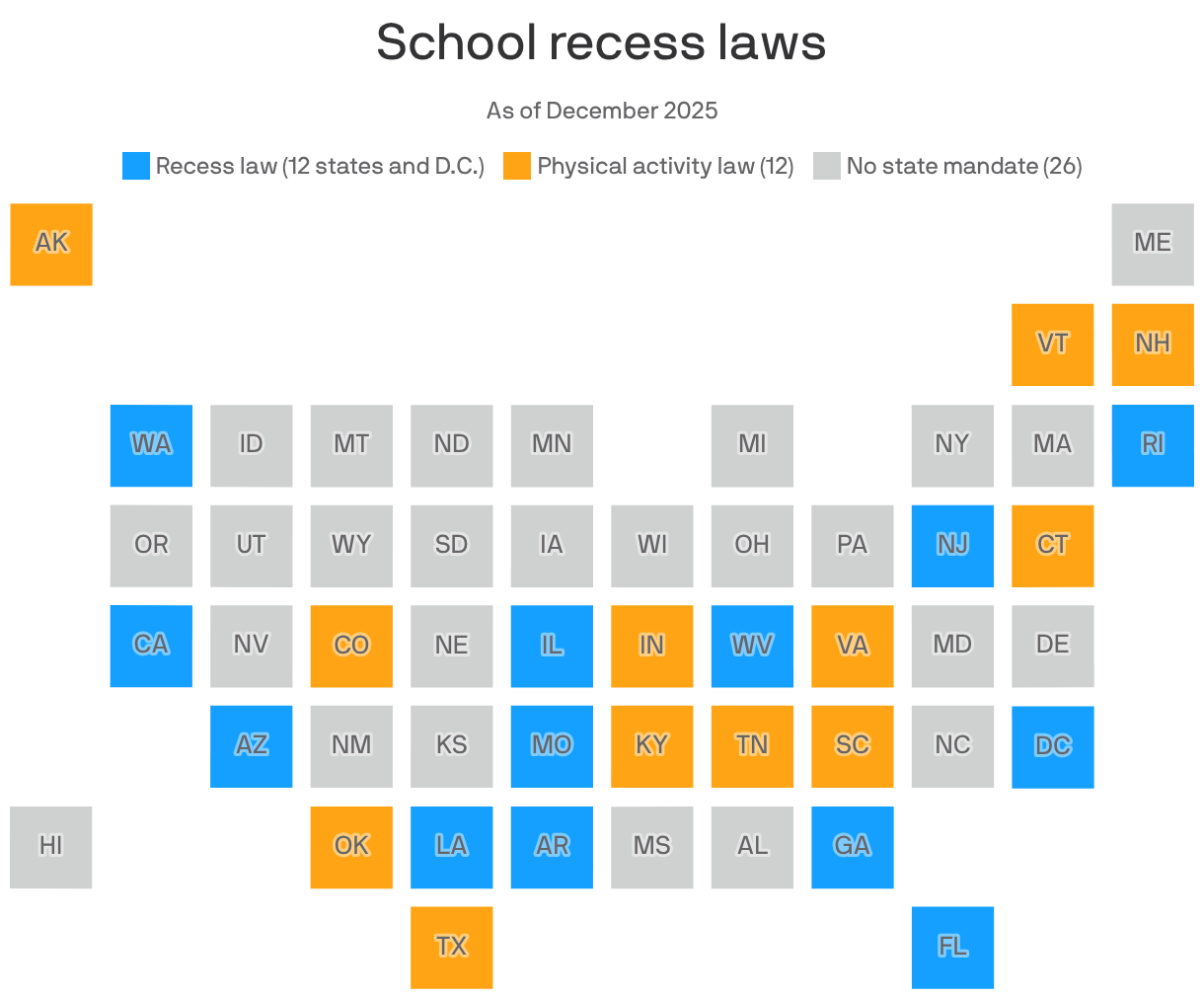
After decades of diminished recess time, a dozen states — including Washington — now require it by law.
Why it matters: Yes, recess is literally child's play. But researchers, pediatricians and parents say it's crucial for young students' physical and mental health.
By the numbers: As of December, school recess is mandated in 12 states and D.C., according to Johns Hopkins research.
Zoom in: Washington adopted a law in 2023 requiring at least 30 minutes of daily recess time for elementary school students.
- Recess sessions must be "student directed" and "held outside whenever possible," the law says.
- Time spent changing into outdoor clothing doesn't count. Neither do physical education classes.
Several other states require physical activity, but don't have a specific recess mandate.
Between the lines: Unstructured play doesn't just teach social skills, but research connects it to increased classroom motivation and behavior, better school attendance, and less stress for students.
- And more physical activity could help academic performance.
What they're saying: "Recess gives you a better feeling about school. Recess refreshes you. Recess helps you feel a little bit less cynical about what's going on," psychologist Peter Gray, author of forthcoming "Restoring Childhood," tells Axios.
- "Anyone who's ever spent even a day with a kid can recognize that if you kept them sitting all day, they'd go insane, they'd drive everybody else insane," says Hannah Thompson, a physical activity epidemiologist with UC Berkeley's Nutrition Policy Institute.
- Although schools don't tend to fight the idea of recess itself, Thompson says it can be a challenge for administrators to carve out more time for it and ensure it's not withheld as punishment.
Catch up quick: From 2001 to 2019, weekly recess time in U.S. schools dropped by 60 minutes, education consulting company EAB found.
- One oft-cited factor for the decline: The signing of "No Child Left Behind" in 2002, which led to more time focused on reading, math and school testing — and less on recess.