Hanford's legacy looms over Washington nuclear debate

Add Axios as your preferred source to
see more of our stories on Google.
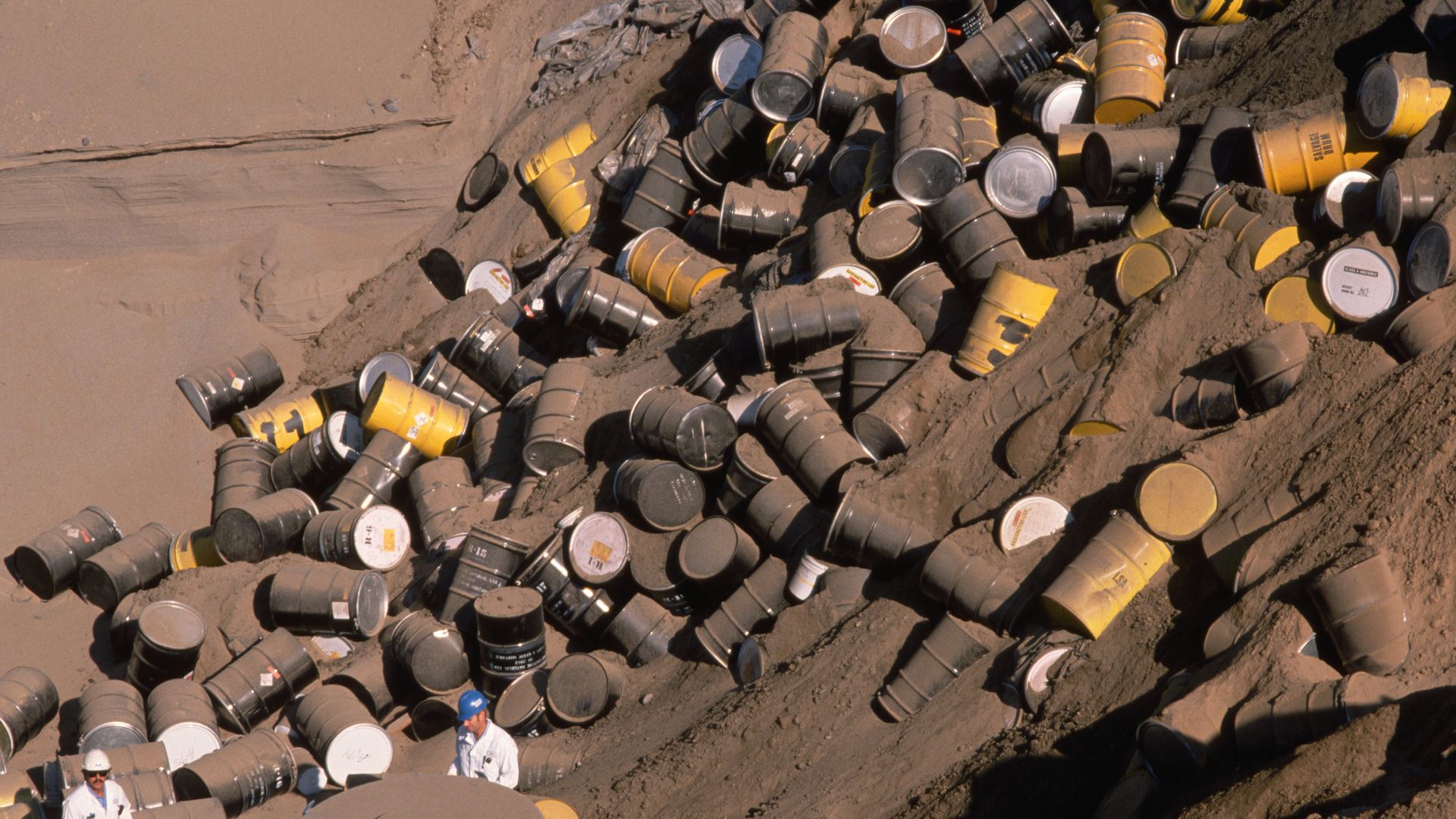
Nuclear waste at the Hanford Site in an undated photo. Photo: Roger Ressmeyer/Getty Images
As Washington's energy industry and lawmakers take another look at nuclear power as a way to reach a carbon-free energy future, a perennial question is reemerging: What happens to the waste?
Why it matters: The country still hasn't figured out where to permanently store high-level nuclear waste — and until it does, every new reactor adds to that unresolved burden.
Catch up quick: That question carries particular weight in Washington because of Hanford — the Cold War site where radioactive and chemical waste from weapons production still requires massive cleanup.
- Today, 177 underground tanks at Hanford hold roughly 56 million gallons of highly radioactive and chemically hazardous waste from decades of plutonium production, per the state Department of Ecology.
- But commercial nuclear waste is not the same as Hanford's legacy defense waste, Nikolas Peterson, executive director of the nonprofit Hanford Challenge, which works to clean the site, told Axios.
- Hanford's waste is chemically mixed and stored in underground tanks, he said, while used fuel from commercial reactors comes in solid fuel rods.
Peterson said the lessons from Hanford still apply when considering nuclear expansion in the state.
- "Don't just build something and assume you'll figure out the waste later," he said. "That's what they did before."
- Wise leadership would nail down the "cradle to grave" path for nuclear waste before adding more, Peterson said.
State of play: At the Columbia Generating Station, the state's lone commercial reactor, used fuel is first cooled in deep water pools, then transferred into steel-and-concrete dry storage casks on site.
- The casks are designed and tested to withstand earthquakes, plane crashes and train derailments among other disasters, according to Northwest Energy spokesperson Jackie Eutsey.
- Those systems are licensed and regulated by the U.S. Nuclear Regulatory Commission.
- "It can be stored safely and protectively for public health," said Mark Nutt, a nuclear engineer at the Pacific Northwest National Laboratory, a federal nuclear research facility in Richland.
- Still, the casks are considered interim storage and not a permanent solution, he said.
Friction point: The U.S. has no operating permanent repository for commercial nuclear waste after plans for a deep site at Yucca Mountain stalled in 2010 amid technical challenges and political opposition.
The bottom line: Whether Washington expands nuclear energy may depend not just on cost or technology — but on whether the country can resolve the ultimate question of safety, and where the waste will go.