Seattle's Estelita's Library part of rise in Black-owned bookstores

Add Axios as your preferred source to
see more of our stories on Google.
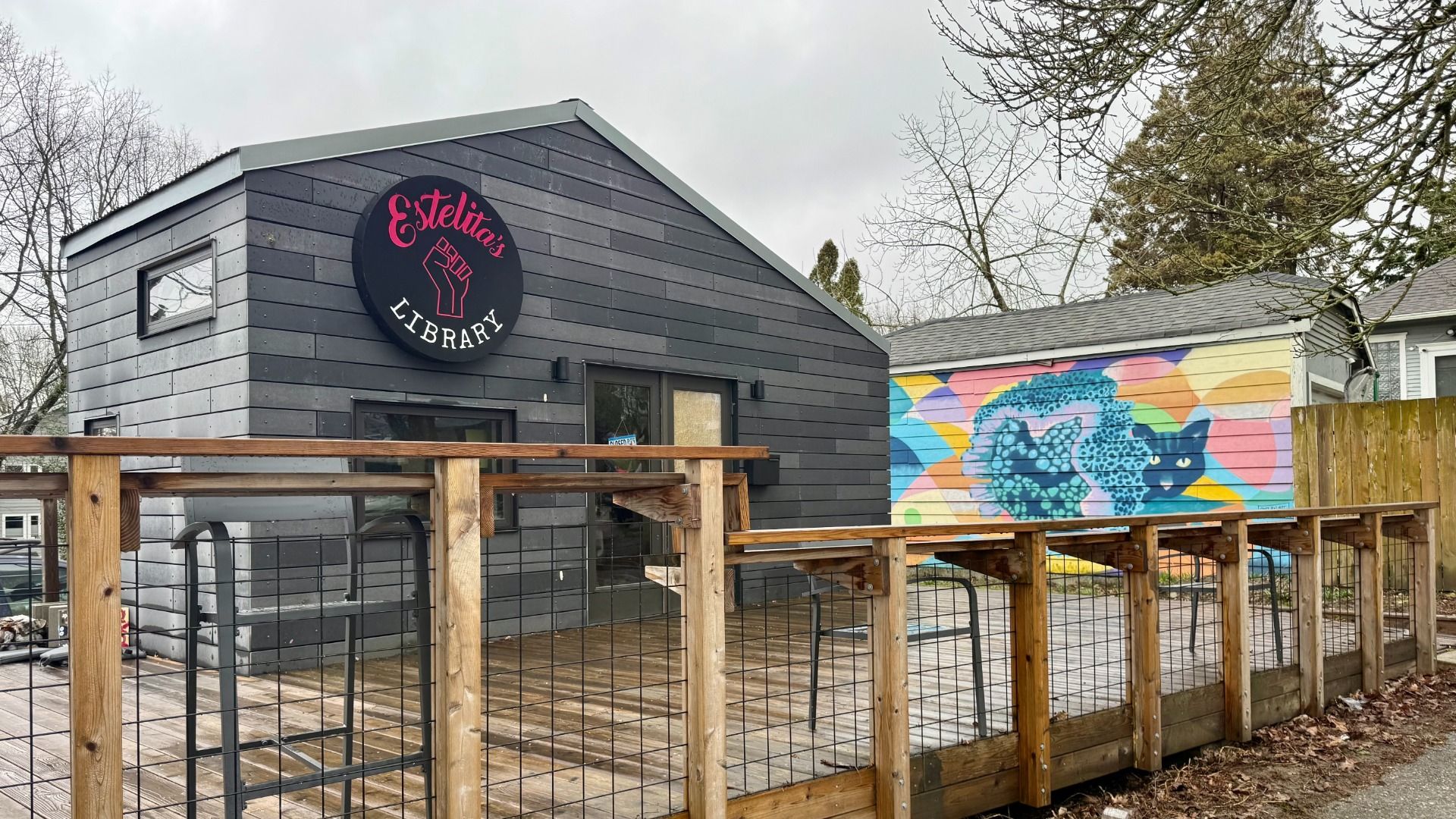
Estelita's Library was founded in Seattle in 2018. Photo: Melissa Santos/Axios
A nonprofit in Seattle's Central District is one of a growing number of Black-owned bookstores nationwide.
Why it matters: As public schools and libraries remove books by Black authors — from Beloved to The 1619 Project — Black-owned bookstores are increasingly serving as places where readers can access contested titles and authors' full bodies of work — and gather in community to discuss them.
The big picture: The first State of the Black Bookstore report from the National Association of Black Bookstores identifies 306 Black-owned bookstores nationwide, up from 54 in 2014.
Yes, but: That growth masks economic fragility, a reality many owners say is forcing bookstores to evolve beyond traditional retail.
Zoom in: At Estelita's Library in Seattle, co-founder Edwin Lindo, a professor at the University of Washington, launched the nonprofit bookstore with his wife, surgeon Estell Williams, as a way to invest in their community beyond their day jobs.
- Founded in 2018, Estelita's archives one of the largest collections of original Black Panther Party newspapers and has raised about $16 million toward a future affordable housing project.
- The bookstore, located near the corner of South Jackson Street and Martin Luther King Jr. Way South, operates less like a traditional retailer and more like a community library centered on social justice, Lindo said.
What they're saying: "Historically, organizing around Black liberation happened in the back rooms of bookstores," Lindo said. "They weren't just selling books — they were creating space."
- "Books are the appetizer," he said. "They bring people in, but the real work is the people who gather around them."
State of play: For Black-owned bookstores around the country, survival often depends less on book sales alone and more on operating as trusted gathering spaces rooted in culture and memory.
- In Atlanta, at 44th and 3rd Bookseller, owner Warren Lee told Axios the industry's economics are sobering.
- "Increased revenue is good. Profitability is always the challenge," Lee said, noting independent bookstores average roughly 3% net profit margins.
- "If that's considered successful," he added, "it means a lot of stores are operating at 2%, zero or even negative."
Between the lines: Lee said independent bookstores play a role in preserving access to the full body of work by Black authors — a motivating factor in opening the store with his wife, Cheryl Lee.
- "We saw the shelf space for Black books shrinking — from a bookcase and a half to half a bookcase — even for major authors," he said.
- Beyond retail, Lee said, the store functions as a convening space — hosting authors, mentoring young writers and investing in literacy initiatives.
The bottom line: In the end, the model is about more than sales.
- "I don't think book selling is a lucrative proposition," Lindo said. "The space is the proposition."