Washington weighs cash rounding as pennies fade

Add Axios as your preferred source to
see more of our stories on Google.
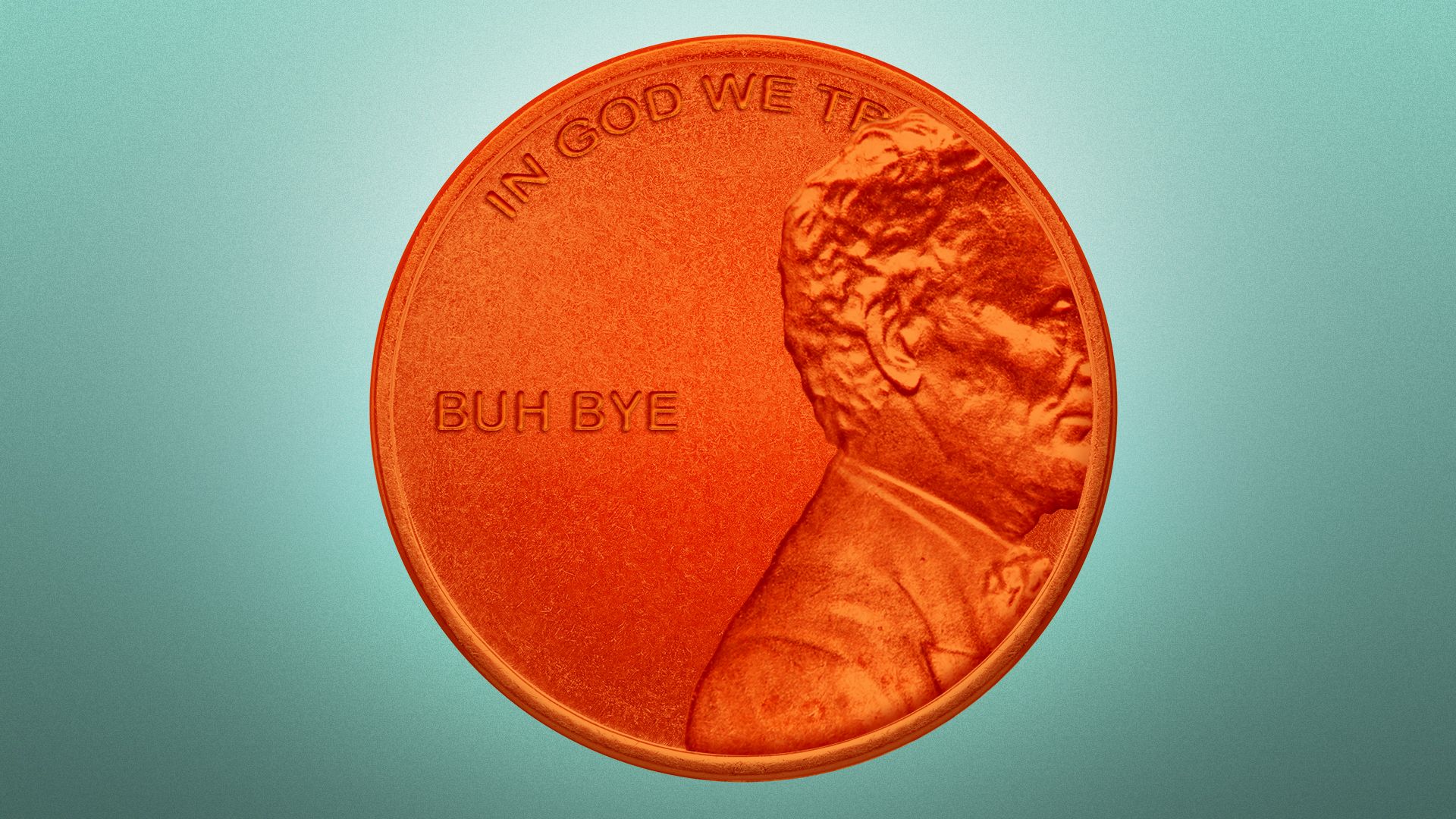
Illustration: Sarah Grillo/Axios
The federal government's decision to stop minting pennies is making it hard for Washington state retailers to give exact change — so state lawmakers may let them round to the nearest nickel.
Why it matters: The legislation to allow rounding on cash transactions aims to clarify how customers and stores should operate in an increasingly penniless world.
What's inside: Under House Bill 2334, if the final digit of a cash transaction ends in $0.01, $0.02, $0.06, or $0.07, it could be rounded down to the nearest nickel.
- If the final digit ends in $0.03, $0.04, $0.08, or $0.09, sellers could round up.
- Electronic and credit card transactions wouldn't be affected — and businesses would owe taxes on the initial sales price before any rounding, the bill says.
- Rounding systems like this should have no overall effect on consumer prices because transactions will be "rounded down just as often as they will be rounded up," the U.S. Treasury Department has said.
What they're saying: Retailers around Washington have struggled to provide exact change on cash transactions in recent months, Molly Pfaffenroth, lobbyist for the Washington Food Industry Association, told a Senate panel last month.
- "We simply cannot get pennies from our banks, and there's not enough pennies circulating in our registers," Pfaffenroth said.
- That's caused many businesses to round up or down, but "we've been concerned about continuing this practice without proper guidance from the state," Pfaffenroth said.
The uncertainty is hurting businesses and customers, said state Rep. April Berg (D-Mill Creek), the sponsor of the rounding legislation.
- "It is going to cost businesses time and money. It's going to cost customers frustration at the register, unless our state steps in and comes up with clear, consistent rules," Berg said at a recent public hearing.
What's next: The bill has cleared the state House and awaits a floor vote in the state Senate.