Amazon lab puts packages through crash-test chaos

Add Axios as your preferred source to
see more of our stories on Google.
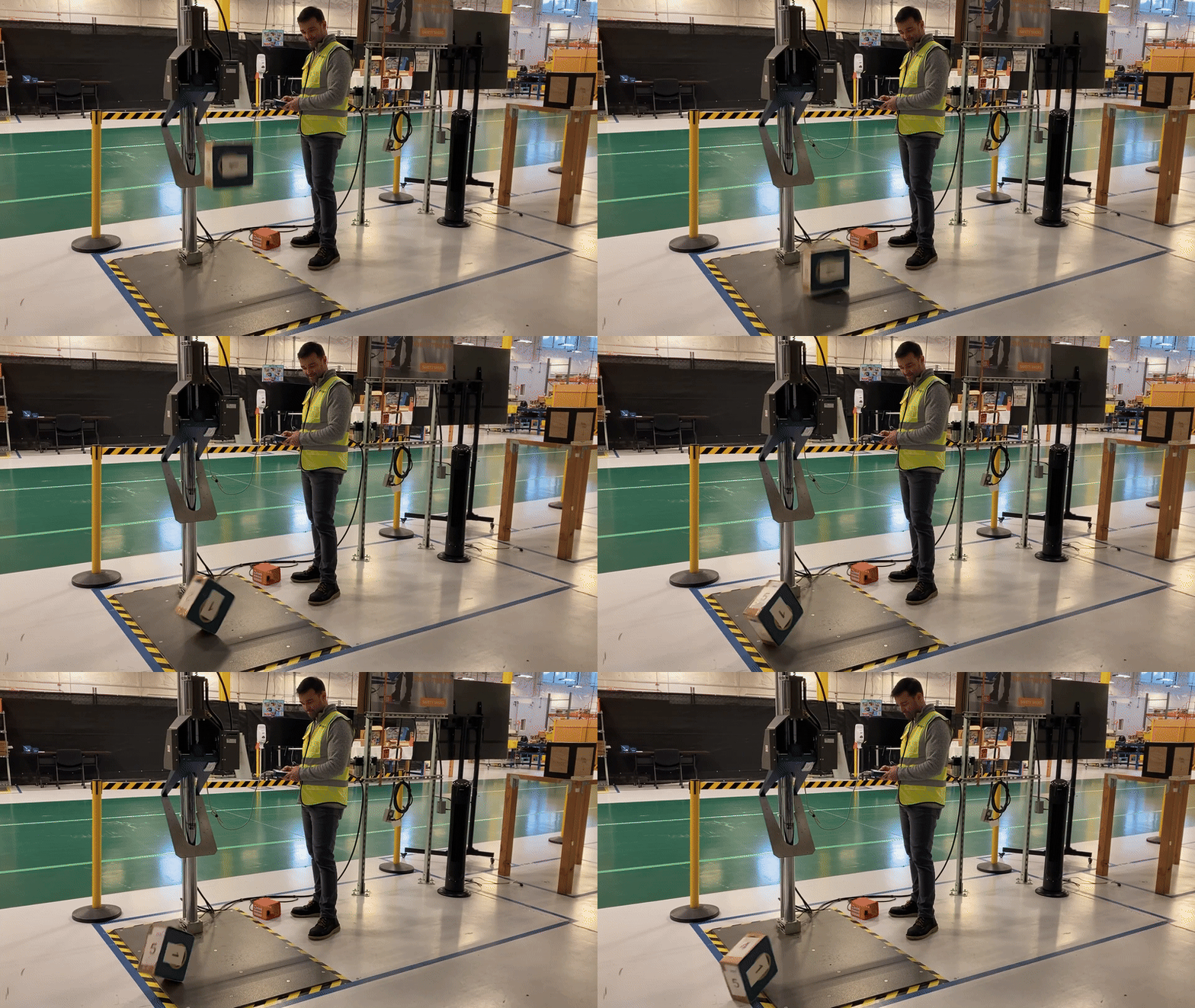
In a warehouse south of Seattle, Amazon spends its days doing unspeakable things to innocent packages.
Why it matters: This abuse is the specialty of Amazon's Packaging Innovation Lab in Sumner, where engineers work to shrink the mountain of cardboard and plastic that cradle customers' orders en route to their doorsteps.
- Package survival becomes doubly important during the holiday season.
How it works: In this cavernous 10,000-square-foot facility, boxes are stacked under the weight of a small car or squeezed until their sides bow, while vibration tables mimic the shaking inside trucks and planes.
- Boxes holding delicate items are dropped from precise heights onto every edge and corner to test durability and how much packing is needed to protect your precious order.
- "We're also looking at cubic efficiency — are we going to be able to reduce the number of trucks needed to move the same volume?" John Sly, a senior manager in Amazon's global material science arm, told Axios during a recent visit. "That's a critical parameter for us as a logistics company."
Case in point: Amazon uses big-screen TVs as a kind of final boss test for packaging.
- Engineers strap TVs onto an incline impact machine — "basically a crash simulation," Sly said — to see what happens when a truck has to slam on the brakes.
- The goal is to see if the TV's own box can survive the worst-case jolt so Amazon doesn't have to add another box on top.
- "If we can ship a 65-inch piece of glass without adding a box," Sly said, "we should be able to do the blender or the air fryer."
The big picture: The best-case scenario for many products is no extra Amazon packaging at all, Sly said.
- The "Ships in Product Packaging" program certifies products that can ship safely in their original manufacturer's box.
- In e-commerce, packages don't have to sit on store shelves or attract shoppers with big graphics and hang tags, allowing manufacturers to redesign packaging to be stronger, smaller, simpler and built for delivery trucks instead of retail aisles, Amazon spokesperson Saige Kolpack told Axios.
- Amazon shares its test results with brands to help them reinforce weak points, adjust materials and certify packaging that can survive shipping on its own.
By the numbers: Kolpack says Amazon's packaging push is adding up.
- 18 million products are certified to ship in their own packaging.
- About 12% of Amazon's global shipments were sent without added packaging last year.
- Since 2015, Amazon has saved 4.2 million metric tons of packaging, and it cut North American single-use plastics from 65% of shipments in 2023 to 37% in 2024.
- Hundreds of retrofitted machines now produce custom paper bags, and another key change has eliminated 15 billion plastic air pillows a year.
Yes, but: E-commerce is growing so fast that even big gains in packaging efficiency can be overshadowed by soaring parcel volume, which is expected to reach 256 billion packages by 2027, per industry analysts.
The bottom line: Your holiday packages are more likely to arrive intact — and with less waste — because Amazon already tried to destroy them first.