Seattle metro grows faster than U.S., driven by foreign immigration


Add Axios as your preferred source to
see more of our stories on Google.

The Seattle metro area is growing faster than the country overall, driven largely by foreign immigration, according to new data from the U.S. Census Bureau.
Why it matters: An exodus of city dwellers rocked many U.S. metros during the COVID-19 pandemic, but some — including Seattle — are now clawing back residents (and their tax dollars).
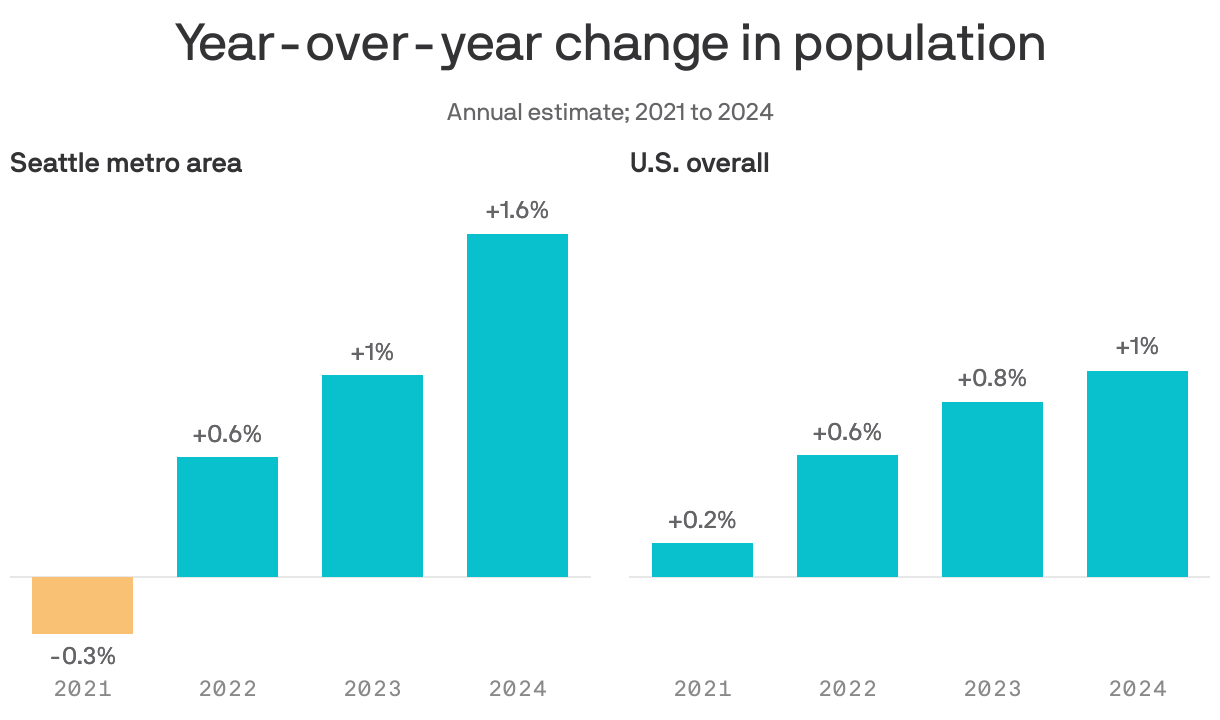
Driving the news: The number of people living in the Seattle-Tacoma-Bellevue metro area increased by 66,666 from 2023 to 2024 — a gain of about 1.6% — the Census Bureau said last week.
- By comparison, the total U.S. population rose by 1% during that time, while all U.S. metro areas combined grew by about 1.1%.
State of play: The bulk of the Seattle area's population growth last year was driven by foreign immigration, a pattern also seen in other U.S. metros, per the Census Bureau.
By the numbers: The Seattle metro gained nearly 64,000 people from international migration last year, while losing about 11,000 residents who moved to other parts of the U.S.
- By comparison, the area gained 14,172 people from "natural change" last year, a figure calculated by subtracting the number of deaths (28,960) from the number of births (43,132).
Between the lines: Some metros hit hard by pandemic population loss — think New York, Los Angeles. and San Francisco — grew from 2023 to 2024, but are still down relative to 2020.
- The Seattle area, by contrast, has fully rebounded, gaining more than 126,000 people since 2020 (despite a brief population dip in 2021).
What's next: Demographers and other researchers will keep a close eye on how Trump administration policies might affect immigration levels.