How Washington is promising free college to low-income kids

Add Axios as your preferred source to
see more of our stories on Google.
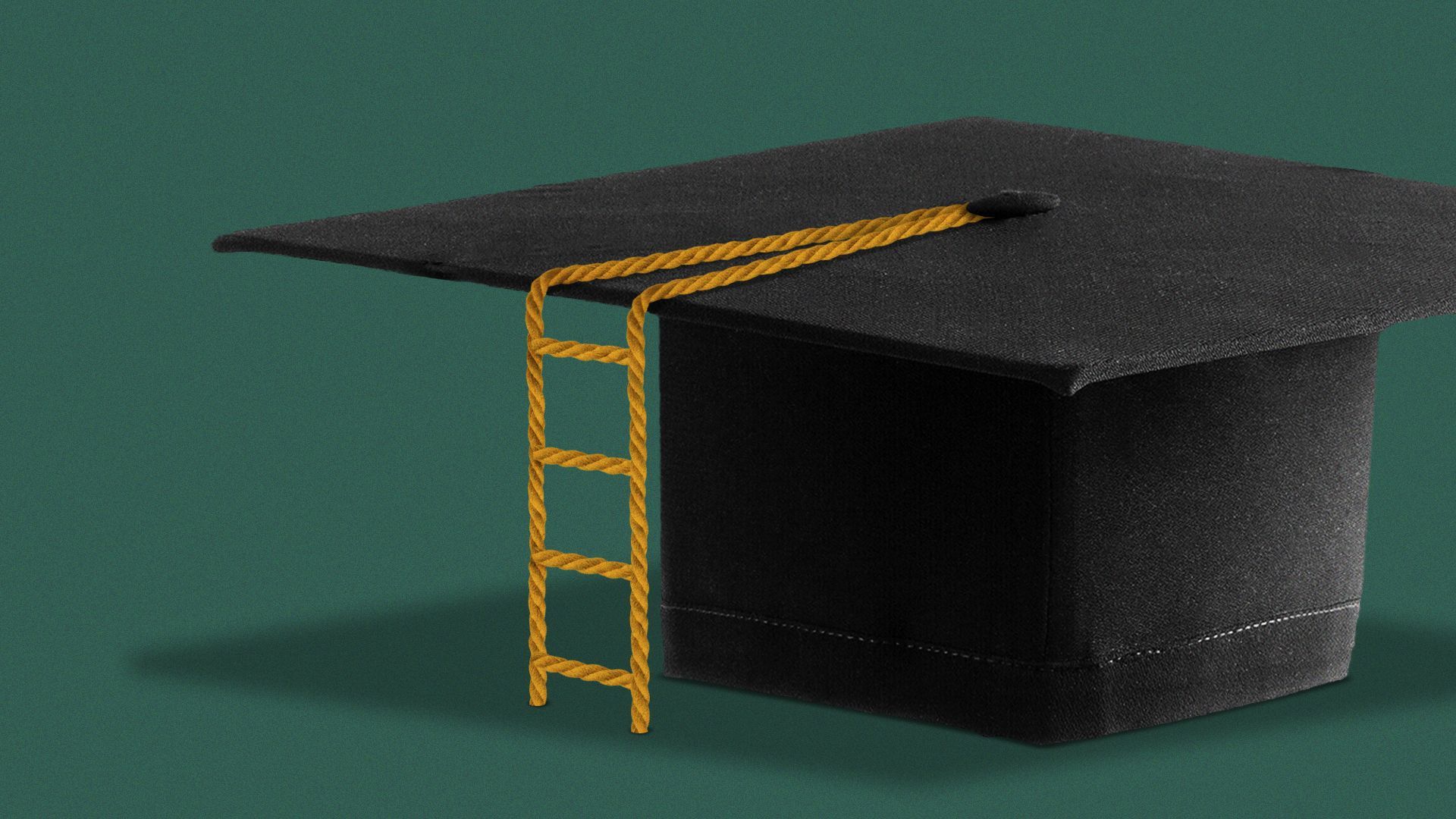
Illustration: Maura Losch/Axios
Washington state plans to let low-income kids know by the 10th grade that they automatically qualify for free college, rather than making them wait on the outcome of financial aid applications in their senior year.
Why it matters: The new system will make it so students whose families are on food stamps can start thinking about college or career training earlier, while eliminating the barrier that the Free Application for Federal Student Aid (FAFSA) can pose for some.
The big picture: Washington has long struggled with low FAFSA completion rates among high school seniors — a rate that dipped even further this year, as a new FAFSA form rolled out amid technical difficulties and delays.
- That's a problem because for most students, if they don't fill out the FAFSA, they can't qualify for financial aid, including Washington state's program that pays full public school tuition for many students.
- Right now, that program covers full in-state tuition for students whose families make up to 65% of the state's median income, which comes out to about $78,500 per year for a family of four.
Zoom in: A new law the Washington Legislature passed this spring will make it so students in 10th through 12th grade automatically qualify for those state aid programs if their families receive state or federal food assistance benefits (such as from the Supplemental Nutrition Assistance Program).
- The new eligibility rules will take effect Jan. 1, 2026, affecting low-income students in this year's junior class and below.
What they're saying: The idea is to give those kids a guarantee that they'll be able to afford college or career training when they graduate, so that they don't give up on those pathways prematurely, Michael Meotti, executive director of the Washington Student Achievement Council, told Axios.
- Students start envisioning their future plans as early as 8th and 9th grade "and that vision is a great driver in making it happen" — but not necessarily if students think their dream is unaffordable and out of reach, he said.
Zoom out: Meotti said Washington state's law is based on an experiment in Michigan, where officials promised low-income students four years of free tuition at the University of Michigan, regardless of whether they filled out financial aid applications, and encouraged them to apply.
- Students who received those notices were twice as likely to apply to the university and twice as likely to enroll, the researchers found.
- "You can give them an upfront guarantee. That actually affects college choice," Susan Dynarski, a former University of Michigan professor who led that pilot project, told The Hechinger Report.
Between the lines: Meotti said the program, if successful, could help reverse declines in college enrollment in Washington over time.
- Meotti said he also thinks the state program could eventually help boost the rate of FAFSA completion among Washington seniors, who may want a shot at additional federal aid.