Seattle’s young adults face economic setbacks, but some make gains


Add Axios as your preferred source to
see more of our stories on Google.
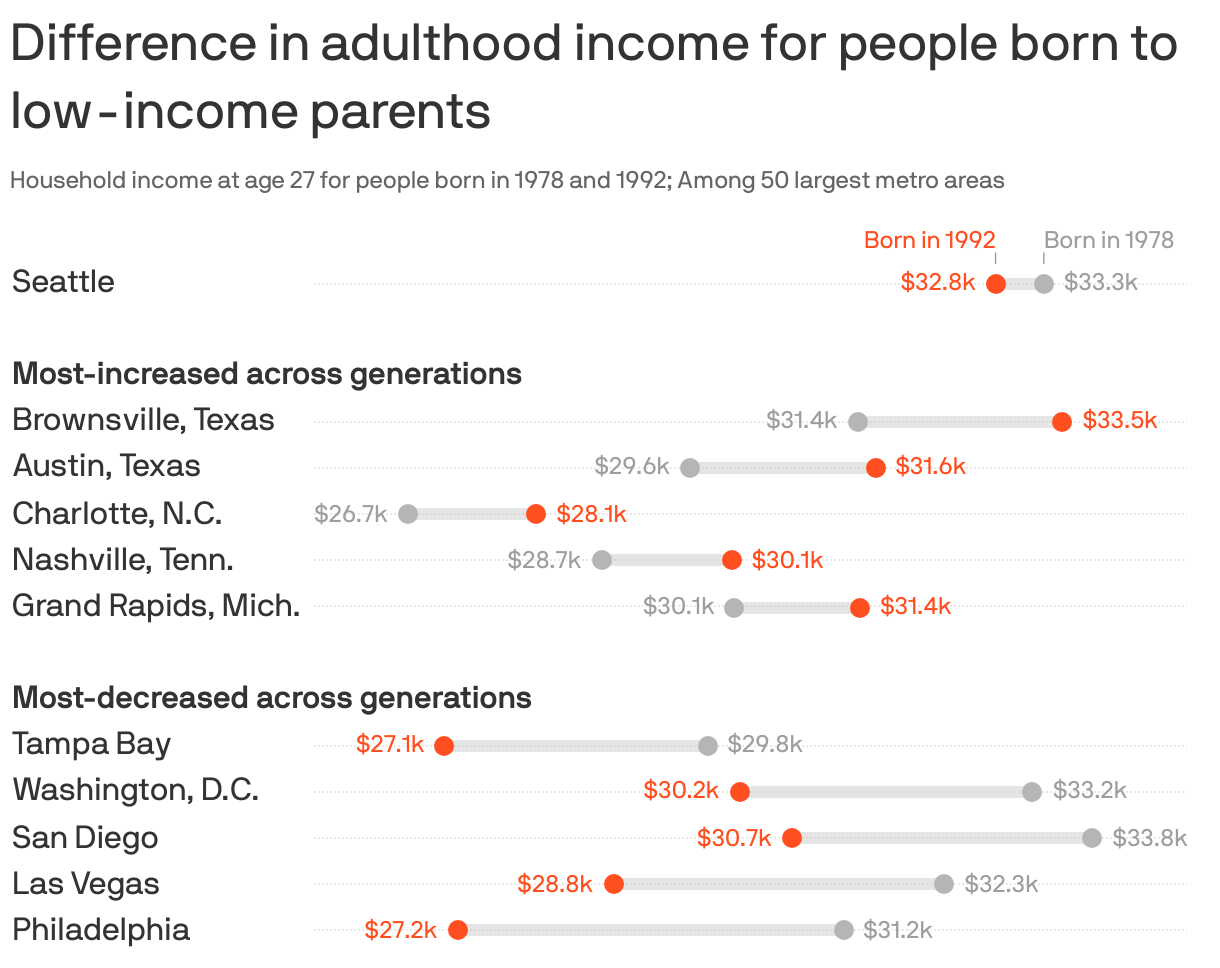
Americans born to low-income families are generally faring worse than the previous generation in most cities, including Seattle, a new analysis finds. But there are some bright spots in the Emerald City as well.
Why it matters: Intergenerational mobility — the idea that a generation will do better than the one before them — is core to the American dream, but it's far from guaranteed.
Driving the news: Seattleites born in 1992 have a lower average household income, adjusted for 2023 dollars, than those born in 1978, according to a study from the Census Bureau and Opportunity Insights, a research group at Harvard University.
By the numbers: Seattleites born to low-income families in 1992 were earning $32,800 at age 27 compared to the $33,300 that people born in 1978 were making when they were 27, according to the report.
- But that decrease of 1.5% is smaller than the national average of 4.2%, researchers found.
- Seattle ranked 15th for upward mobility among the 50 most populous commuting zones in the U.S.
The big picture: The geography of mobility has shifted dramatically, especially when breaking down the data by race. Per the report:
- By 1992, upward mobility for low-income white children in coastal states and in the Southwest fell markedly to rates on par with those observed in Appalachia and other areas that historically offered the lowest chances of upward mobility.
- Conversely, for Black children, upward mobility increased the most in the Southeast and the Midwest, where outcomes had historically been poorest for Black Americans.
Zoom in: White children born to low-income households in Seattle in 1992 earned 3.2% less than their counterparts from 1978.
- By contrast, Black, Hispanic, Asian and Native Americans kids born in 1992 to low-income households in Seattle saw income rise by 14%, 8.5%, 3.1% and 17%, respectively, compared to people born in 1978, per the report.
- Black and Native American children born in 1992 to the very poorest households in Seattle had higher incomes by as much as 23% and 21%, respectively, compared to their 1978 counterparts, the analysis found.
- 1992 babies of all races born to the highest-income families in Seattle saw increased household income across the board, ranging from 10% for whites to 28% for Native Americans.
Yes, but: Black children born in 1992 still had poorer prospects of rising up than white children in most of America, because initial Black-white disparities were so large, the researchers wrote.
What they found: In 38 of the 50 biggest U.S. metro areas, Americans born to low-income families in 1992 were doing worse at age 27 than those born in 1978 at that age.
Go deeper: You can explore more data about intergenerational mobility at The Opportunity Atlas, a web tool published by the researchers.