A new I-5 bridge between Washington and Oregon may actually happen

Add Axios as your preferred source to
see more of our stories on Google.
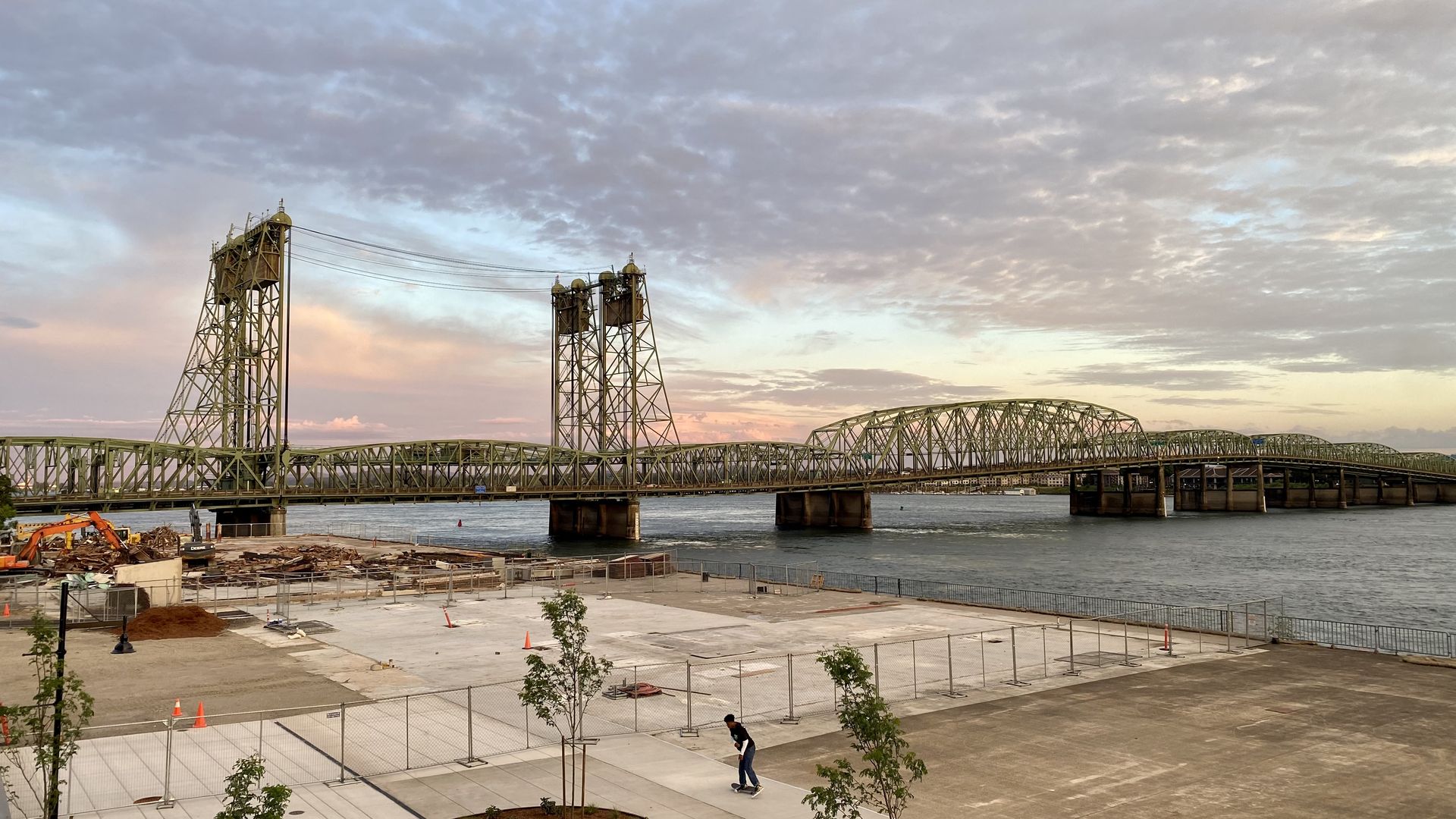
The current Interstate 5 bridge connecting Washington and Oregon. Photo: Melissa Santos/Axios
On Interstate 5 between Mexico and Canada, there's only one spot where car traffic grinds to a halt to make way for boats — and it's on the border of Washington and Oregon.
- That may soon change.
Driving the news: After nearly a decade-long delay, plans are moving forward for a new I-5 bridge connecting the two states.
Why it matters: The current bridge over the Columbia River is old and could collapse in an earthquake.
- What's more, the aging structure must often be raised to let boats through and for maintenance, stalling traffic on the West Coast's main north-south freeway — something a new bridge will aim to avoid.
Catch up fast: Earlier this year, Washington lawmakers approved a $1 billion down payment to help advance the project.
The latest: In recent weeks, eight local government agencies have signed off on a preliminary plan for a new bridge — a key step after an earlier proposal fell apart in 2013.
- Last Thursday, a steering committee advanced the project to the environmental review stage.
What they're saying: "This is a significant step in showing that this region is ready to get this project done this time," Greg Johnson, the bridge's program administrator, told Axios Seattle.
- "It definitely signals the rebirth of this project," added Washington state Sen. Marko Liias (D-Lynnwood) in a separate interview with Axios.
Flashback: The project has a long and contentious history.
- In 2013, Oregon lawmakers approved $450 million toward a replacement bridge.
- But the plan died in the Washington Legislature, where lawmakers disagreed about — among other things — whether light rail should extend over the bridge from Portland to Vancouver, Washington.
Details: The new plan envisions both rail and bus rapid transit, along with a replacement bridge that is taller than the one in use today.
- The plan would also widen the bridge's lanes — which Johnson said don't meet modern safety standards — and add emergency shoulders, which the current bridge lacks.
- Tolling is part of the plan, too, although details have yet to be worked out.
What's next: Washington lawmakers are looking to the Oregon Legislature to approve its share of money for the project.
- Officials will also be applying for federal grants to cover some of the cost — projected to range between $3.2 and $4.8 billion.
- Conversations are ongoing with the U.S. Coast Guard about whether the proposed bridge would be tall enough to avoid needing a drawbridge.
- The environmental review process is expected to take between 18 months and two years.
- Depending on how those steps go, construction could start as early as fall 2025, with likely completion in 2033, Johnson said.