Washington state's undergraduate enrollment plummets

Add Axios as your preferred source to
see more of our stories on Google.
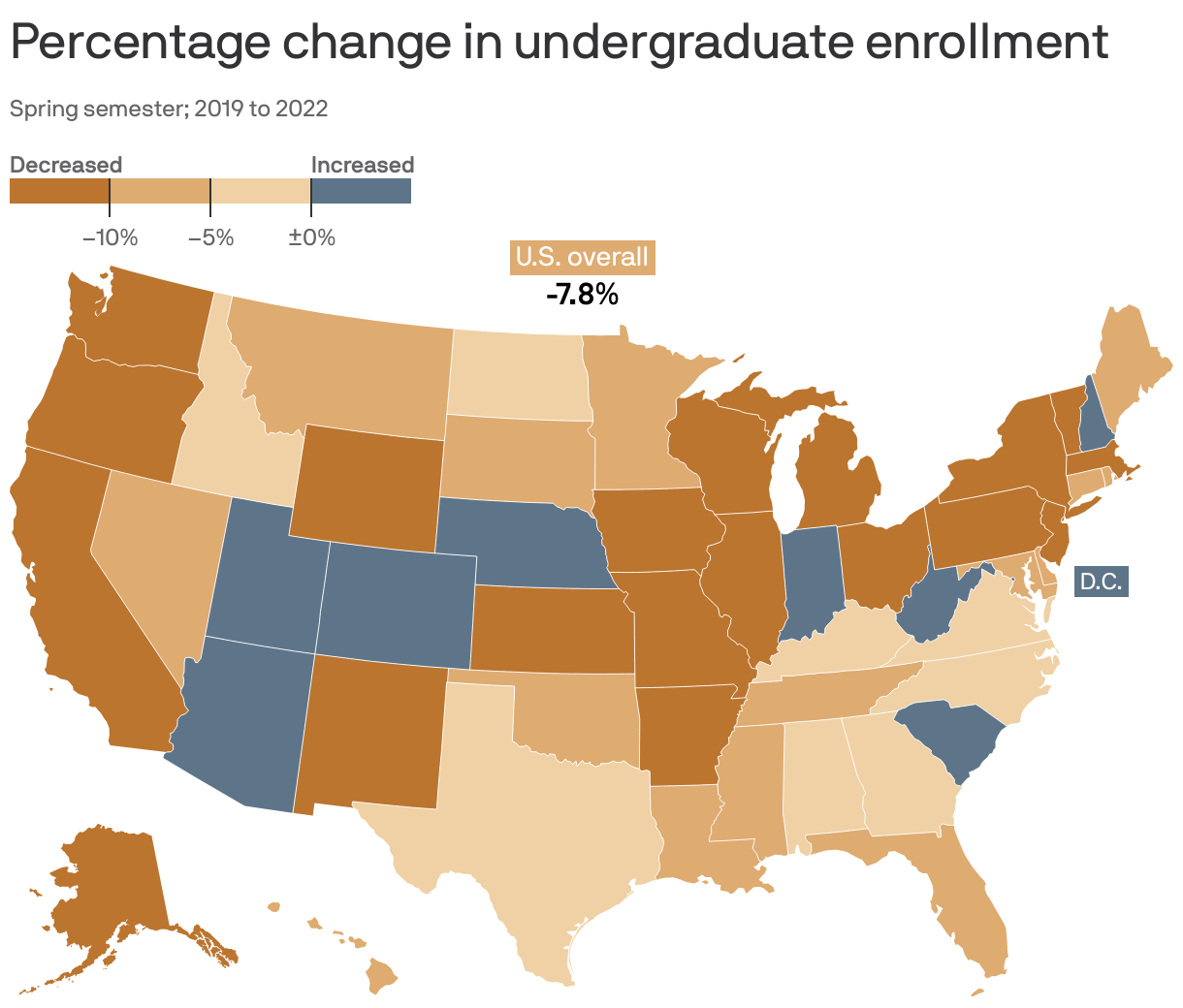
Washington's undergraduate enrollment fell 13.5% between spring 2019 and spring 2022, a much steeper decline than seen in most states since the start of the pandemic, according to recent data from the National Student Clearinghouse Research Center.
Why it matters: If the trend persists, it could force local colleges to reduce course offerings — especially at community colleges, which have taken the biggest enrollment hits.
By the numbers: Washington was one of only nine states whose undergraduate enrollment plummeted by more than 13% during the pandemic, according to the data.
- The average decline in college enrollment nationwide was 7.8%.
What they're saying: "We are actually quite concerned about enrollment across the board," said Michael Meotti, executive director of the Washington Student Achievement Council, in an interview with Axios.
- Meotti said some of the drop-off is tied to changing demographics — the state has a smaller population of 18-year-olds than in years past.
- But other factors are economic, he said, with more students putting off postsecondary education to make money in a labor market that's favorable to workers.
- "The Washington labor market has been very strong in terms of employers paying above minimum wage for what in other states might be minimum wage jobs," Meotti said.
- Compared to times when unemployment is high, Meotti added, people are "less likely to give up the paycheck in exchange for studying for six months."
Between the lines: Jan Yoshiwara, executive director for the State Board for Community and Technical Colleges, said federal relief dollars helped community colleges sustain their program offerings during the pandemic, despite a double-digit enrollment drop.
- However, "those federal relief dollars are ending, and I think there will be some challenges for colleges in the near term," Yoshiwara told Axios last week.
The big picture: Both Yoshiwara and Meotti said colleges and universities may need to adapt to combat lagging enrollment trends.
- For community colleges, that may mean offering more ways for students to complete technical certifications and trade programs remotely, Yoshiwara said.
- For four-year universities, that could mean drawing a clearer connection between the degree students are earning and the job opportunities available to them after graduation, Meotti said.
The bottom line: "Over the next three to four years, we'll see whether we are rebounding from the COVID slump, or if it's just going to continue to be like this," Meotti said.