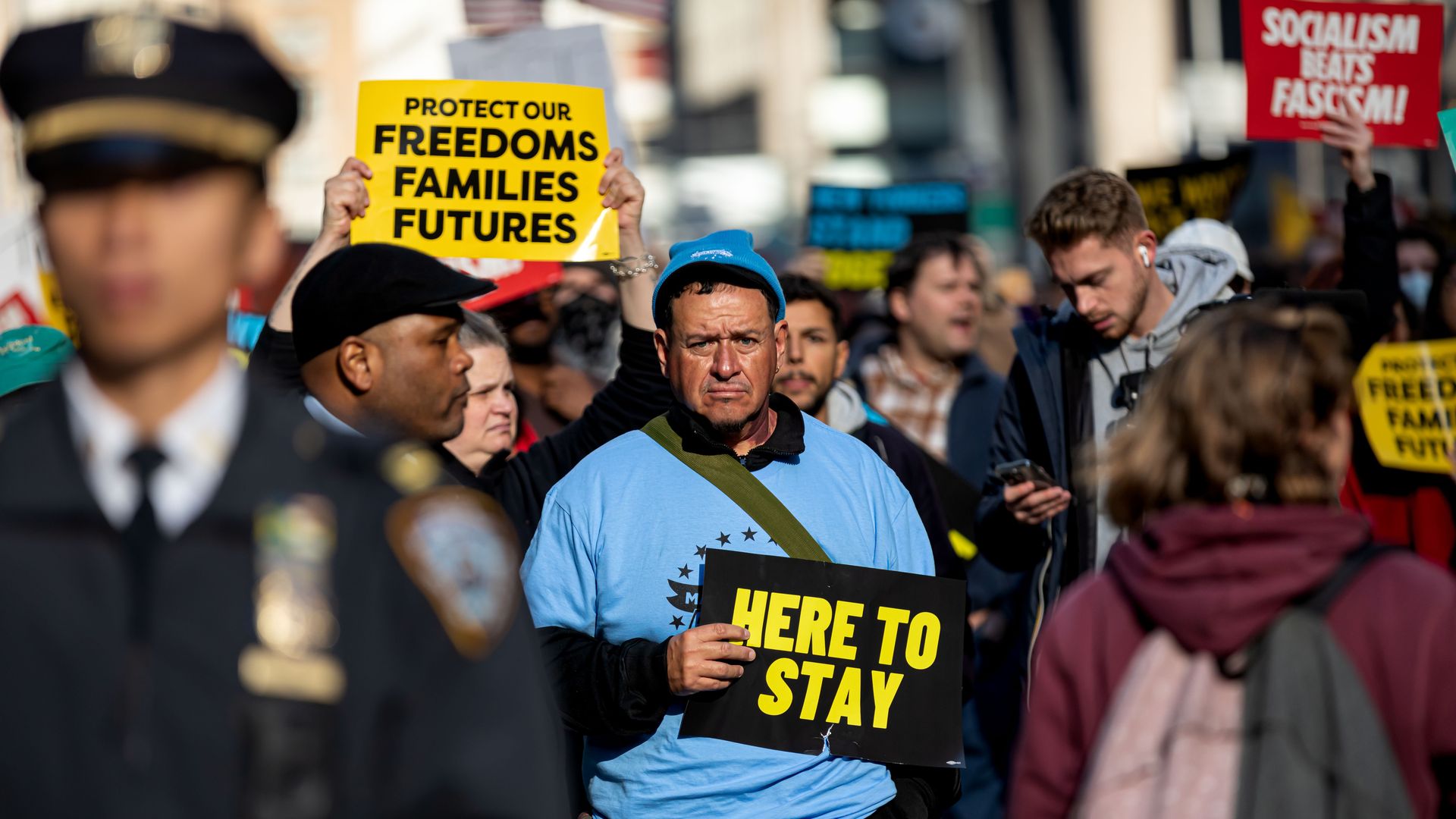
Demonstrators in New York protest President-elect Trump's planned immigration policies on Nov. 9. Photo: Michael Nigro/Pacific Press/LightRocket via Getty Images
Advocates and lawyers are making preparations to defend immigrants against mass deportations and other actions President-elect Trump has vowed to take when he resumes office.
Why it matters: Trump's proposals would gut how the U.S. has conducted immigration enforcement for decades.
By the numbers: There are an estimated 1.6 million to 2.1 million undocumented immigrants in Texas.
About 8% of Texas households include an undocumented immigrant, a three-way tie with California and New Jersey for the second highest share, per Pew Research Center.
The latest: Tom Homan, the former acting director of Immigration and Customs Enforcement (ICE) who will serve as "border czar" in the incoming Trump administration, said the agency will prioritize "the worst first" in targeted deportations.
Homan is an ally of Gov. Greg Abbott and has praised the Texas border crackdown, per the Express-News.
Homan said on "60 Minutes" that the deportations should only "be threatening to the illegal immigrant community."
What they're saying: Immigrant advocates say they've been here before and have been preparing for the possibility of a second Trump administration for years.
"We're ready to fight" mass raids and deportations "both at the legal level, at the advocacy level, and (by) going to the streets," says Maribel Hernández Rivera, director of policy and government affairs for border and immigration at the American Civil Liberties Union.
Yes, but: Trump is coming into office with more seasoned staff to carry out his goals.
Even though immigration enforcement is the job of the federal government, some of the states with the largest shares of undocumented immigrants, including Texas and Florida, have GOP governors who would likely aid deportation efforts.
The administration also can work with like-minded local police and sheriff's departments to implement 287(g), a program that allows them to turn immigrants over to federal authorities if they're arrested on suspicion of a crime.