Immigrant advocates mobilize against planned mass deportations

Add Axios as your preferred source to
see more of our stories on Google.
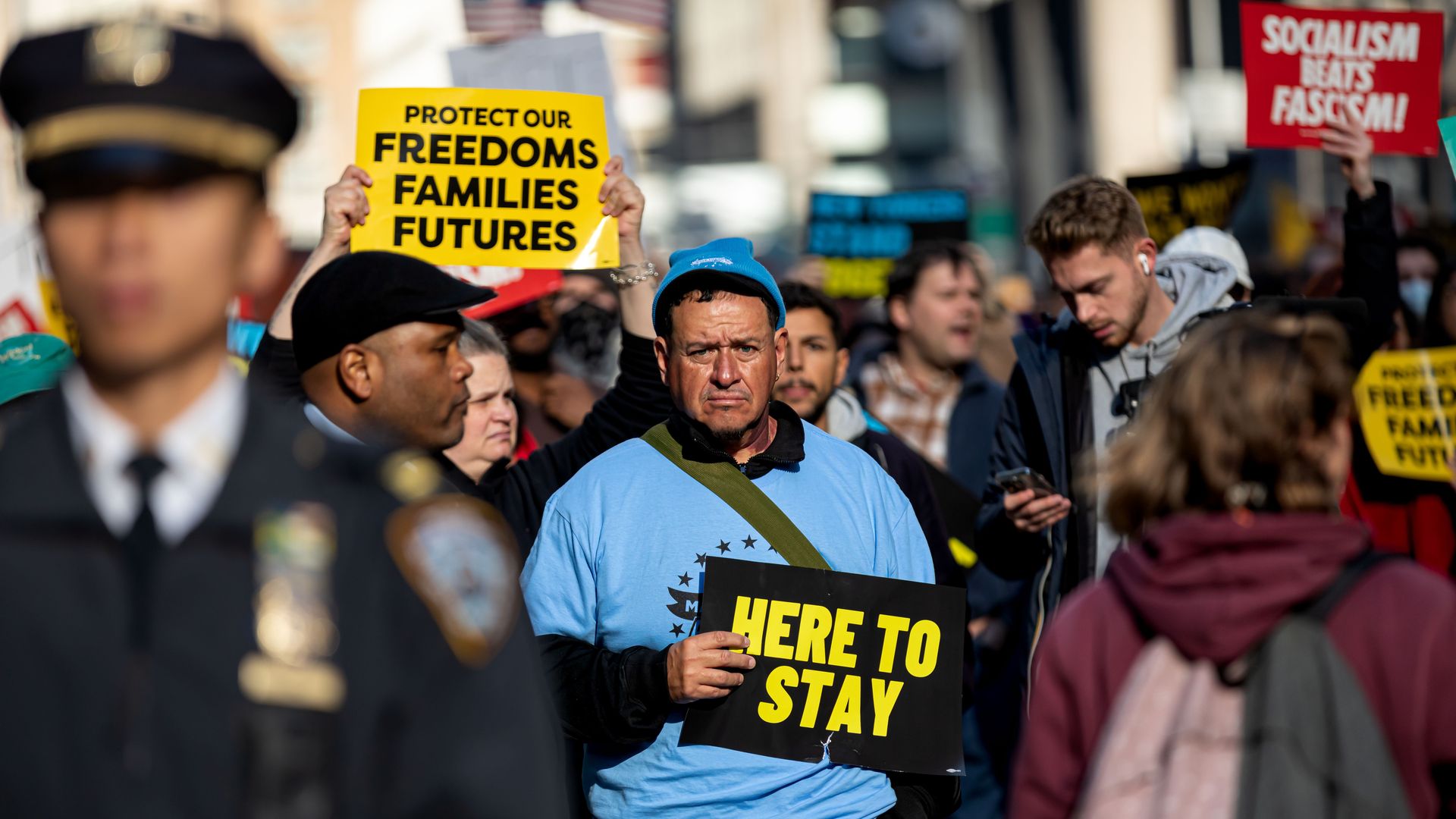
Demonstrators in New York protest President-elect Trump's planned immigration policies. Photo: Michael Nigro/Pacific Press/LightRocket via Getty Images
Advocates and lawyers are making preparations to defend immigrants against mass deportations and other actions President-elect Trump has vowed to take when he resumes office.
Why it matters: There are roughly 11 million undocumented immigrants living in the U.S. In addition to mass deportations, Trump's proposals would gut how the U.S. has conducted immigration enforcement for decades.
- He's said he intends to invoke a 226-year-old law previously used to detain "enemy aliens" in times of war.
Driving the news: Tom Homan, the former acting director of Immigration and Customs Enforcement (ICE) who will serve as "border czar" in the incoming Trump administration, said this weekend the agency will prioritize "the worst first" in targeted deportations.
- In addition to mass deportations, Trump has vowed to "seal the border."
What they're saying: Immigrant advocates say they've been here before and have been preparing for the possibility of a second Trump administration for years.
- "We're ready to fight" mass raids and deportations "both at the legal level, at the advocacy level, and (by) going to the streets," says Maribel Hernández Rivera, director of policy and government affairs for border and immigration at the American Civil Liberties Union (ACLU).
- "One of the things that we strongly believe is that when the American people realize what this threat means, they're not going to go for it."
- Hernández Rivera and others cite the first Trump administration's attempts to ban Muslims from traveling to the U.S. and the separation of parents from children at the southern border as examples of policies that ultimately backfired after overwhelming backlash.
Yes, but: Trump is coming into office with more seasoned staff to carry out his goals.
- Even though immigration enforcement is the job of the federal government, some of the states with the largest shares of undocumented immigrants, including Florida and Texas, now have GOP governors who would likely aid deportation efforts.
- The administration also can work with like-minded local police and sheriff departments to implement 287(g), a program that allows them to turn immigrants over to federal authorities if they're arrested on suspicion of a crime.
Plus, there appears to be more anti-immigrant sentiment across the country this time compared to the first time Trump was in office, says Lee Gelernt, an ACLU attorney who argued some of the most high-profile immigration cases during Trump's first term.
- That could mean less public support for immigrants and their advocates, a key part of the fight against anti-immigrant policies.
- "We're under no illusions about how difficult this will be," Gelernt says.
- Still, "notwithstanding the anti-immigrant sentiment that's pervading the country at this point, I do think there are still places the Trump administration could go, and has threatened to go, that will cause an uproar."
Between the lines: Carrying out mass deportations would be costly to taxpayers and require a large number of detention beds that don't currently exist.
- ICE is currently funded for 41,500 detention beds — largely through contracts with private prisons and local jails — and already has more than 37,000 in use, according to Transactional Records Access Clearinghouse (TRAC), a data gathering hub.
- It costs about $150 a day to hold someone in immigration detention.
- Mass deportations also carry the risk of U.S. citizens being swept up, which happened during previous mass deportations of Mexicans and Mexican Americans in the 1930s.
What to watch: Some Democratic leaders, like California Gov. Gavin Newsom have already said they will fight back against Trump's policies, including immigration.
- Greisa Martínez Rosas, executive director of the immigrant advocacy group United We Dream, says her organization will be putting pressure on local and state governments to not assist in deportations; spread information to immigrant communities about what their rights are; and mobilize supporters.
- "This is going to be a call to action, to active civil society to take action, to defend their neighbors, to defend themselves," Martínez Rosas says.
Subscribe to Axios Latino to get vital news about U.S. Latinos and Latin America.
