The many sides of Salt Lake City's 999 Ride

Add Axios as your preferred source to
see more of our stories on Google.
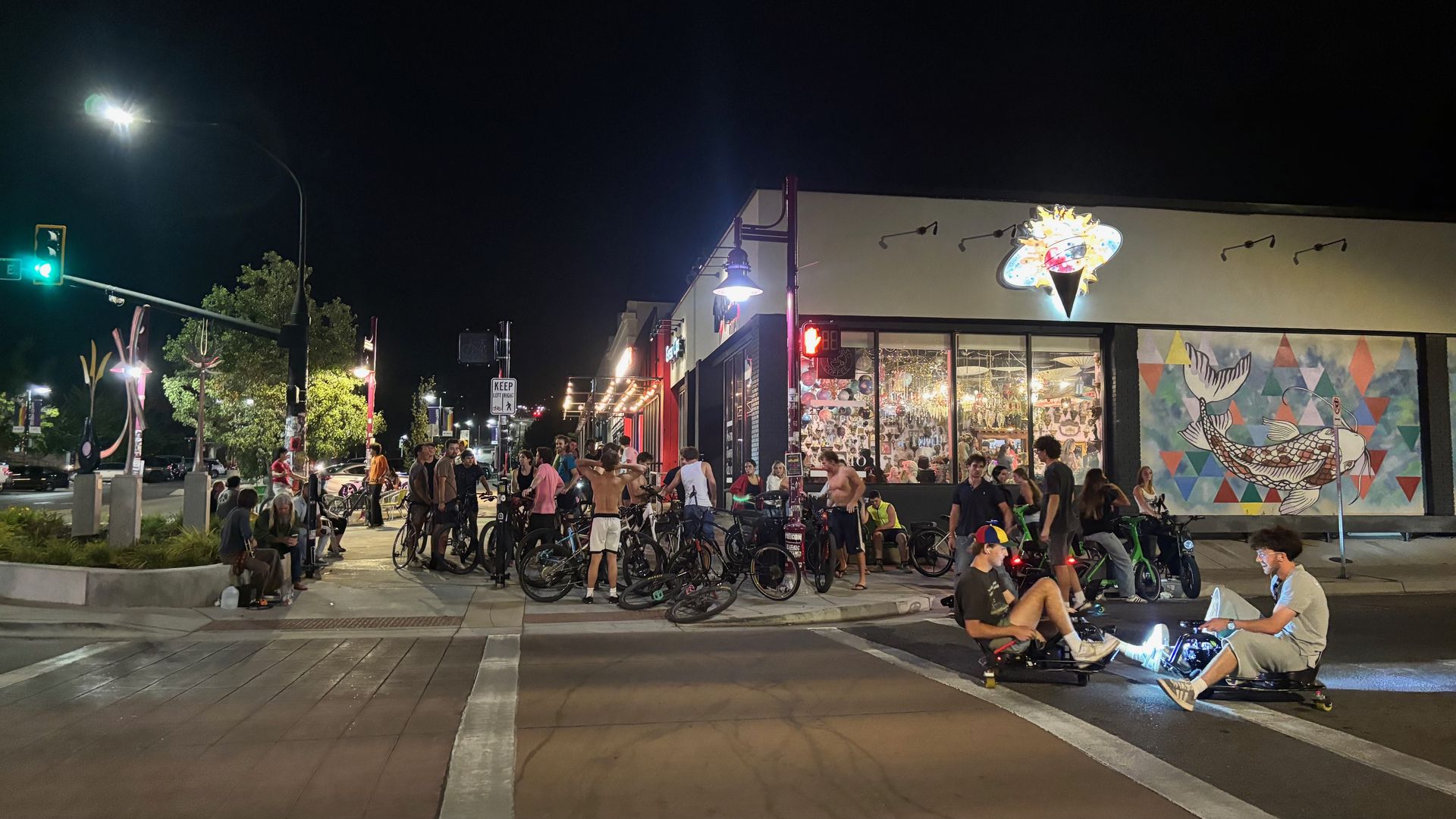
Bicylists gather for the weekly 999 Ride in Salt Lake City. Photo: Kim Bojórquez/Axios
Salt Lake City's 999 Ride is a celebration of cycling culture — and a source of frustration for riders and non-riders alike who see the weekly gathering as chaotic and disruptive.
Why it matters: Salt Lake City police have ramped up enforcement efforts during rides this summer, prompting some longtime cyclists to reconsider the tradition.
- Meanwhile, the behavior of a few has raised questions about whether its original intent has been lost as the event's popularity has exploded.
State of play: The social ride is said to have started in 2011 by two local cyclists. Today, some estimates say the event attracts between 800 and 1,500 riders.
How it works: Bicyclists roll in each Thursday night at 9pm, after the majority of businesses in the trendy 9th & 9th neighborhood have closed, to ride into the night.
What they're saying: Tiffany Phillips, who's participated for the past 13 years, tells Axios the event started off as an "art form" and a welcoming space where people would show off their creativity and hand-built bicycles.
- "It was a very intimate group," she recalls.
- Nowadays, she says it can feel like a "drunken Peloton."
- Still, the crowds haven't kept her away. It allows her to stay physically active and socialize after a busy day at work.
Andrew Welhouse, who's ridden 999 for years, tells Axios he appreciates the event's organic, community-driven nature, but increased police presence has made him less willing to participate.
The other side: Sgt. Greg Wilking, a spokesperson for the Salt Lake City Police Department, tells Axios that police haven't taken much action around the ride in the past, which is why he believes it started getting out of hand.
- He says police received "numerous" complaints of drivers getting surrounded by bicyclists and other reports of property damage, leading to increased enforcement.
- Because there's no official organizer, it can be difficult to get cyclists to follow local laws, he says.
Flashback: 999 has also been marked by loss.
- In 2018, 23-year-old Cameron Hooyer was killed after he was struck by the FrontRunner in Salt Lake City during the ride near 900 South and 600 West.
- The tragedy was a major "turning point" for the event, according to Phillips, who was there the night he died.
- Wilkins said police are trying to prevent it from happening again.
💭 Kim's thought bubble: To prepare for this story, I joined the ride for the first time last Thursday — and I'd do it again.
- I saw a colorful display of bikes decked out in LED lights. Others had giant speakers attached, blasting music.
- Most cars at red lights seemed to show respect for the crowd that stretched a city block, sounding their horns in support as riders passed through.
- I saw one person drinking a beer, and the smell of pot lingered in the air, but I didn't see any debauchery.
Yes but: If anything was disruptive, it was a group of young men riding what appeared to be a hybrid of a go-kart and a skateboard that sped in between bicyclists.
- The 999 group's Facebook page advises against bringing gas-powered vehicles, and many cyclists agree that they are a major point of contention.
The bottom line: Love it or hate it, the 999 Ride is at a crossroads. Whether it can maintain its grassroots spirit amid growing numbers remains to be seen.