To seek execution in Charlie Kirk's murder, prosecutors turn to a seldom-used provision in Utah law

Add Axios as your preferred source to
see more of our stories on Google.
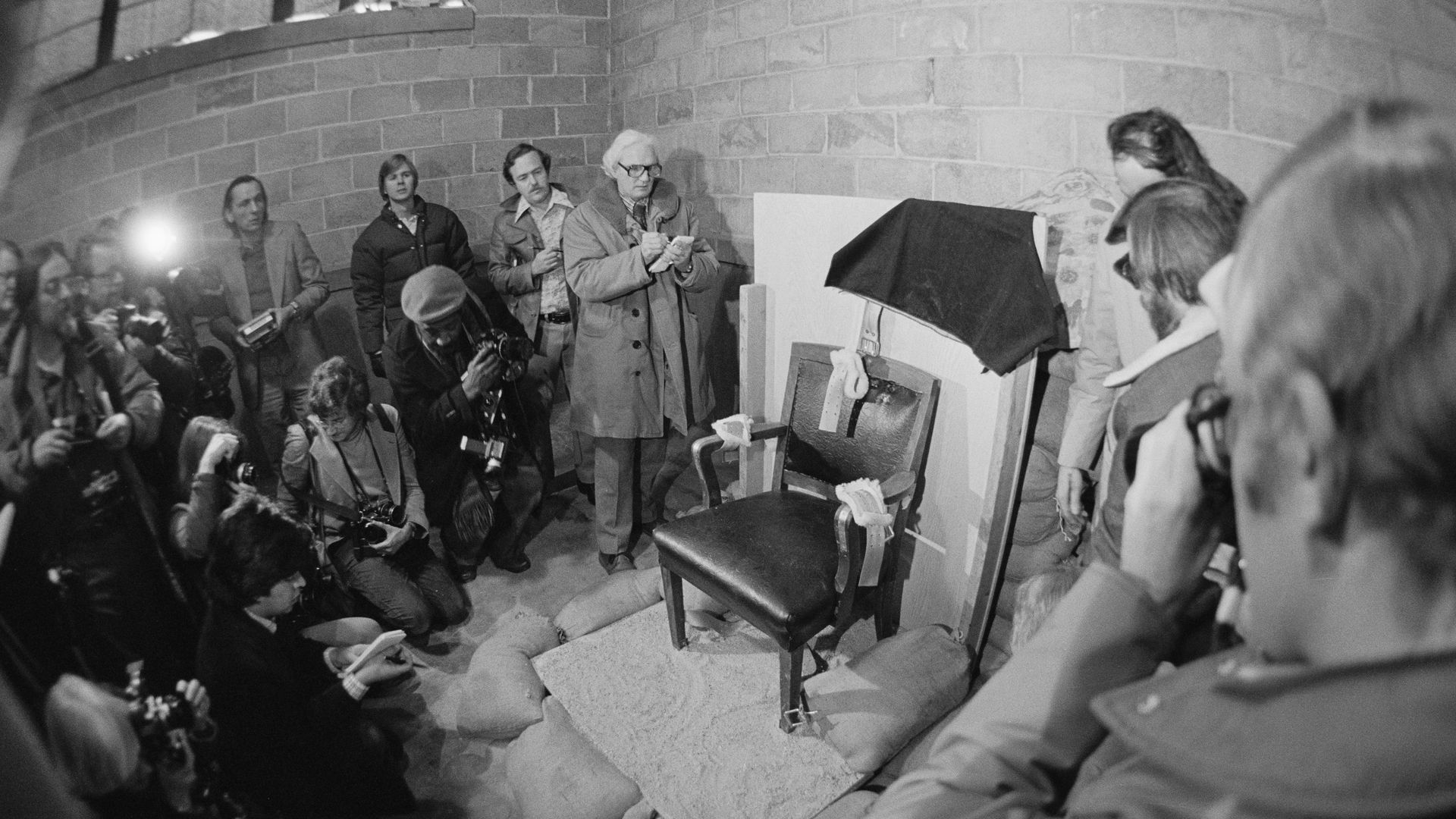
Journalists examine the chair in which Gary Gilmore was executed by firing squad in 1977 at the Utah State Prison. Photo: Getty Images
To get the death penalty in Utah, a defendant has to commit "aggravated murder" — that is, a murder that's particularly heinous, committed alongside other crimes, or involves other factors that state law deems exceptional.
Why it matters: At a preliminary hearing this week, a judge is deciding whether Tyler Robinson can be charged with aggravated murder, which would make him eligible for the death penalty if he's convicted in the fatal shooting of Charlie Kirk at UVU in September.
Zoom in: In Robinson's case, prosecutors are arguing for execution because the shooting was in a crowd and put other people at "great risk of death" — an aggravating factor under Utah law.
The intrigue: In Utah's recent history of capital punishment, it's an uncommon argument.
By the numbers: Putting others' lives at risk was an alleged aggravating factor in just two prior murder cases of 14 where the death penalty was upheld in the past 50 years:
- Ogden's notorious "Hi-Fi" murders of 1974.
- Ronnie Lee Gardner, who was executed by firing squad in 2010 for fatally shooting an attorney and wounding a bailiff while trying to escape from the Salt Lake County courthouse during a hearing for a previous murder charge in 1985.
Here are other aggravating circumstances that have played a role in Utah's death sentences:
Other crimes: The most common factor by far, at least 10 defendants were convicted of murder alongside robbery, rape, kidnapping, burglary and other charges.
- Gary Gilmore was the nation's first executionee after the U.S. Supreme Court allowed the death penalty in 1976. He chose firing squad over hanging after he was convicted of one murder and admitted to another he committed while robbing a gas station and a hotel in Utah County.
Heinous cruelty was cited in at least six cases, including the most recent one:
- Floyd Maestas was sentenced in 2008 for beating, strangling, stabbing and stomping a 72-year-old woman in Glendale. He died in prison.
There were multiple victims in at least four cases, including that of Ron Lafferty, whose 1984 murder of his sister-in-law and baby niece was the focus of the best-selling book and miniseries "Under the Banner of Heaven."
- Arthur Gary Bishop, who confessed to killing five boys ages 4 to 13 starting in 1979, was Utah's most prolific serial killer on death row — but court documents don't list that among the aggravating factors. Instead, prosecutors relied on heinousness, kidnapping and sex abuse, and Bishop's admission that he killed his first victim so the child wouldn't report him for molestation.