When Salt Lake's 1st racist housing covenants took shape

Add Axios as your preferred source to
see more of our stories on Google.
In the early 1910s, Sugar House was booming — and racist.
- This is Old News, where we trace the maps of Utah's past.
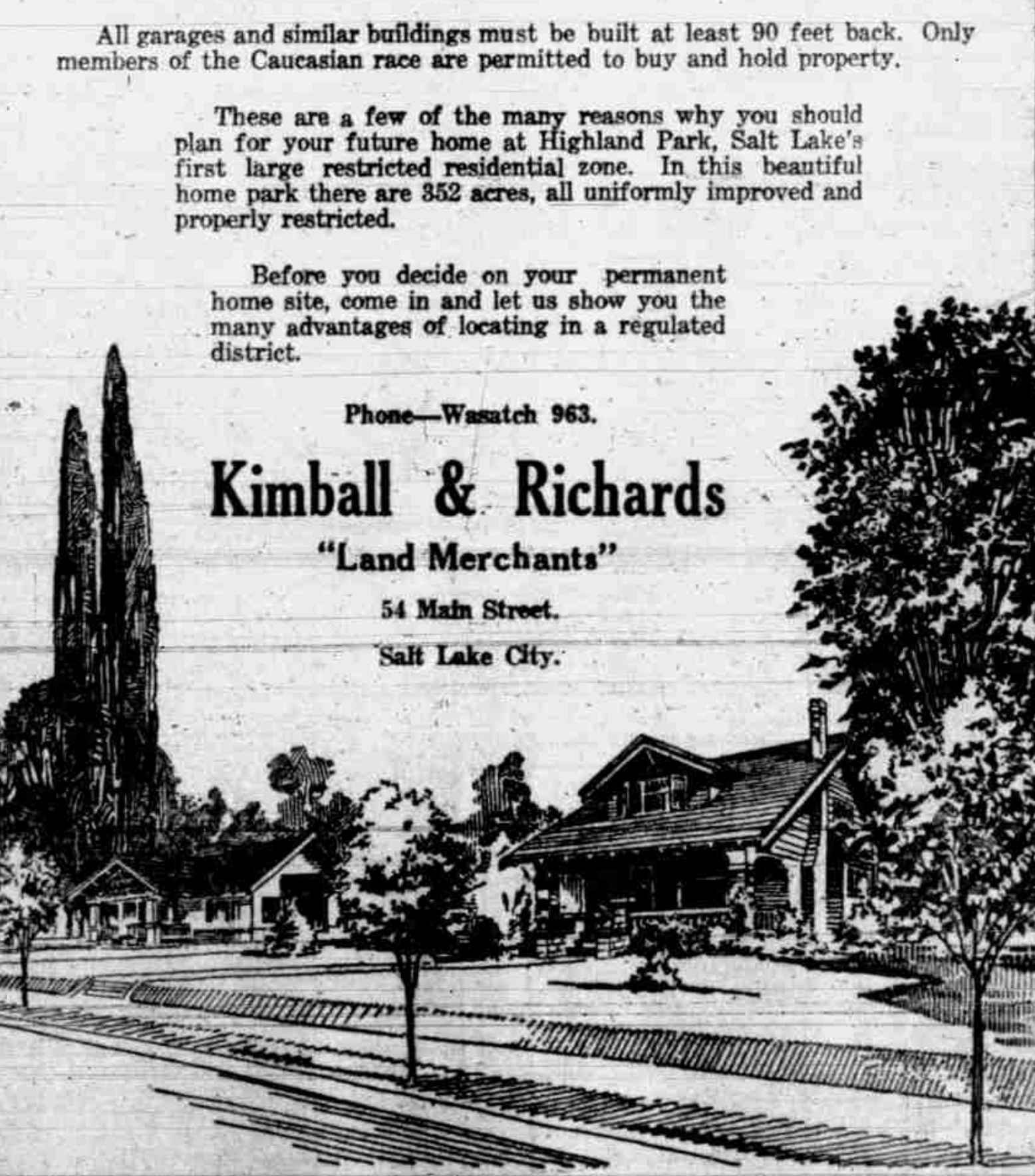
What drove the news: 113 years ago this week, housing developers began promoting whites-only housing contracts in Salt Lake.
- The developer of Westmoreland Place, now an affluent historic district near 1500 East and 1300 South, was the first to announce racist restrictions.
What they said: "This idea seems to be proving very satisfactory to would-be home builders," the Salt Lake Tribune reported in 1913. "This system of selling residence sites has been tried out in southern California with great success."
- Buyers gobbled up the lots in the following weeks, by what the newspaper described as "a better class of people."
Zoom out: The restrictions spread south, to Highland Park, where the developer Kimball & Richards bragged that such "building regulations protect your home."
The big picture: Once those contracts effectively segregated SLC neighborhoods, the city was "redlined" in the 1930s.
- The federal Home Owners' Loan Corp. drew up maps that labeled white neighborhoods "desirable" and others "hazardous" for lenders.
- That blocked families of color from homeownership and prevented investment in those communities, creating racial divides that persist today in many U.S. cities.
The latest: Racist housing covenants haven't been legally enforceable since the 1960s, but the language still appears on some property records.
- Lawmakers in 2021 created a mechanism for county recorders to revise the documents at homeowners' request.
Go deeper: When rumors of segregated zoning unleashed a torrent of racism in Salt Lake