Trump promises to refill the Great Salt Lake as Utah leaders poo-pooh conservation

Add Axios as your preferred source to
see more of our stories on Google.
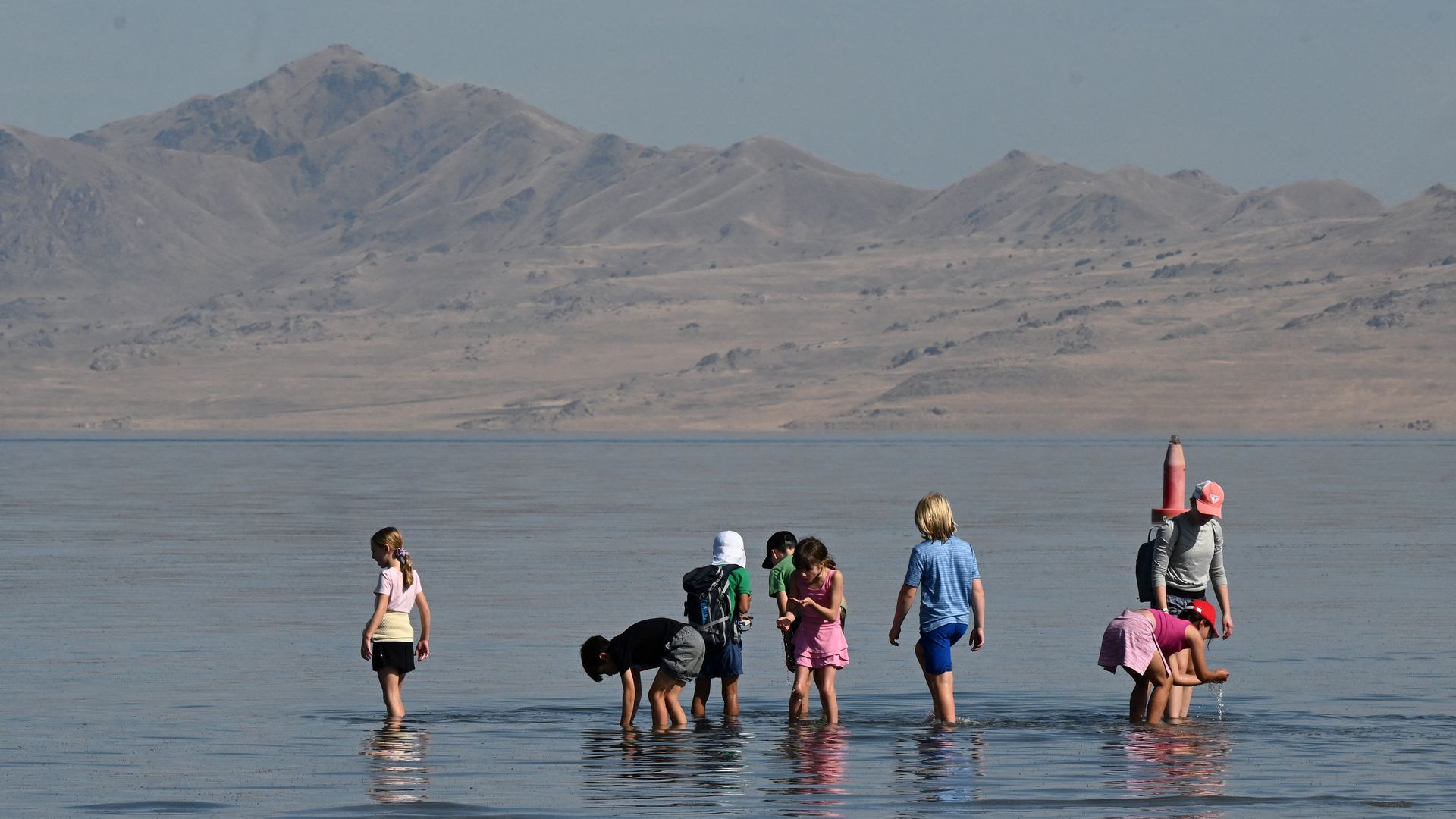
Visitors wade in the Great Salt Lake in 2024. Photo: Frederic J. Brown/AFP via Getty Images
Utah officials are preparing to ask the federal government for $1 billion to support the Great Salt Lake following President Trump's recent statement that it's "very important" to save the lake.
The big picture: Republican lawmakers are looking at measures that sidestep asking Utahns to use less water.
- "The solution simply can't be that we turn off all the faucets and we all move out of here so that all the water can go to the lake," state Sen. Scott Sandall (R-Tremonton) said Monday.
- Instead, lawmakers remain focused on ways to import water via pipelines, or funding desalination plants in California in exchange for more Colorado River shares.
What they're saying: Anyone who supports the lake "cannot oppose a pipeline," Sandall said.
- Previous proposals have included pipelines from the Pacific Ocean or the Snake, Missouri, Mississippi or Colorado rivers.
Reality check: "While water augmentation is often discussed (pipelines, cloud seeding, new reservoirs and groundwater extraction, etc.), conservation is the only way to provide adequate water in time to save Great Salt Lake," BYU researchers wrote in 2023.
- For example, the proposed Pacific pipeline would require hundreds of millions of dollars to construct and 11% of Utah's present total electrical usage to operate, researchers found.
Threat level: As water levels drop, the Great Salt Lake is on the verge of "collapse," exposing the Wasatch Front to dust and other pollution, scientists have warned.
- Like other saline lakes, the GSL is the last stop for all the water that flows into it.
- That leaves those lakes particularly vulnerable to overuse; there is no known example of a saline lake that has fully recovered after it was dried to the point of ecological collapse.
Yes, but: Utah's conservation measures in recent years increased flows into the lake by a fraction of what's needed to bring the lake back to a healthy level of 4,198 feet elevation, per a 2023 report by researchers and nonprofits across the West.
Zoom in: The sudden burst of Republican interest in the lake stands in contrast to state officials' response to an ongoing lawsuit filed by environmental groups to force the state to implement conservation measures that stabilize lake levels.
- After a state judge refused to dismiss the lawsuit last March, the Utah Attorney General's Office this week said it plans to move the case to a new three-judge panel under a law passed two weeks ago that allows the state to effectively switch courts if it's being sued.
Meanwhile, state lawmakers have repeatedly rejected water conservation measures in recent years.
Here are some that failed:
- In 2025, restrictions on inefficient high-spraying irrigation systems for new developments in counties around the Great Salt Lake were narrowly defeated in the House. Limits in the same counties on new turf grass — which requires more water than other landscaping plants — weren't scheduled for debate.
- Efforts to track water usage by golf courses failed in 2025 and 2023, when House Republicans complained the measure would "shame" the golf industry.
- After two heavy-snowfall winters, a 2024 bill asking the Great Salt Lake commissioner to create a plan to maximize flows to the lake in high-water years didn't get a House vote.
- A resolution in 2023 would have set a target lake surface elevation of 4,198 feet, but Senate Republicans blocked it in committee, saying the measure would make the lake too high a priority.
- A 2023 proposal to divert $65 million to buy water rights around the lake didn't get scheduled for debate.
The latest: Lawmakers last week passed a controversial bill that GOP proponents said would "help" the lake by streamlining water applications.
- Conservationists said it actually reduces the grounds for the state engineer to reject a water right application.