Quicksand is real — just ask this hiker in Arches National Park

Add Axios as your preferred source to
see more of our stories on Google.
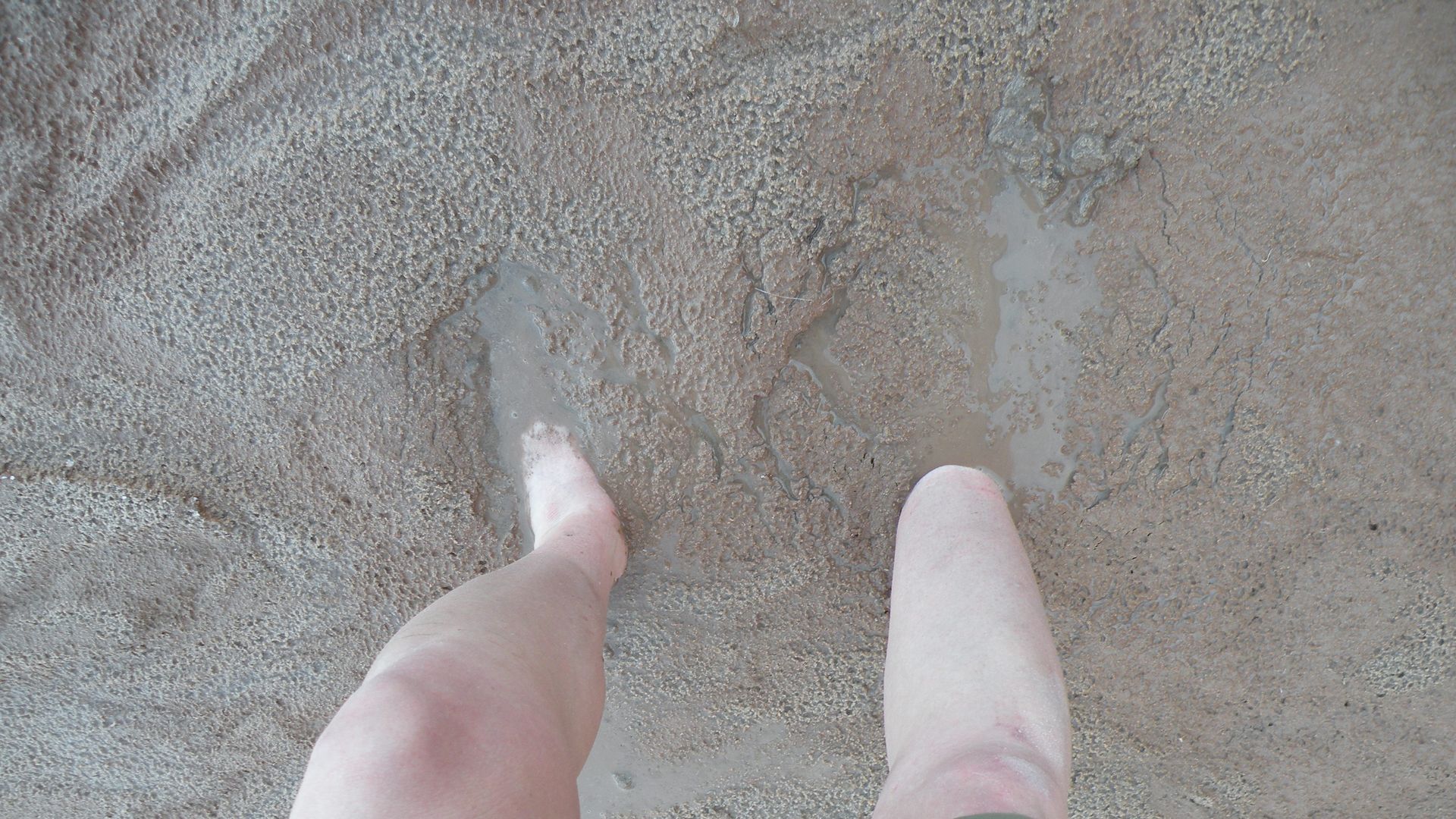
Erin struggles to free her foot from sediment in the Dirty Devil River in 2009. Photo: Erin Alberty/Axios
A hiker was rescued from quicksand last week in Arches National Park, reigniting long-dormant fears of a geologic phenomenon that once featured prolifically in films, video games and nightmares.
The big picture: Austin Dirks, a hiker from Colorado, stepped into shallow water in a remote canyon that is usually dry and felt his foot sink into the streambed, the New York Times reported.
- As he shifted his weight to free his foot, the other foot sank deeper into the mud — and stayed there, trapping Dirks in freezing temperatures as he typed a plea for help on a satellite messenger.
The intrigue: Quicksand rescues are rare, even though encounters used to be common fodder for adventure fiction, from the Atari game "Pitfall" to movies like "The Princess Bride" and "Lawrence of Arabia."
Zoom in: Quicksand occurs when grains of sand are loosely packed in the ground, usually in water, Scientific American explains.
- When disturbed by, say, a hiker, it collapses and becomes so dense the grains of sand can't be displaced by the foot's movement. In a 2005 experiment, scientists in Amsterdam learned that a trapped foot needs 100,000 newtons to be freed from quicksand — the same force required to lift a car.
- Dirks described his foot as "fixed in place as if set in concrete."
Reality check: Although quicksand can trap a person, it can't drown them.
- Bodies are less dense than the quicksand, so you could sink to your waist but probably not much farther.
The other side: Even if you don't drown, sinking to your waist in a cement-like substance is no picnic, especially if you're far from help.
Pro tip: You could potentially free yourself by adding water around the stuck body part to reduce the sediment's density and gradually wriggle out, the Amsterdam researchers said.
- I got my foot stuck years ago in the Dirty Devil River. I'm not sure whether it was definitively quicksand, but after a couple of minutes of wiggling, I felt the water loosen the soil around my foot and popped it out, muddy but in one piece.
Catch up … uh, quick: Although the reputed death traps long provided an attractive plot device, a quicksand retrospective by Slate found that the hazard mostly disappeared from entertainment in the late 1990s and early 2000s.
- Some "quicksand fans" (yes, there's a fetish) say the public became too educated on the physics of quicksand buoyancy to take its risk seriously.
Flashback: In 2014, a 78-year-old hiker was trapped for 14 hours in quicksand near the same spot as Dirks.
The bottom line: Dirk's message summoned a drone and then a search-and-rescue crew that used shovels to dig him out two or three hours after he sank into the ground.