In Trump-loving rural Utah, Dems organize around "No Kings"

Add Axios as your preferred source to
see more of our stories on Google.
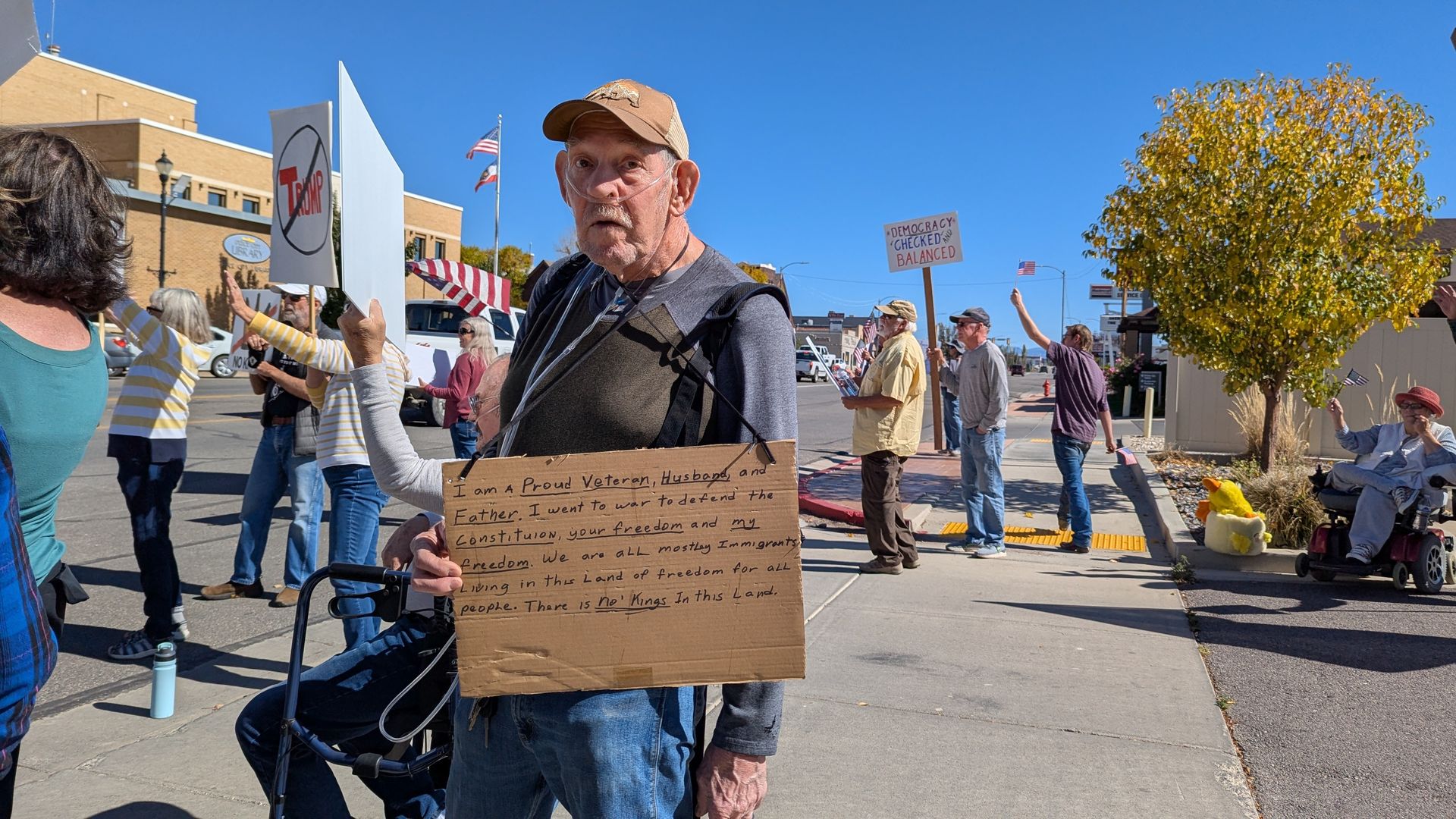
A protester holds a sign at Saturday's "No Kings" rally in Price. Photo: Erin Alberty/Axios
Far from the throngs of protesters captured in aerial views of major cities, "No Kings" rallies in deep-red Utah gathered Saturday at street corners and parks in a smaller show of dissent — but one that could make a big difference.
The big picture: Local organizers are leveraging national anti-Trump rallies as a point of first contact with sympathetic residents who typically keep their heads down and quietly cast losing votes in counties where Republicans for years have won by double-digit margins.
Why it matters: Some critics on both the right and the left have dismissed protests like "No Kings" as performative activism.
- Large rallies "attended exclusively by NPR listeners in blue cities do not impress rural voters," never-Trump Republican commentator David Brooks wrote in The Atlantic last week.
- Yes, but: In Utah's small cities and towns, participants and organizers say rallies like Saturday's have boosted participation on the left, from petition drives and volunteer recruiting, to building a sense of community and morale.
Zoom in: In Price, inflatable costumes bounced amid retired coal miners wearing oxygen cannulas as about 200 people gathered in front of the courthouse.
- Scores of passing drivers honked from their lifted pickups and farm trucks, eclipsing four or five coal-rollers and middle fingers in this onetime union Democrat stronghold where more than 70% voted for Trump in 2024.
What they're saying: "You know, you live here, and sometimes it just feels like you're totally alone," said Wayne Jensen, a Price software developer who grew up in neighboring Emery County. "And then you come to this and see all these people driving by, cheering, honking, and it gives me hope."
Between the lines: Rallies like No Kings give dissenters more safety in numbers to speak up, Jensen said.
- "You kind of assume that more of them are Republican than they actually are because there's a risk of being discriminated against on the job, or being judged in church or whatever," said Jensen, who noted he was fired as bassist from his local rock band over politics.
- In Box Elder County, where Trump won 78% of the vote, some fear being ostracized by their faith communities if they vocally oppose him, county Democratic Party chair Shannon Barton told Axios. Some of Saturday's protesters in nearby Logan told her they wore costumes to stay anonymous, she said.
By the numbers: After sharing contact information at June's No Kings rally, Carbon County Democrats' monthly meetings suddenly grew from a lonely eight to 10 diehards, to 20-30 regular members, party chair Allan Sumnall told Axios.
- "Now we're starting to be able to raise a little money, to start doing a few more things," Sumnall said, pointing to a bearded protester holding a sign. "He showed up to that [June rally], and he became our IT guy. He's helping us do all the web design."
Zoom out: At other rallies Saturday, groups staged breakaway meetings opposing Medicaid cuts and Republican efforts to retain advantage as the state redraws Congressional maps, said Kael Weston, chair of the Utah Democratic Rural Caucus.
- At Kanab's rally, a man reached out to local Democrats to discuss running for office, said Kane County party chair Caralee Woods. Simply recruiting a candidate is a breakthrough in a population of 8,500 that went 73% for Trump, Woods told Axios.
Flashback: Union leaders said springtime anti-Trump rallies were instrumental to their successful signature-gathering campaign for a ballot measure to restore collective bargaining rights to public employees.
The intrigue: In Price, no single issue dominated protesters' concerns. Jim Hill, a registered Libertarian from Castle Dale, cited Jan. 6, 2021, as his tipping point. His wife, Debbie, balked at rising anti-immigrant sentiments in a county where immigration was historically a point of pride.
- Tony Kourianos, who worked 40 years at the Deer Creek mine, said he was wary of eroding worker protections. He pointed to hundreds of names carved into the miners' memorial across the street. "I was standing next to some of those folks when they died."
The bottom line: The older protest crowd in Price was broadly united in support of rights and guarantees they remember living without, like credit cards for women and schools that serve kids with disabilities.
- "Now the Trump administration is messing with ... the Department of Education," said Kimberly Clark, a party delegate from Carbonville, who grew up attending private school because she had cerebral palsy before the disability laws of the 1970s.
- "I'm standing up for it all," Clark said. "I just see it as my civic duty."