Utah's power costs spike 15%

Add Axios as your preferred source to
see more of our stories on Google.
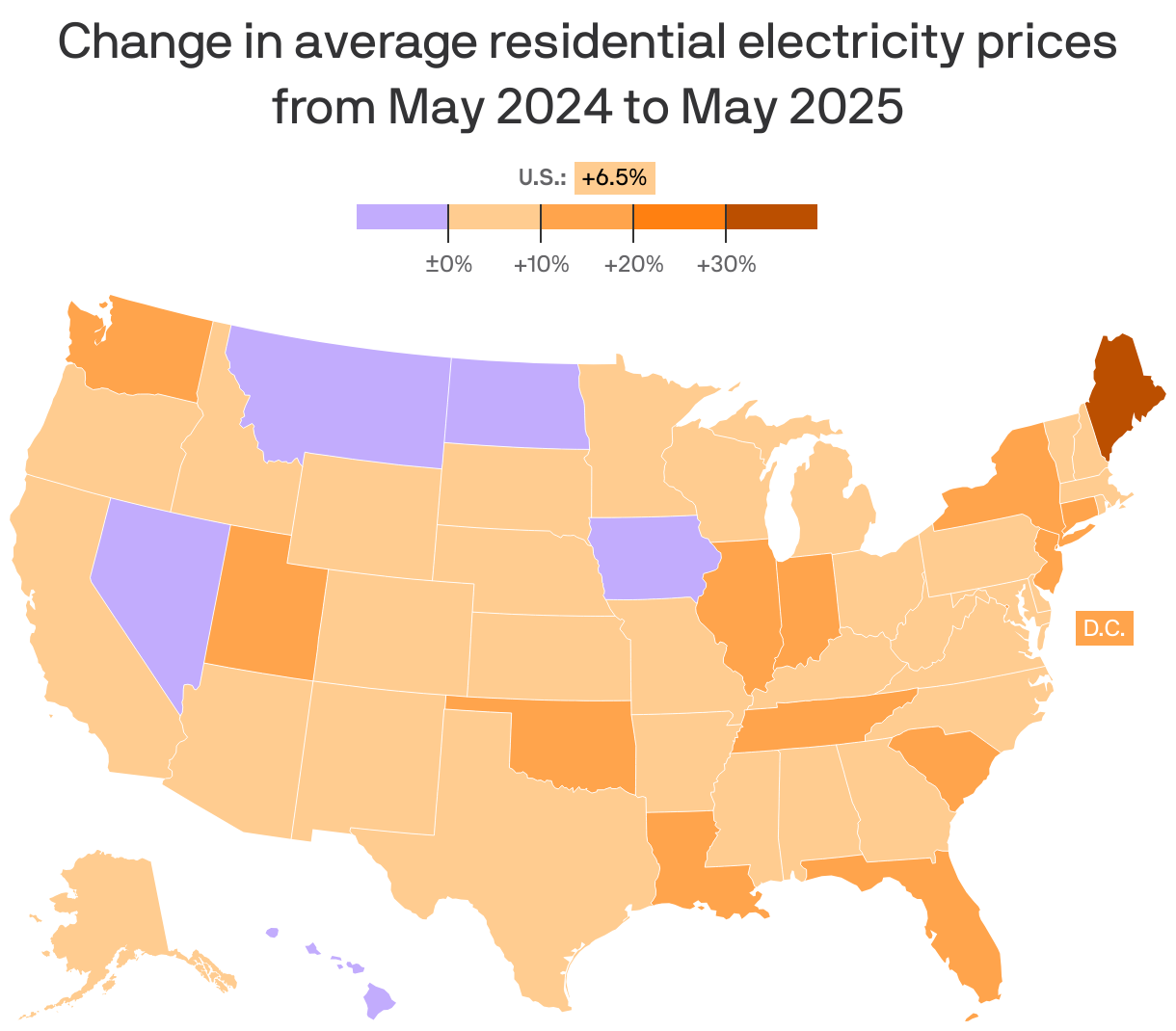
Utah saw one of the nation's highest jumps in electricity costs in the past year.
The big picture: Power costs are rising nationwide — and could get even higher for some amid an explosion in data centers powering AI and more.
Why it matters: High utility bills could further stress many Utahns' budgets as pretty much everything else gets more expensive, too.
- The state's consumer sentiment dropped almost 5% last month, per the University of Utah's Kem C. Gardner Policy Institute report.
By the numbers: The nationwide average retail residential price for 1 kilowatt-hour of electricity rose from 16.41 cents to 17.47 cents between May 2024 and May 2025, per the latest available data from the U.S. Energy Information Administration. That's a gain of about 6.5%.
- Utah's power costs climbed 15.2% during that time, the third-highest spike in the nation.
- Maine (+36.3%) and Connecticut (+18.4%) saw the largest increases.
- Just five states experienced a decrease, including Nevada (-17.7%) and Hawai'i (-7%).
Zoom in: With electricity costs on the rise, Rocky Mountain Power, the state's largest utility, is seeking to hike residential rates.
- The company proposed a 30.5% rate increase in July 2024, citing "inflationary pressures," Utah News Dispatch reported.
- The request was later revised to an 18.1% uptick after drawing sharp criticism from state Republican leaders, including Gov. Spencer Cox.
- Last month, the Utah Public Service Commission reaffirmed its approval of a modest 4.7% rate bump after the utility requested a review.
What we're watching: Rocky Mountain Power filed an appeal to the Utah Supreme Court in June.
Between the lines: Electricity prices vary regionally and have many influences, from basic supply and demand to fuel rates and infrastructure costs.
- Yet many analysts point to power-hungry data centers as a driver of rising rates, especially in hotspots.
What's next: President Trump's administration is pushing "coal, natural gas, nuclear and hydropower plants to feed AI demand," Axios' Daniel Moore reports — but is hostile toward wind and solar.
- Adding a new power source of any kind, meanwhile, takes time and money.
The bottom line: Many of us are paying for the AI boom, whether we use the tech or not.