Superintendents are ditching Utah schools

Add Axios as your preferred source to
see more of our stories on Google.
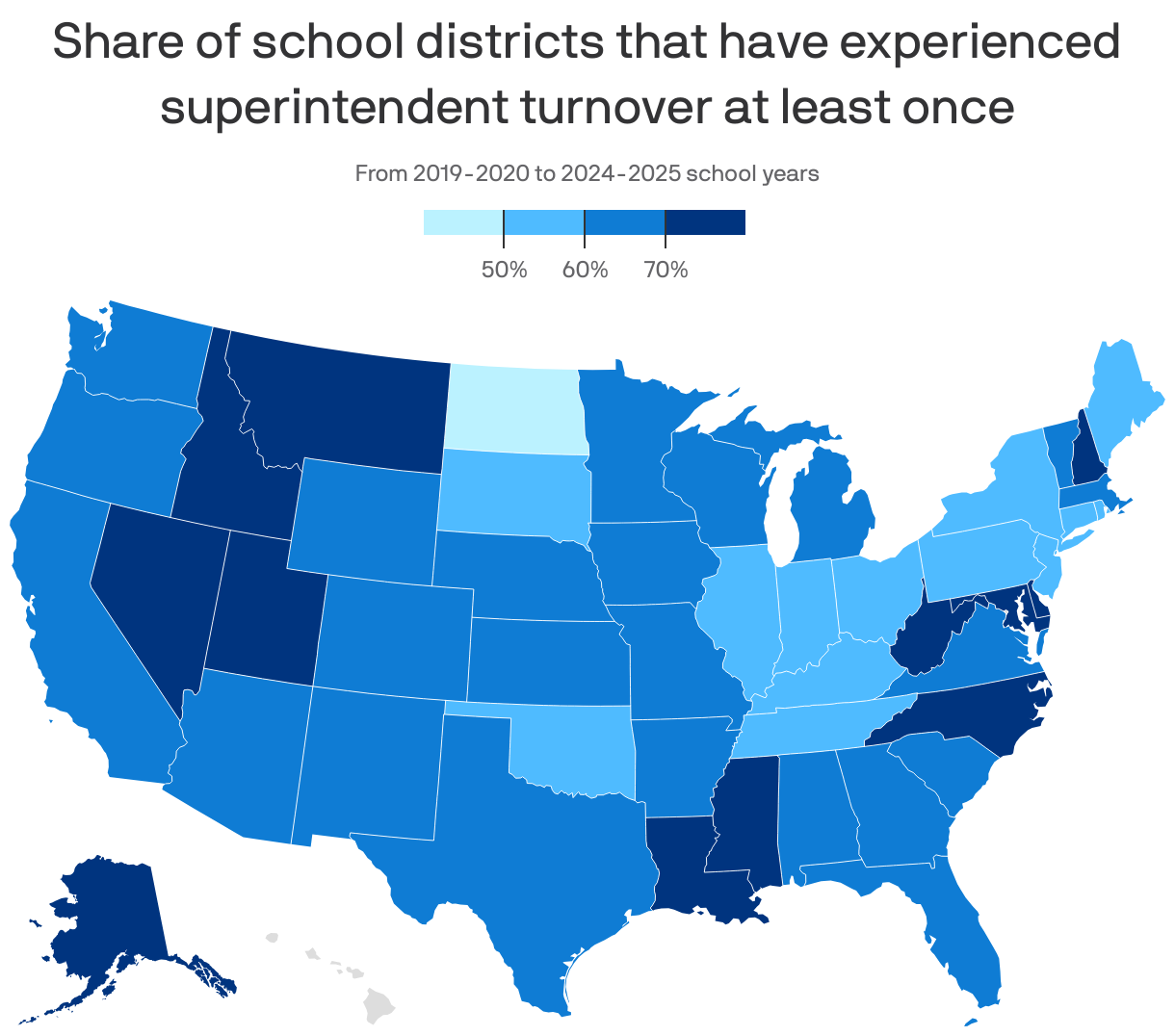
Utah has one of the nation's highest turnover rates for school superintendents.
Why it matters: Frequent leadership turnover is often a cause — or symptom — of broader instability in a school district.
- Districts often struggle to adopt and stick to long-term, effective plans if the person in charge keeps changing, education advocates say.
By the numbers: More than 70% of Utah's public school districts had at least one new superintendent between 2019 and 2024, according to national data collected by Superintendent Lab and reviewed by Axios.
- That's the 10th-highest rate in the nation.
Case in point: Salt Lake City School District has had five superintendents since 2019.
- That includes two interim superintendents between three permanent hires.
Catch up quick: The most recent upheaval came after Timothy Gadsen III — the first Black superintendent of a Utah district — was placed on leave in 2022, leading to allegations of discrimination. He later resigned.
- Before that, former superintendent Alexa Cunningham abruptly resigned along with her business administrator in 2020 after a heated closed-door meeting in which a board member said Cunningham was forced out.
Threat level: Politically contentious firings and resignations can be particularly damaging to a district, according to Rachel White, an education policy scholar at the University of Texas in Austin.
- They often involve costly legal settlements and attorneys fees, White noted earlier this year in an interview with the National Education Policy Center.
- A district may struggle to fill the position if potential candidates fear it's a high-drama environment.
- Districts that appear to be embroiled in controversy may also struggle to win community support when bond issues and levies appear on a ballot, she said.
Context: The high attrition rate comes as the Trump administration wants to dismantle the U.S. Department of Education and as districts nationwide struggle with teacher shortages and falling test scores.
Caveat: Researchers have found small declines in academic performance in the years after superintendents leave.
- But it's unclear whether those declines are related to superintendent turnover or a result of the same conditions that prompted the district's leader to leave in the first place.
- States with high percentages of students in poverty and lagging student achievement often have some of the highest superintendent turnover rates, according to the Superintendent Lab data.
Between the lines: The types of disruptions caused by leadership turnover — changed priorities, lost institutional knowledge, lower staff morale, and stalled initiatives and programs — might not show up immediately in test scores.