Pew: Utah's religious "nones" rise; Christianity — including Mormonism — declines

Add Axios as your preferred source to
see more of our stories on Google.
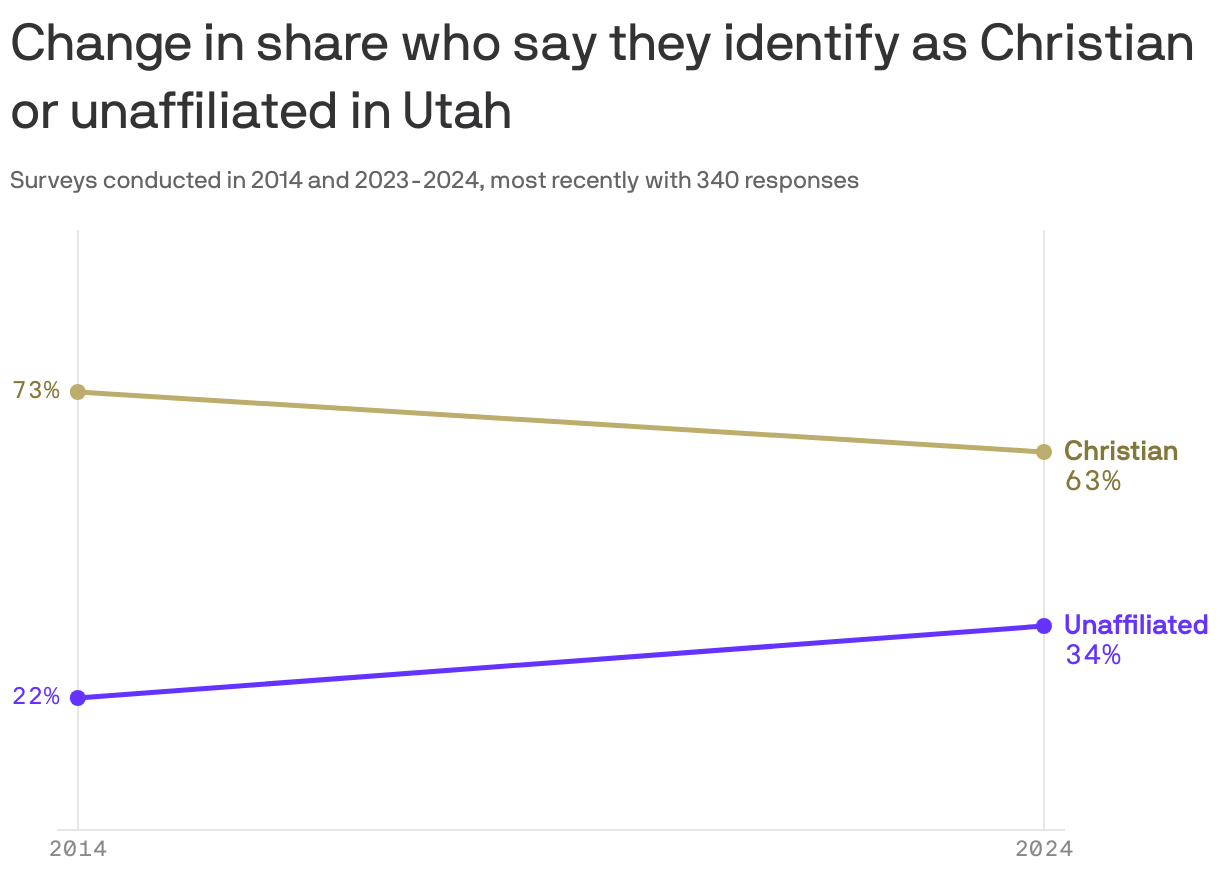
Utahns in a major study were likelier than Americans as a whole to say they were religiously unaffiliated — even though the state is widely considered the most religious.
The big picture: 34% of Utah respondents identified as atheist, agnostic or "nothing in particular," according to Pew's Religious Landscape Study, which surveyed more than 35,000 Americans about their religious and social beliefs in 2023 and 2024.
By the numbers: That's higher than the national average of 29% and up 12 points from 2014, when Pew last conducted the survey.
- 63% of Utahns identified as Christian, down 10 percentage points from a decade earlier and just 1 percentage point higher than the national average.
Zoom in: Latter-day Saints made up 50% of Utahns surveyed, down from 55% a decade earlier.
- Among other Christians, evangelicals saw the biggest declines, from 7% to 4%. Mainline Protestants and Catholics — 6% and 5% of Utah respondents — each lost a percentage point.
Zoom out: "This is a broad-based social change," says Alan Cooperman, the director of religion research at the Pew Research Center.
- "We've had rising shares of people who don't identify with any religion — so-called nones — and declining shares who identify as Christian, in all parts of the country, in all parts of the population, by ethnicity and race, among both men and women, and among people at all levels of the educational spectrum," he says about the survey findings.
Caveat: What researchers call a "secular surge" has plateaued in the last four years.
Between the lines: A significant portion of U.S. adults (35%) have switched religion since childhood, according to the study.
What we're hearing: "It's not surprising," Penny Edgell, professor in the sociology department at University of Minnesota, tells Axios.
- "I think if you're more progressive, you might look at religion and say that the mainstream religious institutions don't reflect my values," particularly when it comes to topics such as LGBTQ+ inclusion, she says.
Case in point: Fewer self-described liberals say they're Christian (37% — down from 62% in 2007) than are religiously unaffiliated, according to the Pew data.
- There's been a much smaller decline among self-described conservatives: from 89% identifying as Christian to 82%.