Utah's Indigenous population counts are skyrocketing

Add Axios as your preferred source to
see more of our stories on Google.
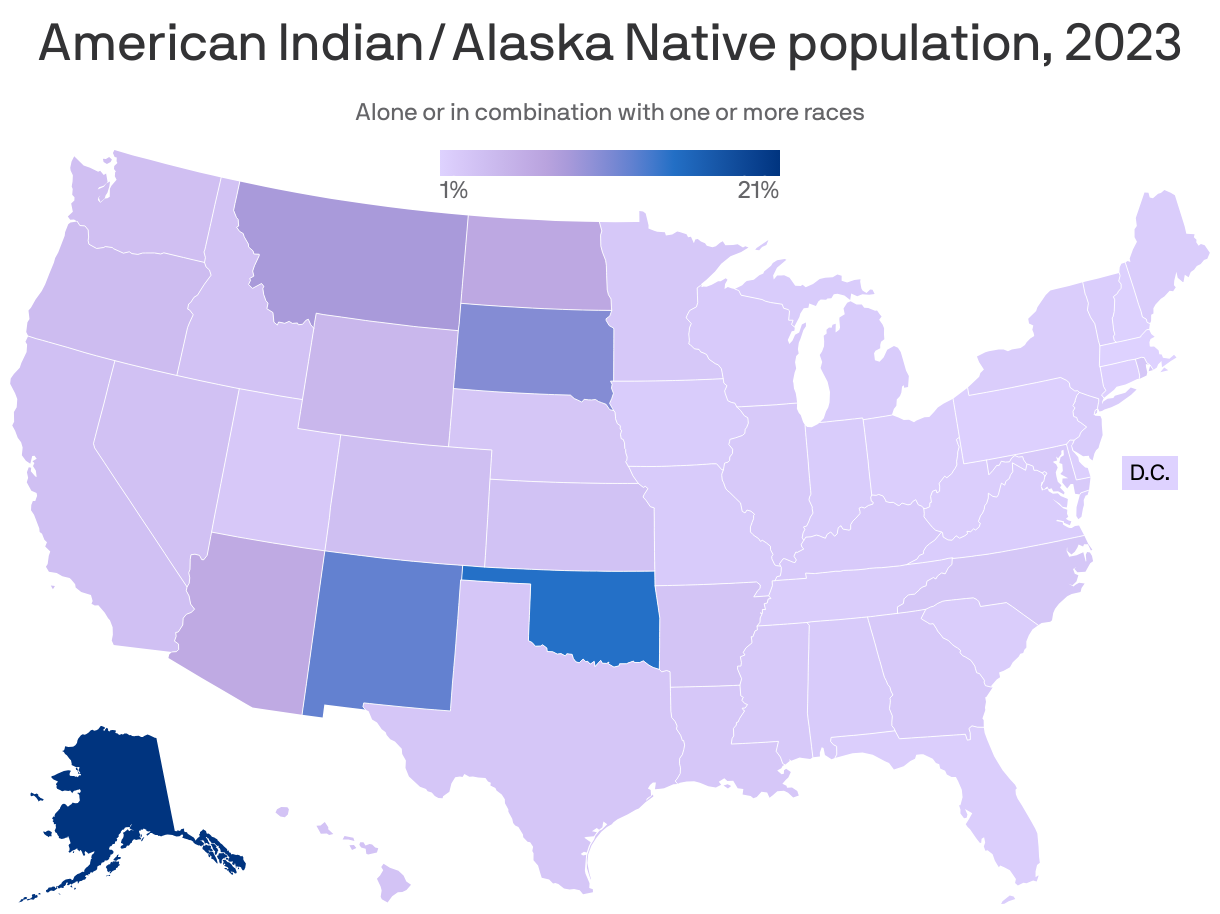
Nearly 79,000 Utahns — 2.3% of the state's population — identify as American Indian, per 2023 census data.
The big picture: Utah's estimated Indigenous population is growing sharply, even by conservative estimates.
- Annual census calculations based on five years of data show the number of Utahns identifying as American Indian or Alaska Native grew by nearly 50% in the past decade or so.
Between the lines: Federal counts of Indigenous Americans have skyrocketed nationally in recent years — a phenomenon that demographers largely attribute to how respondents are describing their race or ethnicity.
- The 2020 Census began collecting more data about Americans' ancestry, the Washington Post found, leading to a rise in people identifying their American Indian family ties.
The intrigue: While Utah's share of Indigenous residents ranks squarely in the middle of U.S. states, it's at the very bottom of all western states.
Driving the news: November is national Native American Heritage Month — a good time for all of us to brush up on Utah's own Indigenous communities.
By the numbers: Utah has eight federally-recognized, sovereign nations, representing five tribal cultures: Goshute, Paiute, Ute, Shoshone and Diné/Navajo.
- Salt Lake County has the state's largest Indigenous population (28,000), followed by Utah County (11,899).
Yes, but: Detailed county-level census data from 2022 show the most concentrated populations are closer to tribal lands.
- San Juan County, which includes part of the Navajo Nation and the Ute Mountain Ute community near White Mesa, was 48.7% Indigenous.
- Communities also are found in four counties that include or are near the Uintah and Ouray Reservation: Uintah (8.4% American Indian), Duchesne (5.1%), Daggett (4.7%) and Grand (4.3%)
- Rich County (4.1%), historically the home of Shoshone and Ute people, is nearest to the Northwest Shoshone Reservation in Box Elder County.
Zoom in: The 840 citizens of the Paiute Indian Tribe of Utah are more geographically dispersed, in keeping with the culture's history in a vast, ecologically varied area around southwest Utah.
- The tribe is divided into five bands that operate independently of the central government, with land on 10 parcels scattered from the high aspen groves near Fish Lake to the vibrant red rock of Washington County.
Caveat: Utah also has a significant indigenous Hawaiian population, which is counted among Pacific Islanders, not American Indians — even though Hawaii is an American state.
- While the U.S. has recognized the sovereignty of Indigenous tribes and nations in other states, that has not extended to Hawaii — and Indigenous Hawaiians themselves are divided on federal recognition.
Zoom out: Massachusetts, home to the celebrated first Thanksgiving at Plymouth Rock, now has the nation's smallest share of Indigenous residents at 1.08%.
- Alaska has the largest at more than 20%.