Utahns are driving way more than before COVID


Add Axios as your preferred source to
see more of our stories on Google.

Illustration: Annelise Capossela/Axios
Drivers in the Salt Lake metro are putting on far more miles now than they were before the COVID-19 pandemic.
Why it matters: Driving plummeted during the pandemic as people sought to "stop the spread," offering cities a unique chance to get a handle on transportation-related emissions — but we didn't seize the moment.
- The lost opportunity is especially painful along the Wasatch front, an area where people with health problems are told to stay indoors and schools cancel recess to protect children on poor air quality days.
Driving the news: Average daily vehicle miles traveled (VMT) per capita increased 20.14% in the Salt Lake metro from spring 2019 to this year, per a new report from StreetLight Data, a transportation analytics firm.
- Other Utah metros were up even more, with a 21.42% rise in Ogden-Clearfield and a whopping 32.7% in Provo-Orem — the sixth-sharpest rise of the nation's 100 largest metros.
Zoom out: Nationally, per-capita VMT rose 12.3% across the those 100 metro areas.
- It increased the most in McAllen, Texas (+67.6%); Boise, Idaho (+57.8%) and El Paso, Texas (+42%).
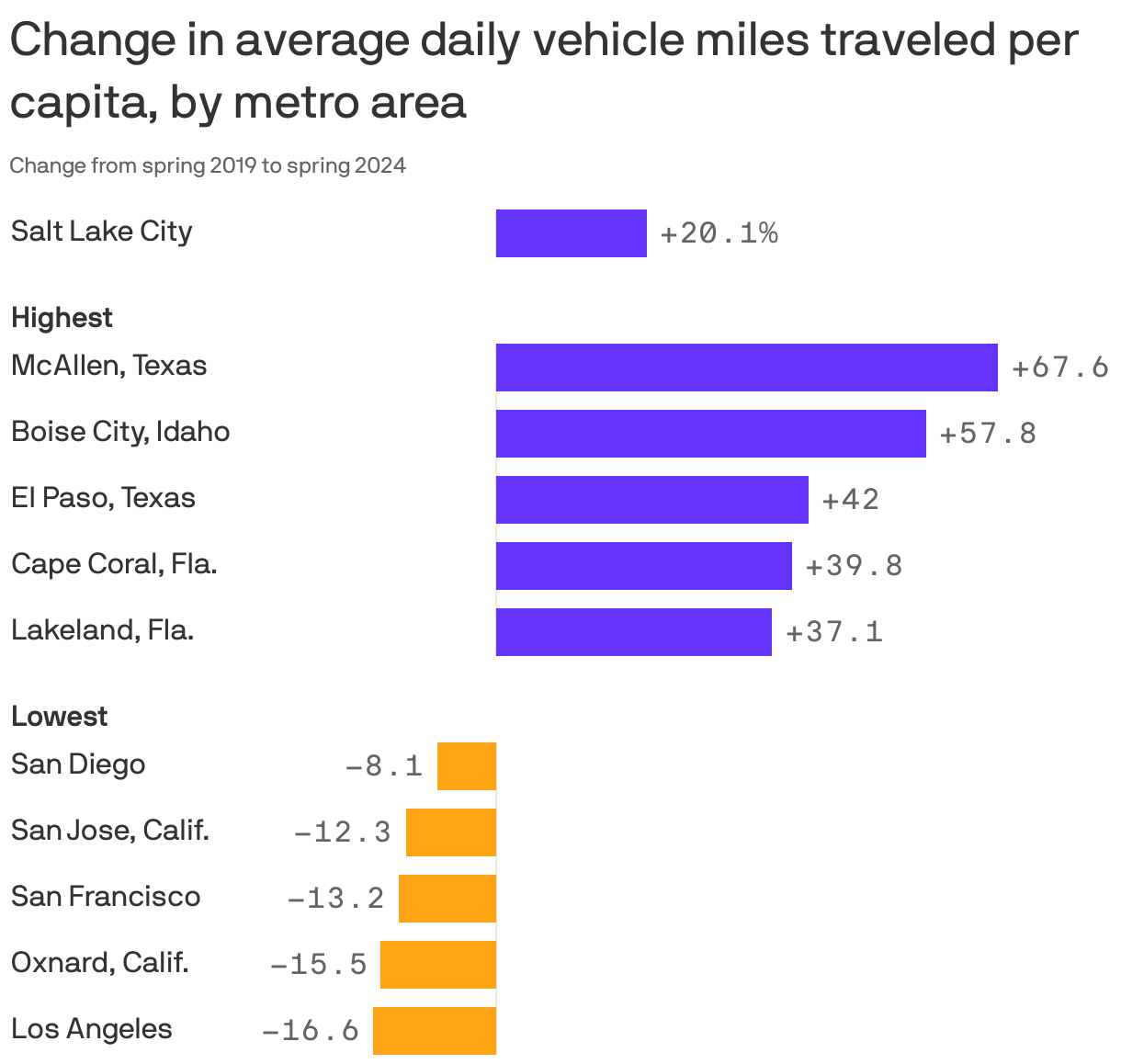
The other side: The metros with the biggest reductions in VMT per capita are concentrated in California, like Los Angeles (-16.6%), San Francisco (-13.2%) and San Jose (-12.3%).
- Standouts elsewhere include Springfield, Massachusetts (-6.1%); Memphis (-4.1%) and the Twin Cities (-2.9%).
The intrigue: Salt Lake is doing better than most other cities when it comes to approaches to clean transportation, like mass transit ridership, walking and biking, and EV adoption.
Between the lines: While higher VMT tends to mean more vehicle-related emissions, it can also be a sign of changes generally perceived as positive, like more economic activity.
The bottom line: "It's not just that [VMT] is back up, but we're actually seeing a bit of an acceleration compared to the previous couple of years," Emily Adler, director of content at StreetLight, tells Axios.
- "So that suggests that we're not peaking, that whatever efforts we've strived for to keep VMT down, they're not quite working — or they're not working yet."