Cooling demand in Salt Lake City schools rising amid high temperatures


Add Axios as your preferred source to
see more of our stories on Google.
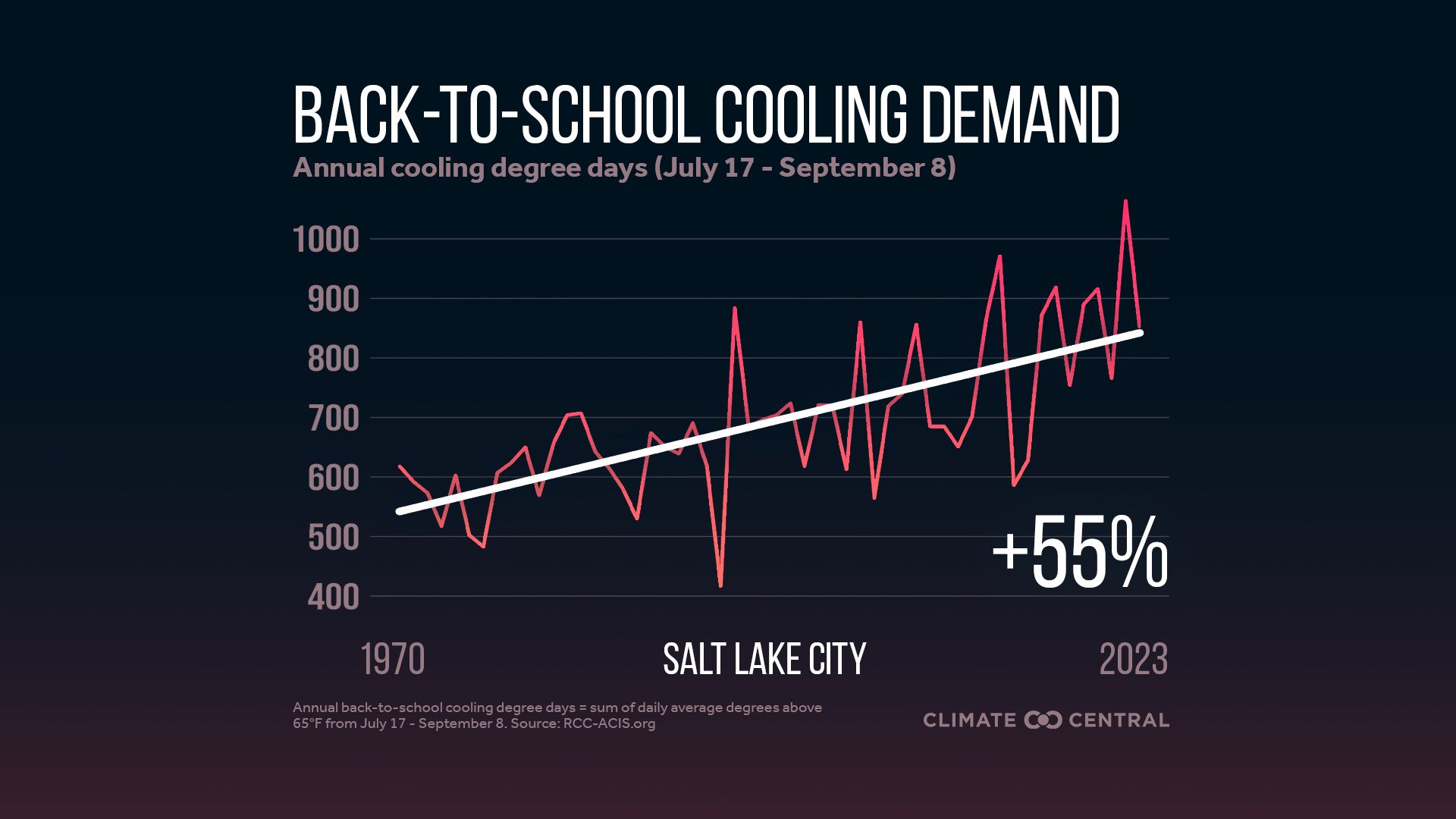
Courtesy: Climate Central
Classrooms nationwide need more cooling during the back-to-school season now compared to past decades, a new analysis finds.
Why it matters: Maintaining a comfortable and healthy environment in schools is key to kids' educational success, but that's getting harder amid a warming climate.
- Children are more susceptible than adults to extreme heat because their bodies are smaller compared to their skin surface, per the EPA.
Driving the news: A Climate Central report finds that cooling demand between late July and early September increased in 95% of nearly 250 U.S. locations analyzed between 1970 and 2023.
- The nonprofit climate research group's analysis is based on a metric called "cooling degree days" (CDD), which measures the difference between a location's daily average outdoor temperature and 65°F — "considered the ideal indoor temperature," per the report.
- For example: A day with an average temperature of 90°F has 25 CDD.
Zoom in: In Salt Lake City, cooling demands increased by 55% during that period, per Climate Central.
What they did: To get annual demand, CDD was added together for every day in the 7 weeks when students typically return to school.
Zoom in: Reno, Nevada (+320%); Eureka, California (+300%); and San Francisco (+240%) saw the biggest percentage increases in back-to-school CDD between 1970 and 2023.
Between the lines: Back-to-school cooling demand was around 34% higher over the last decade largely due to human-caused climate change, Climate Central estimates.
- That's based on the group's Climate Shift Index, which seeks to measure how climate change has affected daily temperatures.
Threat level: Many schools in rapidly warming locations also start school in mid-to-late August, when heat waves can strike.
What's next: Like other buildings, schools must adapt to a changing climate — and that can mean costly upgrades.
- "Buildings can be retrofitted with better windows and insulation to reduce energy waste, and existing fossil-fuel burning systems can be replaced with safer, more energy-efficient options," per Climate Central.
- Some schools are already making adjustments like shifting recess to earlier in the day or limiting students' time outside.