How Utah's 1st recorded fossil reshaped the dino timeline

Add Axios as your preferred source to
see more of our stories on Google.
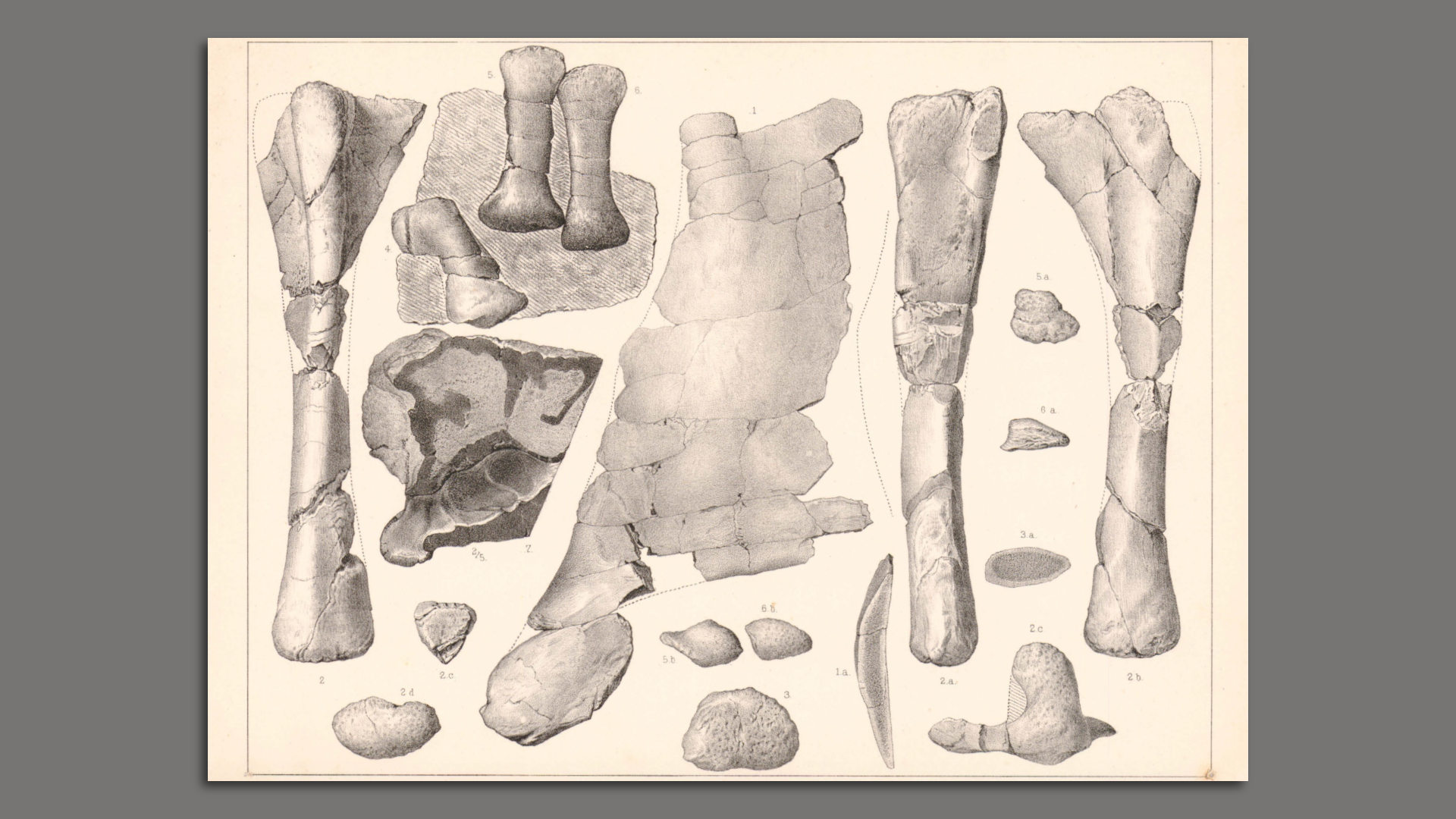
Illustrations of the fossils found near the Colorado River, from an 1877 federal report. Image via the U.S. Geological Survey
In a remote red rock canyon near what is now Canyonlands National Park, Utah's first documented dinosaur fossil discovery occurred 165 years ago this week.
- This is "Old News," our weekly dig into Utah's past.
Reality check: Indigenous people across North America were well aware of fossils long before the U.S. government sent white people to poke around the desert.
- Oral tradition and archeology passed down creation stories that explain prehistoric life and extinction, writes Stanford science historian Adrienne Mayor. Fossils also appear in ancient art and tools.
Flashback: Geologist John Newberry was part of a U.S. Army expedition to explore the area around the Colorado River in 1859, when, on Aug. 17, he noticed some massive bones in the sandstone walls of a canyon.
- They once belonged to a Dystrophaeus viaemalae, an early sauropod — i.e. the ginormous long-necked plant-eaters, like brachiosaurus and apatosaurus.
- The name, meaning "Bad bones, bad way," was later given to reflect the difficult-to-reach site where the fossils were discovered.
What they said: The team was fascinated by the "old petrified monster ... whose gigantic bones are our wonder," expedition engineer Charles Dimmock wrote in his diary.
Oops: Newberry and his expedition leader, John N. Macomb, thought the animal was an ichthyosaurus — a sharklike marine reptile from an earlier era.
- But they didn't get a good look at its face; Dystrophaeus is estimated to have been more than 40 feet long, and they only had light hand tools.
What they did: The team hauled some hunks of its front leg out of the labyrinthine cliffs and sent them to the Smithsonian.
- "The special object of our efforts, the head, was not reached, but still remains to reward some future geologist who shall visit this interesting locality." Newberry later wrote.
The intrigue: That took more than a century, because the fossils were shipped around and largely forgotten — along with the exact location of Newberry's dig.
Catch up quick: In the 1970s, a Moab historian and naturalist, Fran Barnes, searched the unpublished diaries and notes from Macomb's expedition, and, in 1989, refound the Dystrophaeus' final resting place.
Why it matters: Paleontologists found that the site is deeper and older than most of Utah's other renowned dino graveyards — and Newberry's Dystrophaeus remains the earliest sauropod ever found in North America.
- That has big implications for how dinosaurs traveled, evolved and diversified, state scientists wrote.
Fun fact: Coincidentally, Charles Darwin published "On the Origin of Species" just three months after Newberry spotted ol' Bad Bones.