Utah's highest levels of economic distress are in rural areas


Add Axios as your preferred source to
see more of our stories on Google.
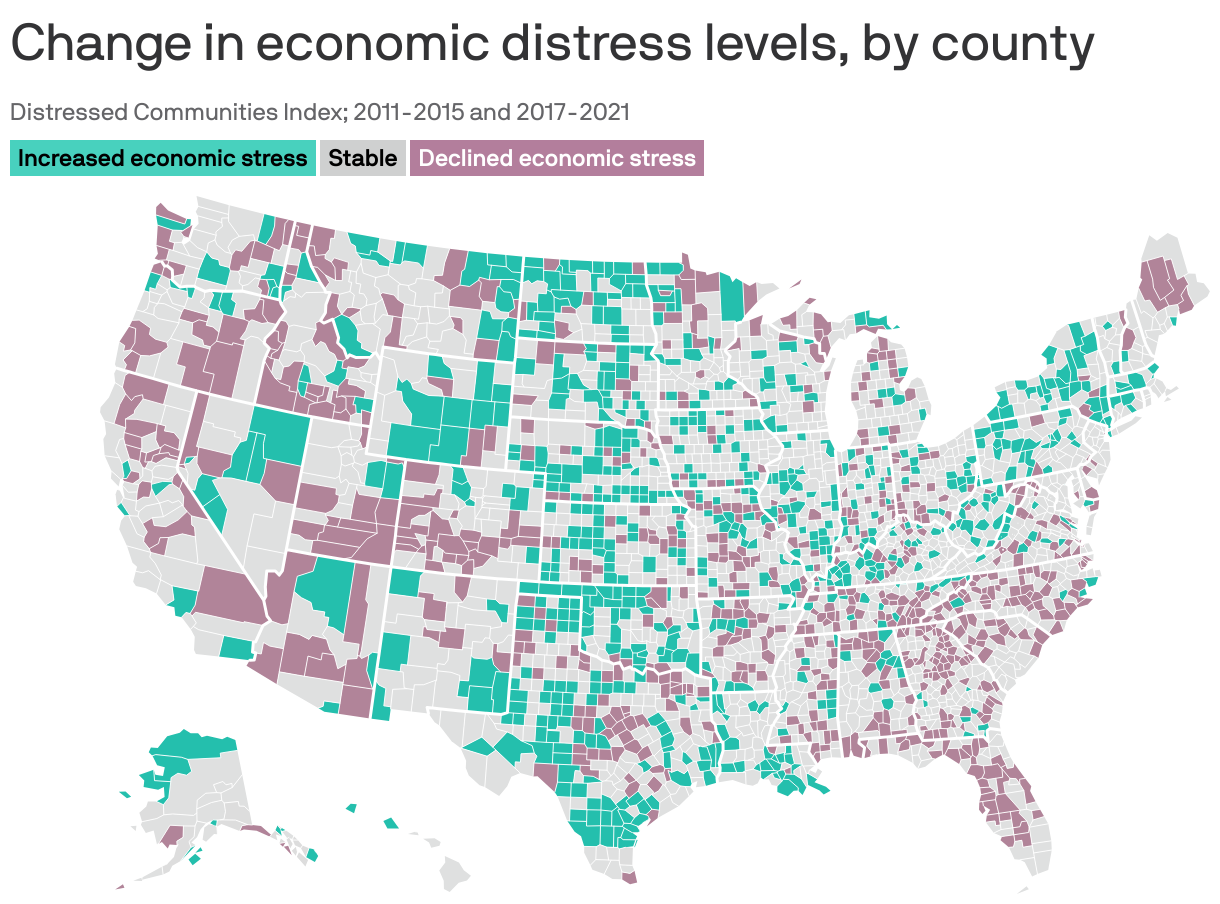
Parts of rural Utah are showing big swings in economic distress compared to past years, according to new data first reported by Axios Neil Irwin.
How it works: The latest update of the Distressed Community Index, Economic Innovation Group, is based on seven factors pulled from U.S. Census Bureau data and aims to capture whether a given area is rich with economic opportunity or faltering.
- Those factors include the share of adults who are not working, the housing vacancy rate, and growth in the number of businesses.
- The latest edition is based on data from 2017 to 2021. Previous numbers were from 2011 to 2015.
By the numbers: The biggest rise in economic distress was found in Uintah and Duchesne counties, and in drilling and mining hotspots.
- Those counties had the state's highest rates of employment in oil and gas during the years studied, despite big drops in the industry, according to data from the Utah Department of Workforce Services.
- The biggest improvements were also in rural counties, with Piute — previously the state's most distressed county — seeing a 40-point jump as employment increased.
Zoom in: Emery County is one former mining hotspot that saw major improvement, with its economy stabilizing after mining job losses in the 2000s and early 2010s.
Zoom out: The entire southern half of Utah has seen significant relief from economic distress since 2015.
- Wasatch County was the least distressed overall; San Juan County, while showing improvement, was the most.
The big picture: The Southeast has become distinctly more prosperous in just a few years — part of a broader shift in the geography of economic distress in the U.S.
- The share of people living in prosperous communities has risen most in the mountainous states of the West, most notably Idaho, Montana, and Utah.
- By contrast, Louisiana, Oklahoma, and New York state showed significant growth in the share of the population living in distressed ZIP codes.
The bottom line: A rising tide may lift all boats — but some communities' boats are rising faster than others.