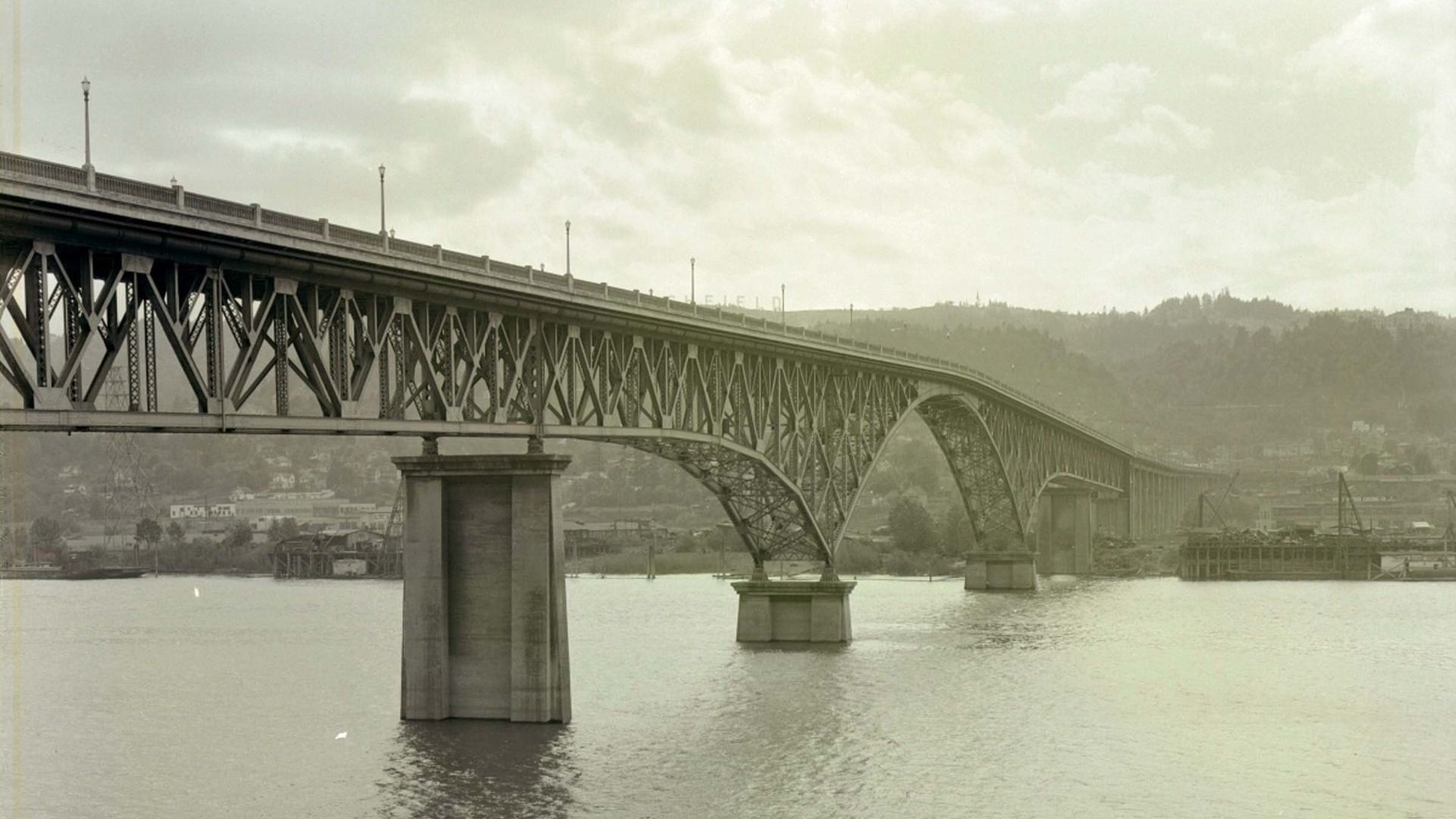
The Ross Island Bridge, in its original black paint, looking west circa 1935. Photo: Portland City Archives/A2009-009
Portland's Ross Island Bridge turns 100 this year and is the city's true workhorse compared to the Willamette's other, ornamental spans.
It doesn't concern itself with fancy bike lanes, viewpoints or even medians — with just four lanes and one narrow sidewalk, its sole focus is on moving traffic swiftly, east to west and vice versa.
The big picture: Opened on Dec. 21, 1926, during the city's bridge boom, the Ross Island Bridge is known locally as a relatively boring commuter bridge. It carries more than 55,000 vehicles per day via U.S. Route 26.
Plus: It's the only bridge connecting Portland's busy South Waterfront district — home to Oregon Health & Science University — to the Southeast side, as the Tilikum doesn't allow cars and the Sellwood is 2-plus miles down the river.
Flashback: Designed by Austrian engineer Gustav Lindenthal (who is associated with four other Portland bridges), the Ross Island Bridge was built primarily to accommodate the city's rapidly growing automobile traffic.
It has the appearance of an arch bridge but is actually a 3,700-foot-long cantilever deck truss bridge with no suspended span and was not designed to raise for river traffic — an engineering rarity and the only one of its kind in Oregon.
It was originally painted black but got a "phthalo blue" makeover in 1965.
Despite its name, the bridge sits about 800 feet north of Ross Island and does not provide access to the island itself.
Follow the money: Construction cost about $2 million in 1926.
Its 2001-era rehabilitation project to replace its deck and modernize its lighting and draining cost $12.5 million.
The intrigue: The Ross Island Bridge also hides an unusual function: large pipes built into its structure move water from the Bull Run reservoir system to Portland's west side.