Portland office tower sales prompt worries over tax revenue

Add Axios as your preferred source to
see more of our stories on Google.
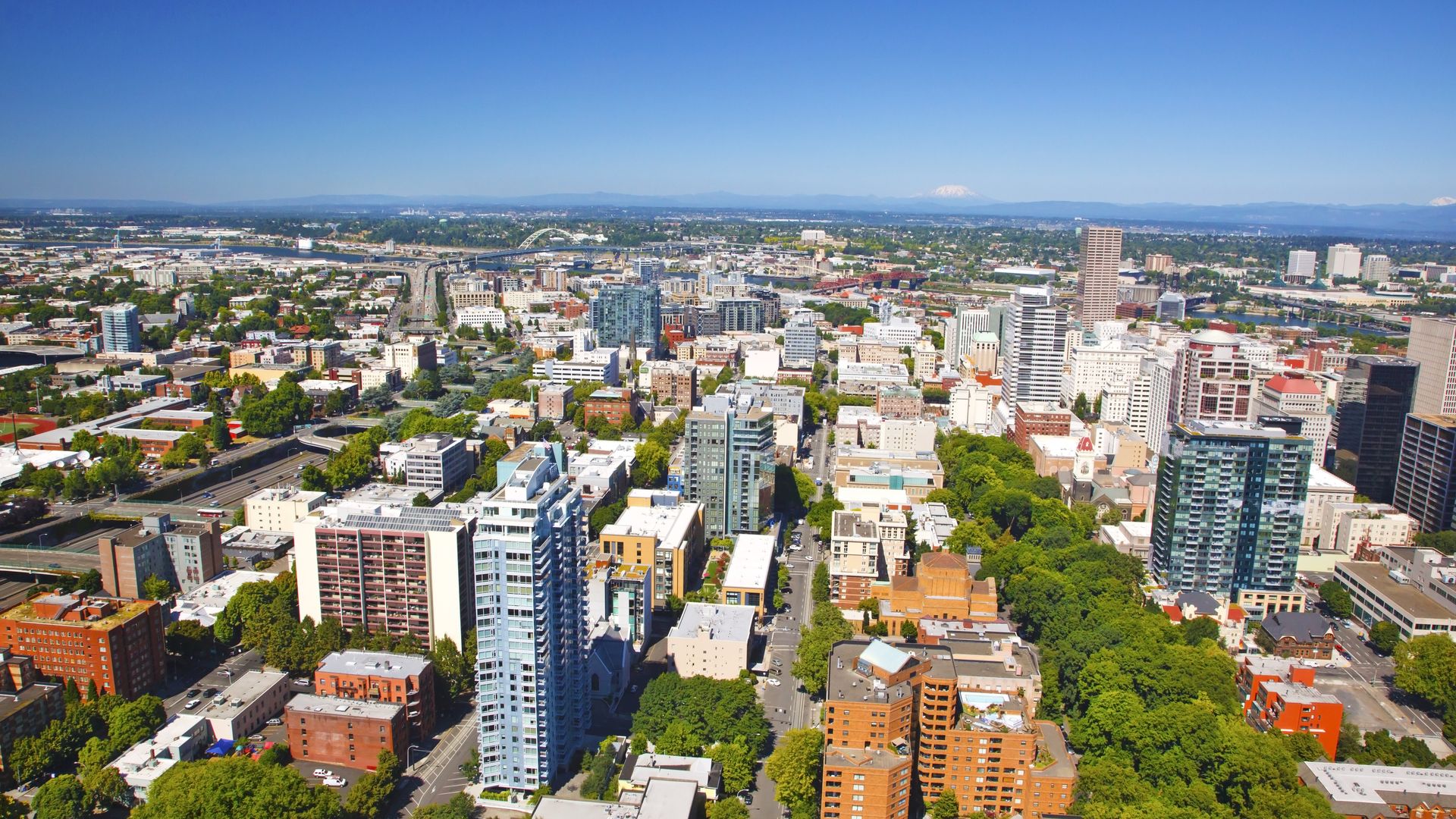
A lot of those buildings are a lot cheaper than they used to be. Photo: Craig Tuttle/Design Pics Editorial/Universal Images Group via Getty Images
Deeply discounted office tower sales — including some landmarks of the Portland skyline — show how far the city's commercial real estate market has fallen.
Why it matters: The fallout is now hitting property tax revenues, pressuring city and county budgets to do more with less money.
By the numbers: For years, the impact was hard to quantify because so few buildings were selling, but that's changed.
- Montgomery Park, in Northwest Portland, sold for $33 million in August after it was bought for $255 million in 2019.
- The PacWest Center went for $55 million in October after it was purchased for $170 million in 2016.
- Big Pink, arguably the most recognizable office tower in the city, sold in July for $45 million, just 12% of the $372 million it fetched in 2015.
Many of the biggest downtown office buildings have lost 70% to 85% of their value, Multnomah County economist Jeff Renfro tells Axios.
The big picture: Property taxes in Oregon are based on assessed value, not current market prices, and those values only change as sales provide new data.
- Renfro says falling market values are now hitting the system in two ways: deeper tax compression, which lowers the legal cap on what a property can owe, and declining assessed values themselves.
- Together, they're slowing the growth of property tax revenue.
Case in point: In a general fund forecast from December, city economists noted that Portland has seen two straight years of assessed value growth of less than 2.2%, the worst stretch since the 1990s.
Yes, but: This isn't just a Portland problem.
- Office markets nationwide are resetting after the COVID-19 pandemic permanently reduced how much space companies need.
- "Every major U.S. market was hit at the same time," Jason Green, Portland managing director at commercial real estate firm CBRE, tells Axios.
Between the lines: Downtown office buildings make up just 3.5% of Multnomah County's assessed value, so it's not enough to cause property tax revenue to crash completely, but it does weigh on the bottom line of the city and county — both of which are facing sizable budget deficits.
The intrigue: Some office owners are now intentionally triggering reassessments of their buildings, seeking lower valuations and, in turn, lower tax rates for years to come, Renfro says.
- He warns that kind of thing could keep revenues suppressed even when values recover.
The bottom line: There is a fix, Renfro says, but it won't be a quick one.
- "Anything that we can do to make downtown a more vibrant space where people want to come work, where they want to come shop or just hang out would help the values of those buildings," he says.