Some fish and frogs thrived after Oregon megafires, study finds

Add Axios as your preferred source to
see more of our stories on Google.
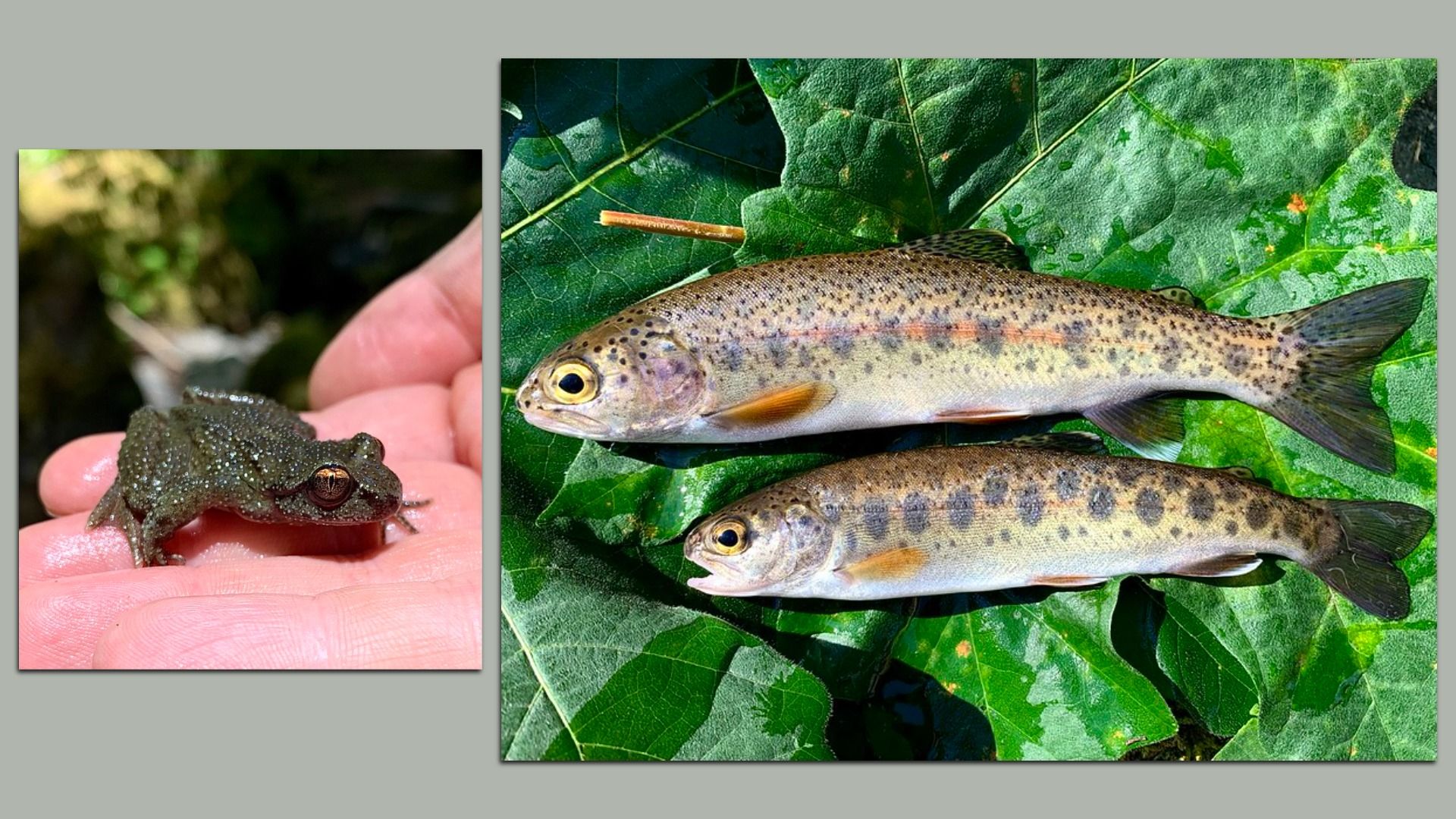
Resilient critters. Photos: Courtesy of Oregon State University
Despite megafires that reduced much of their habitat to ash, some fish, amphibian and crayfish species in the Cascades persisted — and in some cases flourished — after their homes burned.
Why it matters: With large wildfires expected to grow more severe and more frequent, understanding how the natural world recovers will become more important as more ecosystems are affected.
What they did: A team of researchers from Oregon State University looked at 30 watersheds in the western Cascades that were burned in the Riverside, Beachie Creek and Holiday Farm fires around Labor Day of 2020.
- They looked at areas that burned at different severities, accounted for salvage practices — removing burned trees and planting new ones — and analyzed the number and size of different animals in each watershed for the three years starting immediately after the fires.
- They analyzed 18 species of fish, amphibians and crayfish — including coastal cutthroat trout, coastal giant salamanders and Pacific chorus frogs.
What they found: Surprisingly, the areas that were most severely burned had the densest numbers of all animals.
- Areas with the most salvage also had higher densities of trout and crayfish, as well as a higher total of organic material, though densities of some frog species were lower.
- The findings were published in the journal Nature.
The researchers couldn't pin down an exact reason for the surprising results, but hypothesized that, with less tree cover, rivers and streams receive more sunlight in the aftermath of a fire.
- More sunlight elevates stream temperatures — increasing metabolic demands on fish and amphibians — but it also drives more production of microinvertebrates, a food source for the larger animals in the study.
Yes, but: Not all the species found in the watersheds responded in the same way and more research will be needed to find causal links between fire and animal abundance.
The bottom line: "Understanding the fire ecology of freshwater ecosystems is critical to our learning to co-exist with fire in ways that are socially and ecologically just," said Meg Krawchuk, a professor in the OSU College of Forestry and co-author of the study.