Get to know Portland's bridges: Morrison

Add Axios as your preferred source to
see more of our stories on Google.
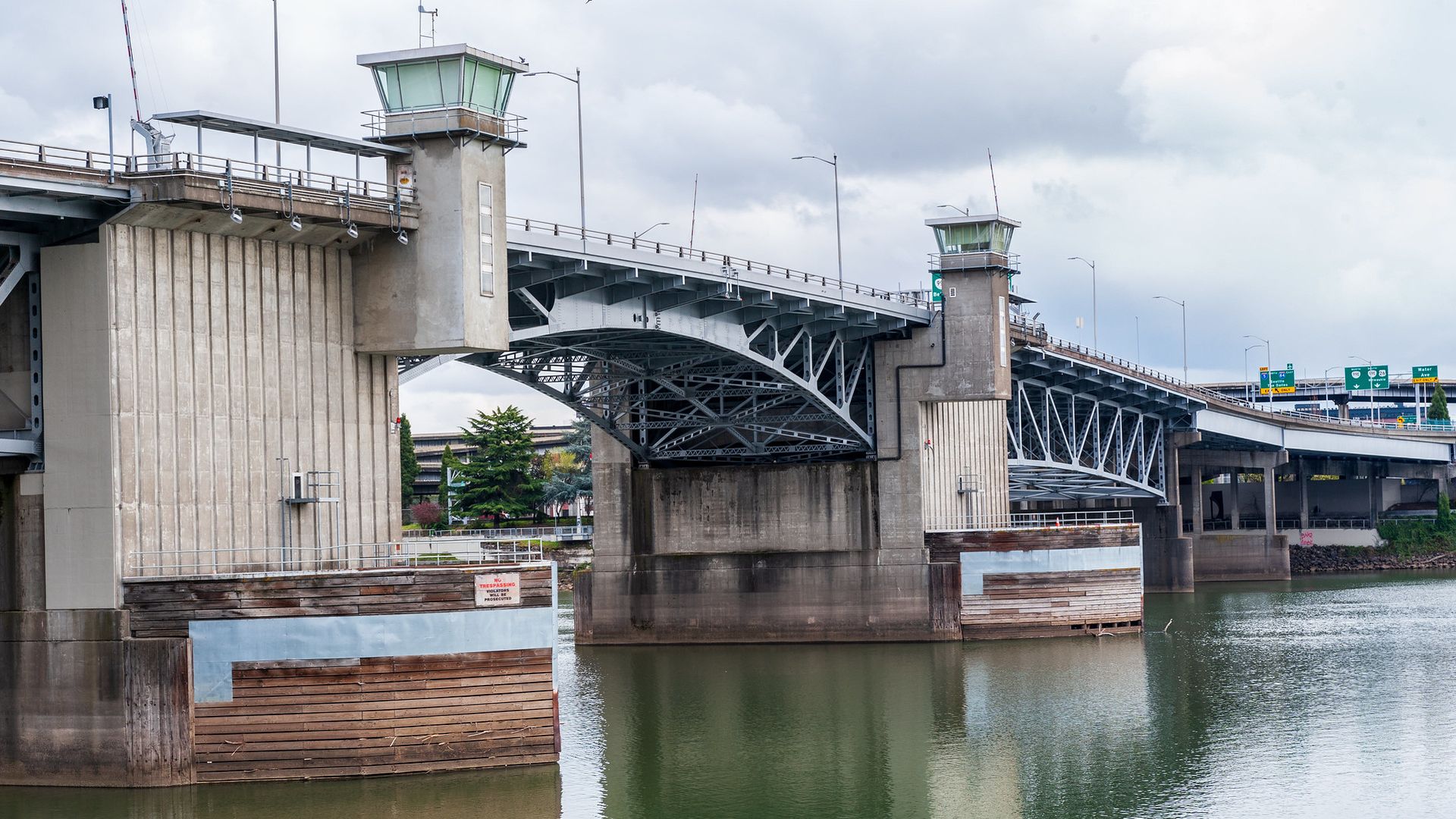
The Morrison Bridge has had many makeovers. Photo: Courtesy of the City of Portland
The earliest version of the Morrison Bridge was the first to span the Willamette River and was the longest span west of the Mississippi.
The big picture: There have been three iterations of what Portlanders know as the Morrison Bridge.
- Today, located at the crossroads of two interstates, the six-lane bridge — lauded for its minimalist architecture — carries roughly 50,000 vehicles daily, making it one of the busiest crossings in the city.
Flashback: The first Morrison Street Bridge — a wooden truss swing-span bridge totaling 1,650 feet — was built in 1887 and was the first to connect Portland and East Portland, which at the time was a separate municipality. It also was a toll bridge.
- The wooden structure became warped under heavier traffic than it was built for. So in 1905, a steel Pratt truss swing span was built in its place.
- Shortly after, the transportation needs of the city began to change. Many Portlanders were buying cars and commuting from the east side to downtown. The City Planning Commission began studying an appropriate type and location for a new Morrison Bridge in 1927.
- The third Morrison Bridge, the one we know today, wouldn't be completed until 1958 due to local political infighting and an anemic postwar economy.
Zoom in: Designed by St. Louis' Sverdrup & Parcel, the Morrison Bridge is a 3,700-foot-long Chicago-type double-leaf bascule, which uses two movable "leaves" that pivot upward to allow for boat traffic below.
- The bridge is largely known for its LED lighting system, which was added in 1987 and is managed by the Willamette Light Brigade.
Follow the money: The bridge cost $12.8 million to build, while recent modifications — like replacing the lift span deck and adding shared-use paths — have added to the cost of operations since.