Cascadia and San Andreas faults may be linked

Add Axios as your preferred source to
see more of our stories on Google.
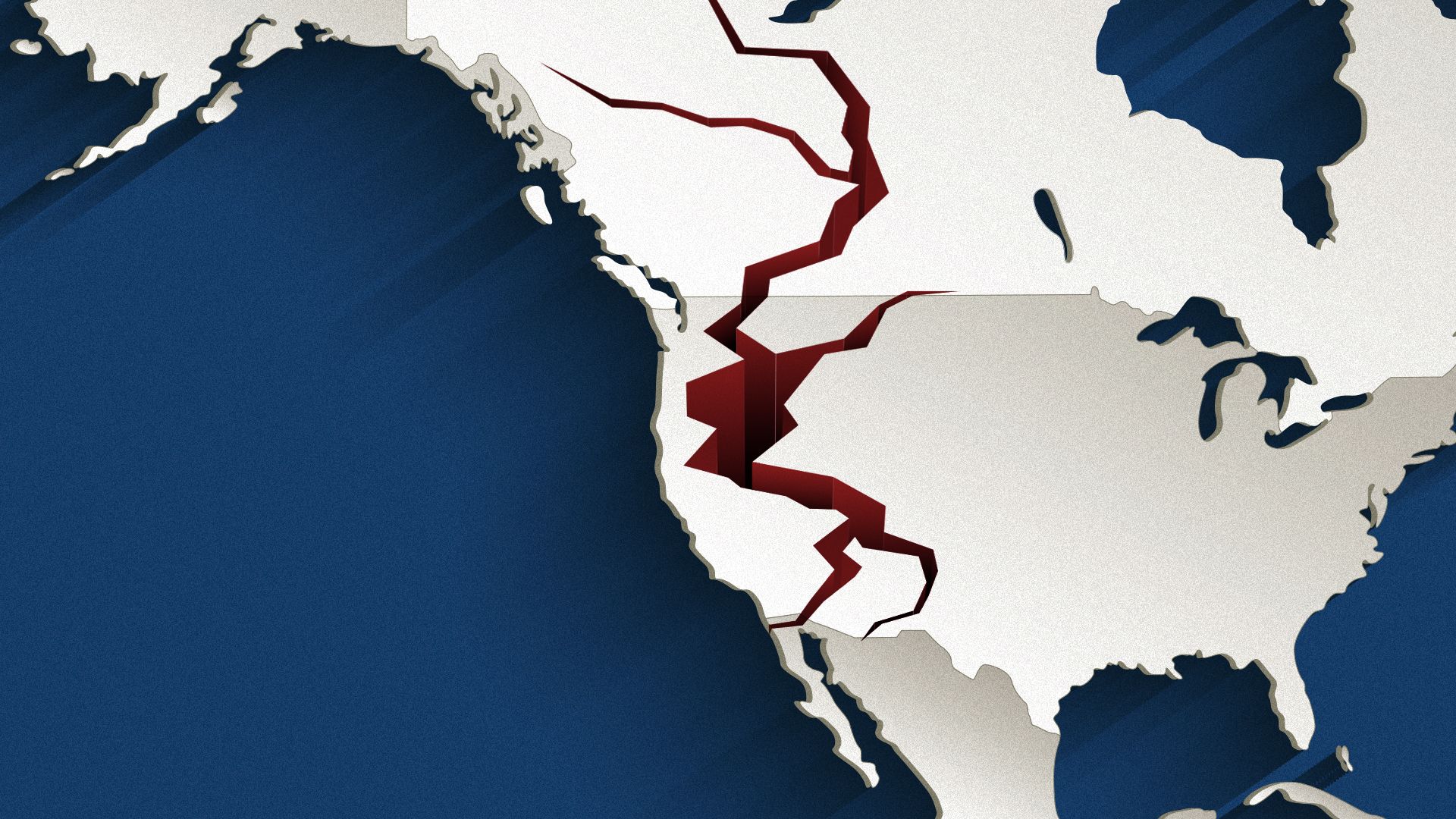
Illustration: Lindsey Bailey/Axios
Two of the biggest seismic threats on the West Coast — the Cascadia Subduction Zone and the San Andreas Fault — may be more connected than previously thought, per new research.
Why it matters: If the two are connected, that would mean an earthquake on both seismic zones could cause widespread damage from San Francisco to Portland to British Columbia.
What they're saying: "We're used to hearing the 'Big One' — Cascadia — being this catastrophic huge thing," Chris Goldfinger, a marine geologist at Oregon State University and lead author of the study, said in a statement.
- "It turns out it's not the worst-case scenario."
What they did: Goldfinger and a team of researchers analyzed sediment cores dug up from the seafloor near the Oregon-California border, where the Cascadia Subduction Zone ends and the San Andreas Fault begins.
- The cores, which span more than 3,000 years of geologic history, showed similarities between the two seismic zones, suggesting an earthquake on one could lead to an earthquake on the other.
- There were three instances in the last 1,500 years, the most recent in 1700, when quakes on the fault and the subduction zone were just minutes or hours apart, according to Goldfinger.
Threat level: The Cascadia Subduction Zone is capable of producing a quake up to magnitude-9.0, which would likely be followed by a tsunami.
- The San Andreas Fault has been responsible for earthquakes close to magnitude-8.0, including the 1906 earthquake that devastated San Francisco.
The bottom line: "We could expect that an earthquake on one of the faults alone would draw down the resources of the whole country to respond to it," Goldfinger said.
- "If they both went off together, then you've got potentially San Francisco, Portland, Seattle and Vancouver all in an emergency situation in a compressed time frame."