Judge blocks Portland National Guard deployment

Add Axios as your preferred source to
see more of our stories on Google.
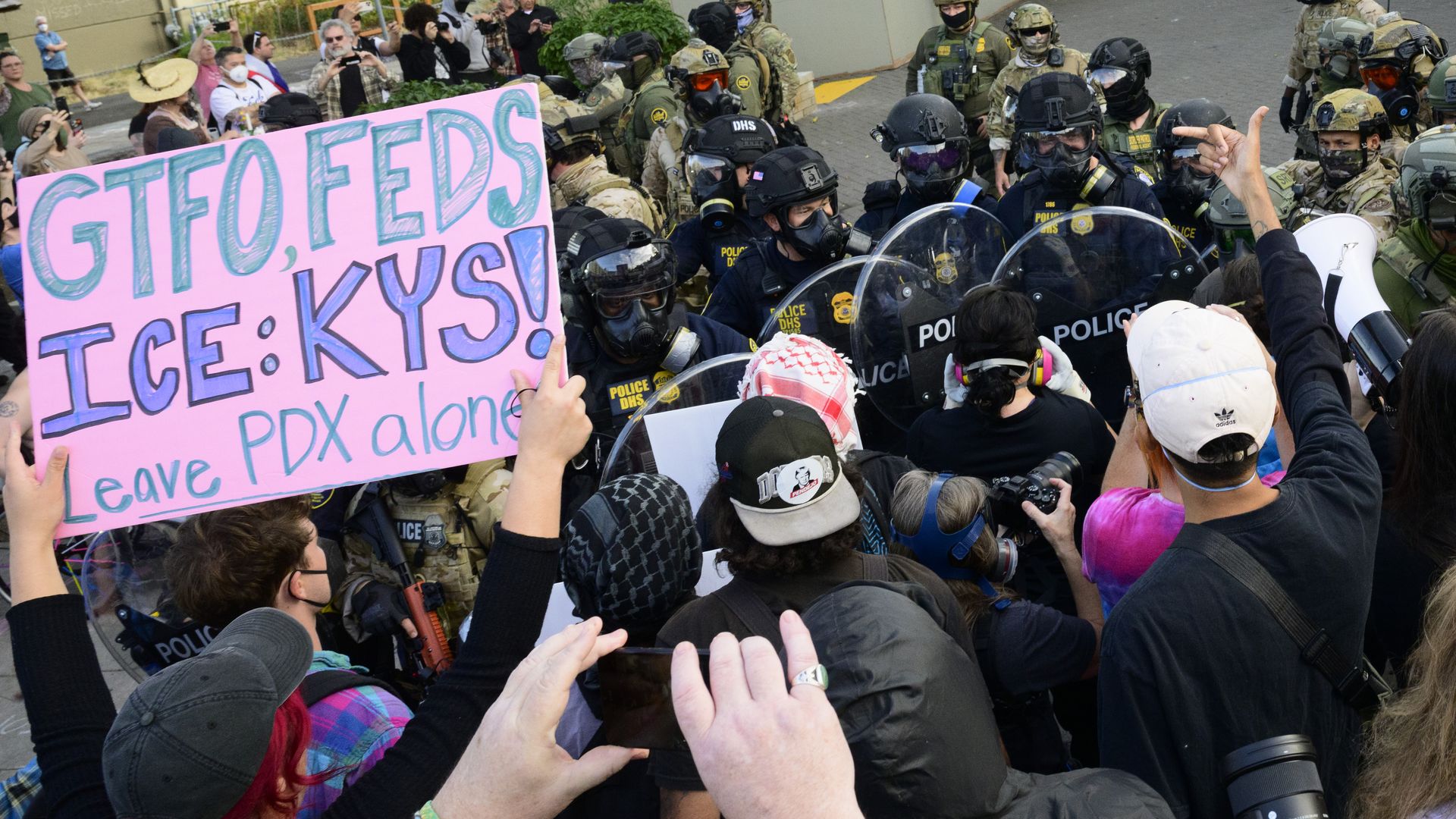
Federal agents confront protesters outside of the U.S. Immigration and Customs Enforcement building on September 28, 2025 in Portland, Oregon. Photo: Mathieu Lewis-Rolland/Getty Images
A federal judge granted a temporary restraining order blocking the deployment of National Guard troops to Portland on Saturday.
Why it matters: The ruling represents a setback for the Trump administration's efforts to send troops to Portland to protect an ICE facility from long-running, but small, protests.
- In a 31-page opinion, U.S. District Judge Karin Immergut said the federal government had failed to provide evidence that the protests couldn't be handled by local law enforcement.
What they're saying: The protests "were not significantly violent or disruptive in the days - or even weeks - leading up to the President's directive," Immergut wrote.
Catch up quick: President Trump said last weekend that he was authorizing the use of "all necessary Troops to protect War ravaged Portland, and any of our ICE Facilities under siege from attack by Antifa, and other domestic terrorists."
- The city and state filed for a temporary restraining order seeking to block the arrival of troops, which was the subject of a hearing Friday.
- Oregon Attorney General Dan Rayfield also filed a lawsuit seeking to block the deployment, alleging the move violates the Posse Comitatus Act, which prohibits using troops for domestic law enforcement.
The latest: Over the course of a nearly two-hour hearing Friday, Immergut heard competing narratives over the state of protests at the ICE facility.
- Lawyers for the Trump Administration cited several incidents at the facility — high-powered lights being pointed in agents' eyes, officers being followed home and protesters throwing rocks — as evidence the federal government was unable to enforce the law without the assistance of the National Guard.
- Attorneys for the city and state cited reports from the Portland Police Bureau that protest activity in recent weeks was "minimal," said the presence of troops was more likely to inflame the situation than calm it and called the deployment an infringement on state sovereignty.
White House Press Secretary Karoline Leavitt said Friday that President Trump asked his administration to review potential funding cuts to Oregon due to the situation in Portland, adding "we will not fund states that allow anarchy."
Yes, but: Local elected officials have pushed back on Trump's characterization of what's happened at the South Portland facility, noting the protests have been small, relatively low key and easily handled by the Portland Police Bureau.
- "The necessary number of troops is zero," Mayor Keith Wilson said in a statement.
State of play: Roughly 200 Oregon National Guard troops have traveled to Camp Rilea in Warrenton for training in crowd control tactics and use-of-force protocols.
- They were expected to arrive in Portland within the next few days.
Context: Demonstrators have been gathering at the ICE facility in South Portland on a near-nightly basis since June, with crowds ranging from a handful of people to more than 100, usually calling for the release of immigrants detained by the agency.
- Federal agents arrested more than two dozen people at the facility this summer, per the Oregonian, for charges ranging from felony aggravated assault to misdemeanor failure to follow orders.
- The vast majority of arrests — 22 of 29 — came in June and July.
- Separately, Portland police have made more than two dozen arrests at the facility, most of them earlier this summer.
What's next: Lawyers for the Trump administration indicated they were likely to appeal the ruling during Friday's hearing.
- The temporary restraining order expires Oct. 18.
Editor's note: This story has been updated with the judge's ruling and additional details.