AI listens for endangered owls in Oregon forests

Add Axios as your preferred source to
see more of our stories on Google.
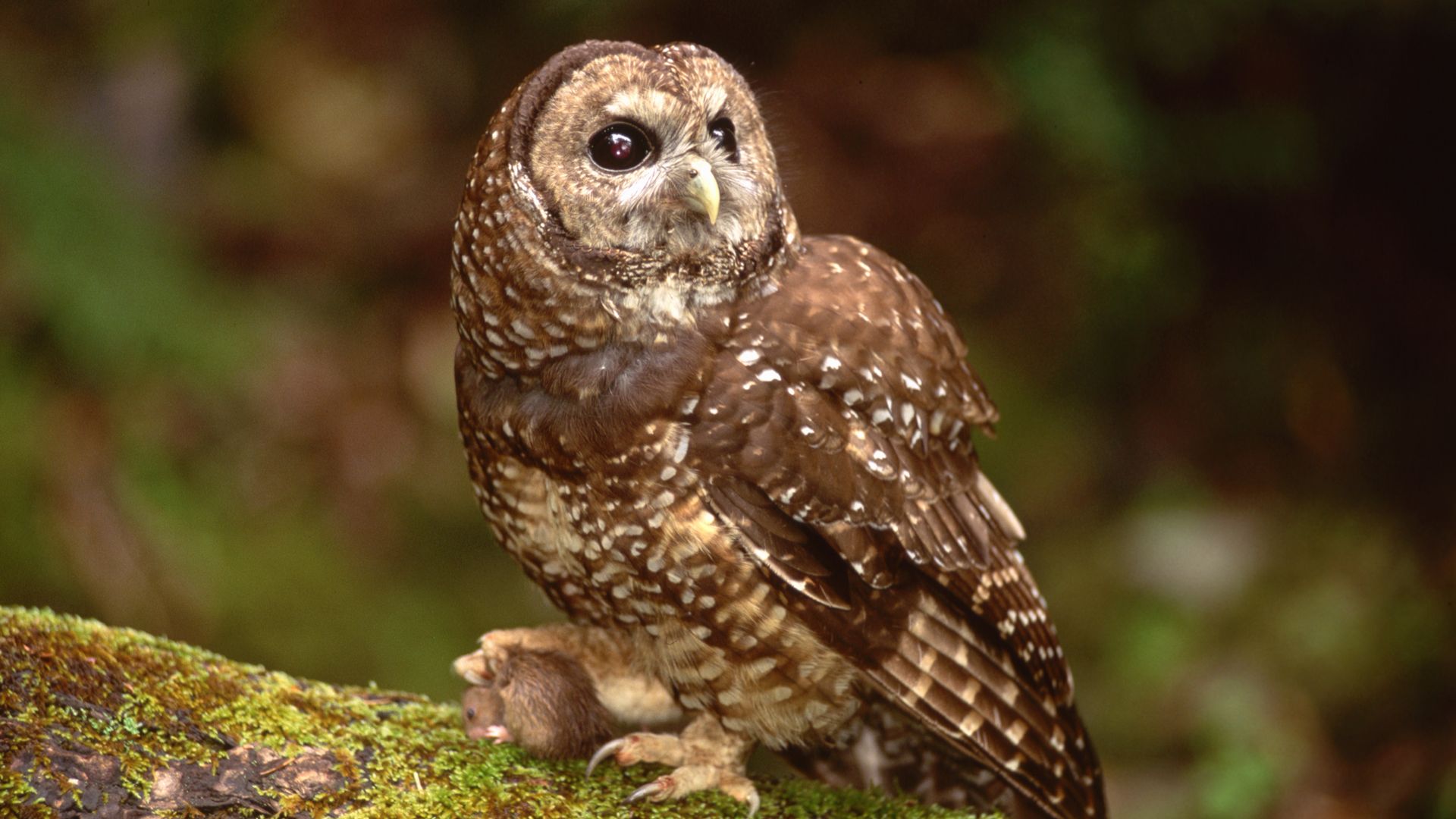
Does a spotted owl make a sound if only AI is there to hear it? Data says yes. Photo: Galen Rowell / Corbis via Getty Images
In Oregon's forests and beyond, a network of microphones is tracking some of the state's most sensitive species and feeding the tweets, chirps and hoots into an AI processing tool.
Why it matters: Artificial intelligence gives researchers exponentially more power to process the sounds of our forests and learn where endangered species live so we can better protect them.
Zoom in: Matthew Weldy, a doctoral student at Oregon State University, has been working with other scientists at the Lesmeister Lab to try to get a better handle on where spotted owls are living in the Pacific Northwest.
- The species has been in decline for decades because of habitat loss and, more recently, an influx of barred owls, which are larger and can push their counterparts out of the best habitat.
- Before the introduction of AI, researchers had to manually review audio files for signs of the threatened species, a task that became untenable when data collection scaled up.
- "You have a needle in a haystack problem," Weldy said.
By the numbers: Recorders used by Weldy and his team collect up to 11 hours of data per day over a six-week period.
- With roughly 4,000 recorders across Washington, Northern California and Oregon, the team collected more than 2.5 million hours of data in 2023 alone — or slightly more than 285 years' worth, Weldy said.
- "It's longer than the United States has been around as a country," he told Axios.
How it works: Weldy said the team uses a combination of BirdNET, Perch and its own in-house neural network to identify the sounds of spotted owls and other birds.
- The programs don't actually analyze the sounds themselves — audio is converted to spectrogram "images" and then likely species calls are flagged.
- "For endangered species, we use the AI as a filtering algorithm and then humans validate the clips," Weldy said. "It's imperfect, but far better than trying to listen to everything."
Case in point: Similar AI tools were used in Australia, where researchers rediscovered a rare species that hadn't been seen in more than 30 years.
The bottom line: The expansion of monitoring efforts helps people like Weldy give policymakers the necessary data to decide which areas need protection to help species like the spotted owl.
- "To decide what habitat to protect, you either take a guess or you have a data-driven process," Weldy said. "These tools let us monitor at the scale needed for that."