Parents push for seismic upgrades in record schools bond

Add Axios as your preferred source to
see more of our stories on Google.
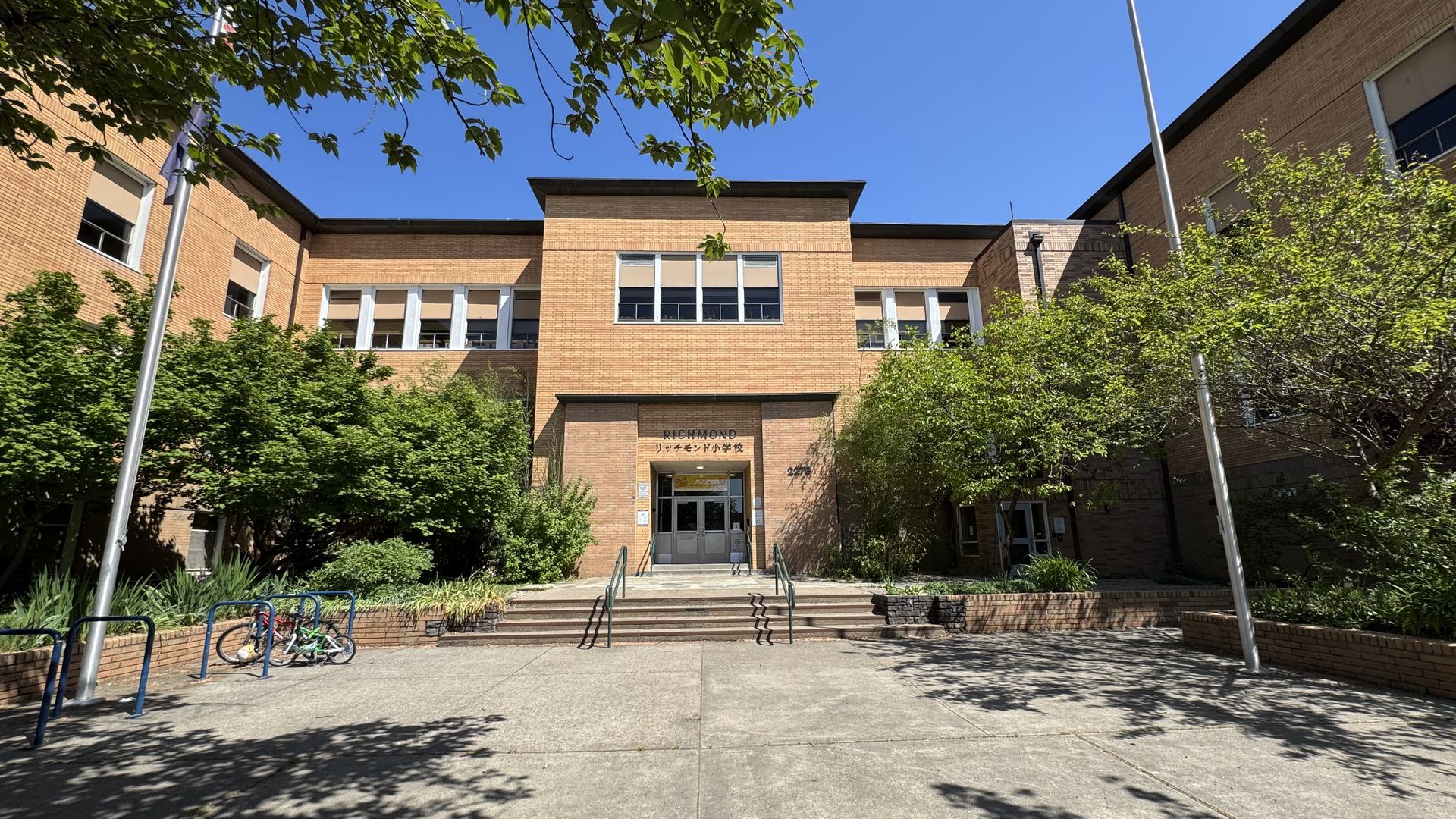
Richmond Elementary is one of many schools in Portland built with unreinforced masonry. Photo: Kale Williams/Axios
A group of parents is urging the Portland Public School Board to commit to spending more than $100 million to upgrade older schools that are vulnerable to earthquakes.
Why it matters: More than a dozen schools are built from unreinforced masonry, which could collapse when the next earthquake hits and threaten the safety of thousands of students, they warn.
Driving the news: More than 300 people have signed a petition calling on the board to dedicate bond funding to seismic retrofits.
- The money would come from a $1.8 billion bond, the largest in district history, which voters will decide on in the May 20 special election.
- Much of that money is already earmarked for remodels of high schools, but Per Olstad, a petition organizer, said there is roughly $400 million in bond money that could be put toward upgrades at vulnerable schools.
What they're saying: "Thinking about what it would be like for my kids if there is a collapse, and how terrified they would be" is a constant source of concern, Olstad — whose two children attend Beverly Cleary Elementary in NE Portland — told Axios.
- "If they lived through the first moments, being stuck under thousands and thousands of pounds of rubble, and there's no realistic way for us to get to them in time."
By the numbers: Just over $1 billion of the proposed bond is designated for modernization of three high schools along with crucial repairs to elementary and middle schools.
- Roughly $100 million to $200 million is set aside for deferred maintenance, school board chair Eddie Wang told Axios, with another $190 million dedicated to "updates and repairs to aging schools."
- But none of that roughly $390 million is dedicated to quake-related upgrades.
That's what Olstad and his group are hoping to change.
- "What we are really looking for is a clear, specific commitment to prioritize funding from the 2025 bond in a meaningful way to address the seismic risks at the riskiest schools," he said.
The bottom line: The total estimate to retrofit the district's most vulnerable schools is between $120 million and $140 million, board member Julia Brim-Edwards told Axios, but a 2024 seismic assessment noted that does not include costs for engineering, construction management, and relocation.
What's next: Brim-Edwards told Axios she's working on a resolution to present at Tuesday's board meeting that would declare "identification, mitigation, and seismic retrofitting of high-risk school buildings is an urgent district priority," according to a draft of the resolution.
- "We have to strike a balance between flexibility and specificity about where this significant sum of money will be spent," she told Axios. "If you're a parent, you need to understand how the bond will impact your school and your student."
Editor's note: This story has been corrected to reflect that the bond that voters will act on May 20 is for $1.8 billion (not million).