Oregon's measles outbreak highlights state's high vaccine exemption rate


Add Axios as your preferred source to
see more of our stories on Google.
Oregon's recent measles outbreak — one of the largest in the state's history — is refocusing attention on declining childhood vaccination rates as kids head back to school.
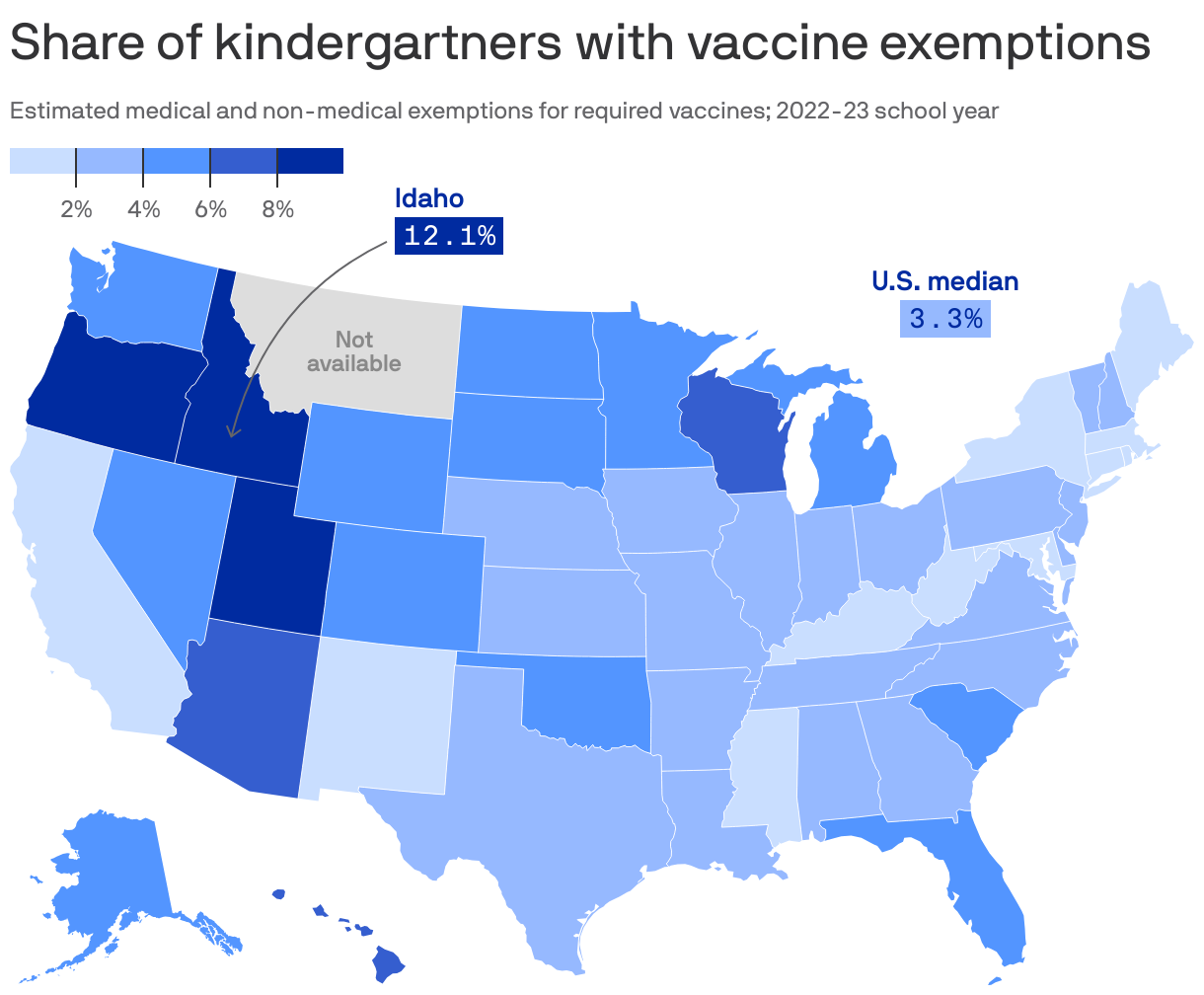
Why it matters: Oregon has one of the highest vaccine exemption rates for kindergartners in the country, according to the Centers for Disease Control and Prevention.
- Studies have found an increased risk of infection from vaccine-preventable diseases, such as measles, which is potentially fatal, among exempt children.
Threat level: There have been 30 confirmed cases of measles in Oregon as of Wednesday, all among unvaccinated individuals. A dozen of those cases are in children under age 10.
- The majority, 20 cases, are concentrated in Marion County, according to Oregon Health Authority data.
- Nine cases have been reported in Clackamas County and one in Multnomah County.
Driving the news: Health officials are urging parents and guardians to get their children vaccinated against measles before the school year begins.
- For many school districts in the state, the first day of school is Sept. 3.
Zoom in: Oregon is one of 15 states that allow exemptions for school children whose parents philosophically object to immunizations.
- Parents who seek a non-medical exemption must either complete an online vaccine education class or have a medical professional sign a vaccine education certificate.
By the numbers: Oregon's kindergarten exemption rate reached 8.8% in the 2023-2024 school year — up from 8.1% and 6.9% in the two preceding years.
- Over 70 schools have non-medical vaccine exemption rates of up to 20%, many among charter and private schools — a rate higher than some developing countries.
The big picture: U.S. parents still overwhelmingly support childhood vaccinations. But kindergarten exemptions rose to a median of 3.3% nationally during the 2022-2023 school year, up from 2.7% the year before.
- A Gallup Poll this month found that 69% of respondents view childhood vaccines as "extremely" or "very" important, down from 94% in 2001.
What they're saying: While large numbers of kids are getting vaccinated, it takes a 95% rate to maintain herd immunity against a disease like measles, Tom Lacy, chief of Florida Primary Care for Nemours Children's Health, told Axios.
- Parents are not just opting out of the well-known childhood shot against measles, mumps and rubella known as MMR, but also vaccines against whooping cough, chicken pox, meningitis, and the flu, he said.
- Some may be picking and choosing vaccines based on their perceptions of which seem more important or safer.
Editor's note: This story has been corrected to reflect that kindergarten exemptions rose to a median of 3.3% (not 3%) nationally during the 2022-2023 school year.