Portland's motel shelters are successful. Here's why there aren't more

Add Axios as your preferred source to
see more of our stories on Google.
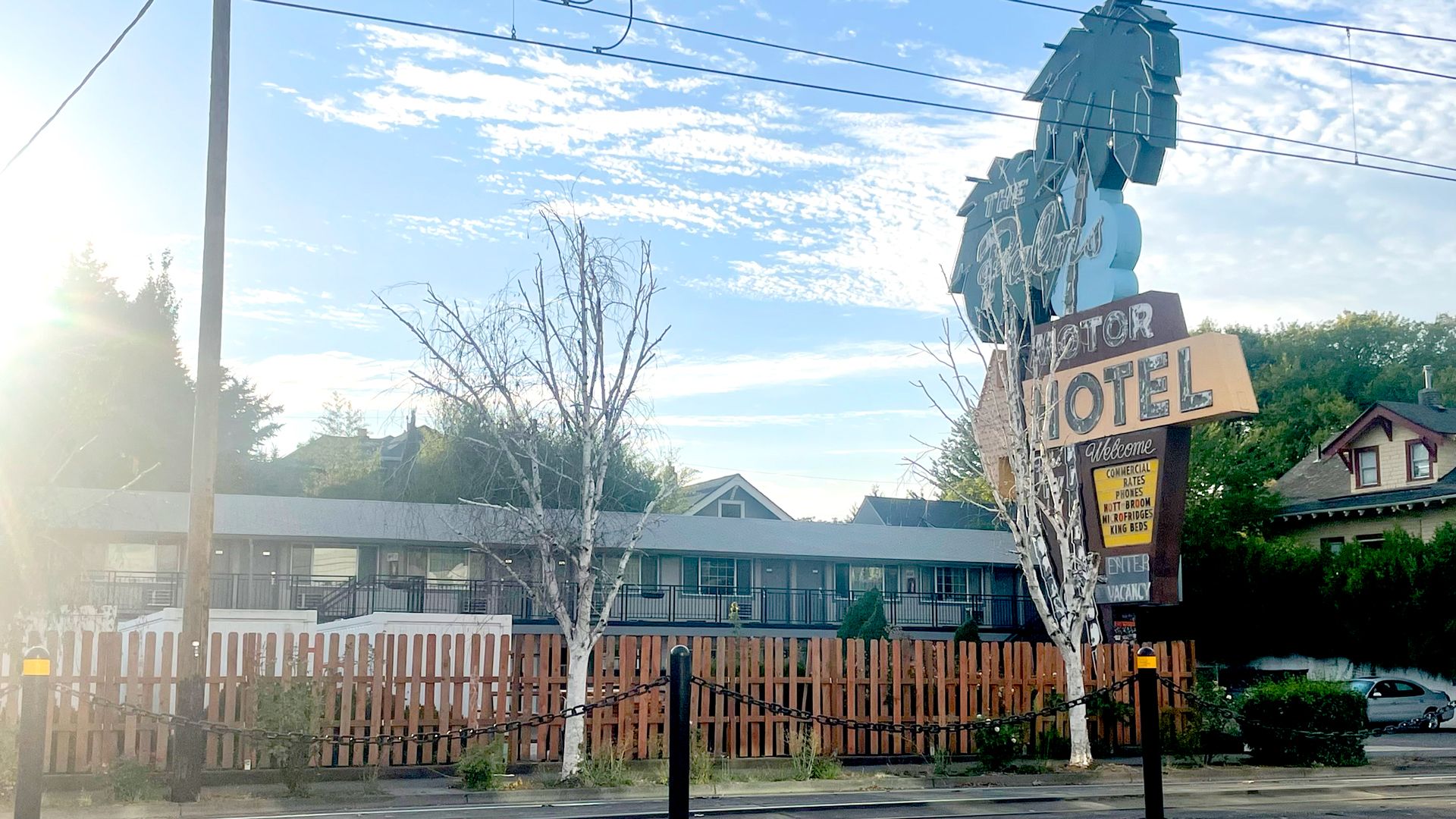
The Palms Motel serves older adults facing homelessness who identify as African American. Photo: Meira Gebel/Axios
Motel-converted shelters are one of the most successful shelter types across Portland at placing those experiencing homelessness into permanent housing, but high initial costs have made it difficult to expand.
Why it matters: While motels are quick to turn into housing, they tend to be more expensive and therefore harder to acquire.
- That's according to Jacen Greene, assistant director of Portland State University's Homelessness Research and Action Collaborative.
State of play: Dozens of the region's shelter sites — ranging from tiny home parks, mass shelters and motels — are operated by the Joint Office of Homeless Services (JOHS), a partnership between the City of Portland and Multnomah County.
- Officials recently agreed to a new partnership with a goal to open 1,000 more shelter units by the end of 2025.
- Out of 805 additional shelter units JOHS has budgeted for and proposed by the end of next year, only 140 are motel units, per its shelter strategy.
Yes, but: Motels have not been placed on the back burner.
- The agency recently put out an "expression of interest" to hotel and motel facilities to find potential motel shelter sites, Julia Comnes, a JOHS spokesperson, told Axios via email.
By the numbers: JOHS currently runs seven motel shelters across Portland and Gresham, with a total of 441 rooms. This doesn't translate into people served, Comnes said, because one room can serve families and couples.
- A motel shelter costs on average $104,000 to acquire and $43,400 to run annually per unit, according to a PSU report released last spring.
- Congregate shelters, which account for the largest share of shelter beds, are about half that — costing a yearly operating average of $20,400 per unit.
- 34% of people who entered into a motel shelter between 2021 and 2023 were able to transition into temporary or permanent housing, the second most successful shelter type behind JOHS-run tiny home sites.
What they're saying: The autonomy of having a private room brings about "better client experiences," Greene told Axios.
- Plus: Motels have longer building lifespans compared to the 8-by-8-foot tiny homes, and can be "converted into permanent housing."
Flashback: Researchers at PSU recommended in their March report that JOHS not pursue more congregate shelters — where many people stay in one big room for up to a few days — as part of their long-term plan to address homelessness.
- Mass shelters are cheaper to operate but "return more people into homelessness," per the report.
- A new, 106-bed shelter in Portland's Arbor Lodge neighborhood opened in June. JOHS plans to add up to 163 more congregate shelter beds by next December, according to its sheltering strategy.
The other side: "Our goal is to offer a range of shelter options so that as many people as possible have access to shelter that meets their needs and supports them on their journey back to housing," Comnes said.