Advocates and providers aim to lower cost of psilocybin treatment

Add Axios as your preferred source to
see more of our stories on Google.
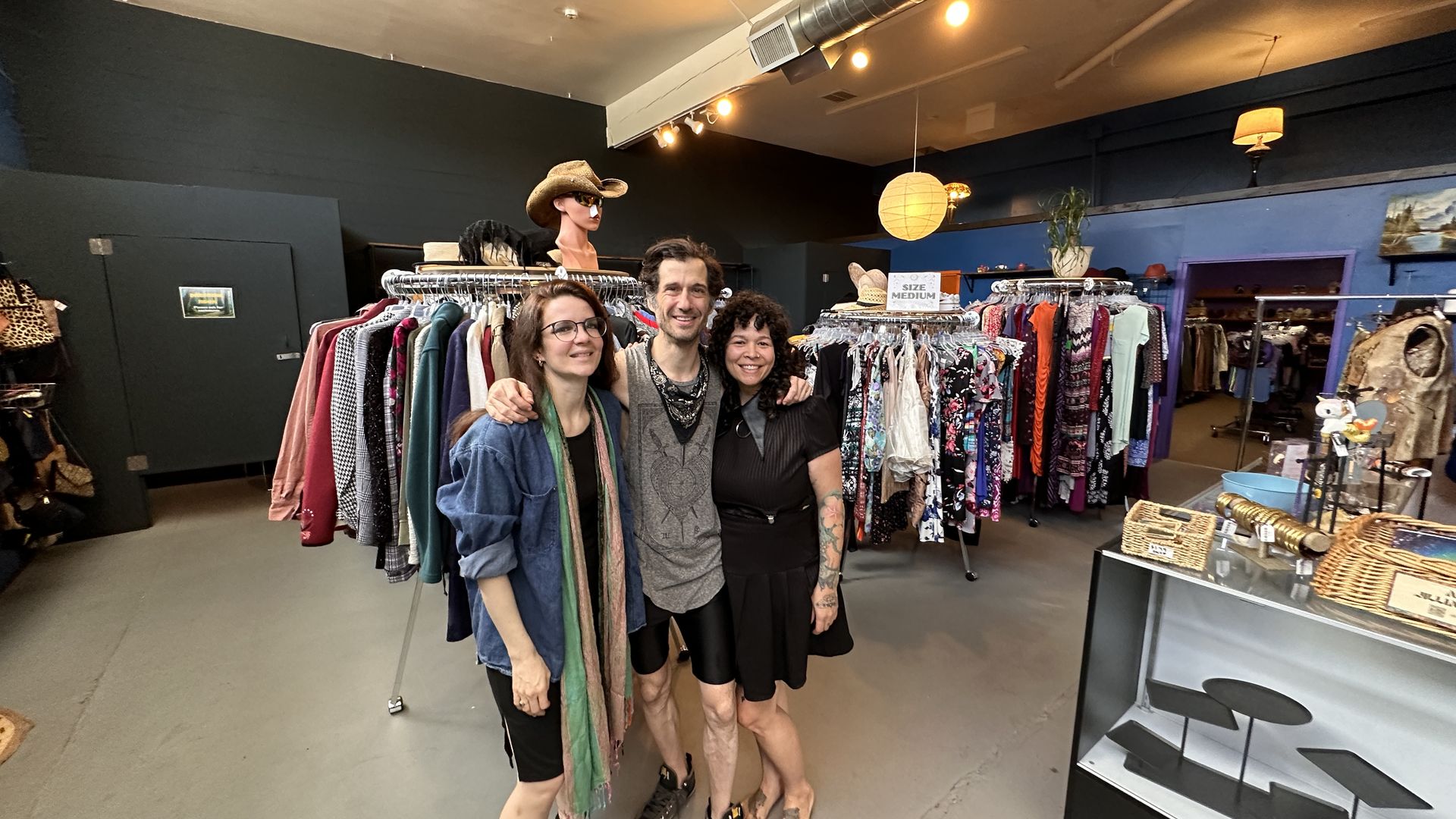
Eden Woodruff, Tom Hatsis and Jilly Bean at Psanctum Thrift. It funds psychedelic research. Photo: Joseph Gallivan/Axios
A year after the first legal psilocybin treatment centers in Oregon opened, some providers and advocates are trying to make psychedelic therapy more affordable.
Why it matters: Psilocybin journeys have shown promise in treating people with depression, addiction and anxiety, but industry experts say "magic mushroom therapy" is cost-prohibitive for many people.
- This is despite an Oregon Health Authority requirement that licensees have a social equity plan.
State of play: Services provided by licensed psilocybin centers can range from $1,500 to $3,200 for individual sessions, says Emma Knighton, director of services at InnerTrek, a psilocybin services and training center in Portland.
- InnerTrek offers individual sessions for $1,800, with the least expensive being $1,200 for a one-day group experience, Knighton tells Axios.
- A session is usually an hour of intake, six to eight hours of a guided journey under the influence of mushrooms, plus follow-up talks.
Driving the news: The Sheri Eckert Foundation, named for the co-sponsor of Measure 109, recently awarded $51,000 through its Psilocybin Access Fund to 33 individuals accessing psilocybin therapy.
- It's also working with the OPEN research group at Oregon Health & Science University (OHSU) to persuade insurers to cover psilocybin treatment.
What they're saying: "The solution is health insurance, the same way acupuncture and chiropractic care were once not covered and were very expensive," Nate Howard, InnerTrek's director of operations and spokesperson for the Sheri Eckert Foundation, told Axios.
- The foundation and InnerTrek were founded by Sheri Eckert's widower, Tom Eckert, and the two partner together to connect clients with financial assistance.
Zoom in: Last year, Eden Woodruff and Tom Hatsis co-founded Psanctum Thrift, a second-hand store in SE Portland's Brooklyn neighborhood whose profits fund psilocybin treatment for people who cannot afford it.
- Woodruff told Axios they are ready to disburse two grants per month to online applicants starting in July.
Meanwhile, Fractal Soul, a psilocybin center in Beaverton, offers a discounted $600 session for those who qualify as low-income.
By the numbers: As of June 21, there were 341 licensed facilitators and 29 service centers in Oregon, according to OHA figures.
- The nonprofit Healing Advocacy Fund reported last month that 3,500 people have been treated since psilocybin's legalization.
Between the lines: These are experimental times, Sam Chapman, the fund's former executive director and now a political consultant, told Axios.
- Lower-price programs are beneficial, Chapman said, but the bigger goals include coverage by insurance or state Medicaid programs.
What's next: More than two dozen states have considered legislation or a policy change related to psychedelic-assisted care.
- "If we can show safety, efficacy and cost savings [with scientific research], in the next couple of years, we'll get states to directly invest in [psilocybin] programs," Chapman said.