Demand for OBGYN services rises in Oregon

Add Axios as your preferred source to
see more of our stories on Google.

Illustration: Lindsey Bailey/Axios
Nearly two years after the fall of Roe v. Wade, reproductive health providers in Oregon — where abortion is considered a right under the state Constitution — are still seeing high demand for services as neighboring states crack down on the procedure.
Why it matters: Healthcare providers focused on family planning have expanded the services they offer and hired additional help to fit the needs of both in-state and out-of-state patients, who often need extra assistance with travel, lodging and coordinated care.
Driving the news: Idaho — Oregon's closest neighbor with a near-total abortion ban — lost 22% of its OBGYNs since the top court overturned Roe, leaving half of the state's 44 counties without practicing obstetricians, a new report found.
What they're saying: Alyssa Colwill, medical director of family care services at Oregon Health & Science University, told Axios that Oregon is seeing patients from a variety of states where abortion access has been curtailed and noted a "definite strain in order to meet the needs of people who do come here."
- OHSU has increased its obstetrics recruitment in response, she said, and the department is now serving more of the state's hospital systems.
The big picture: 21 states have moved to ban or restrict abortion since 2022, and 16 states plus Washington, D.C., have measures in place to protect abortion rights.
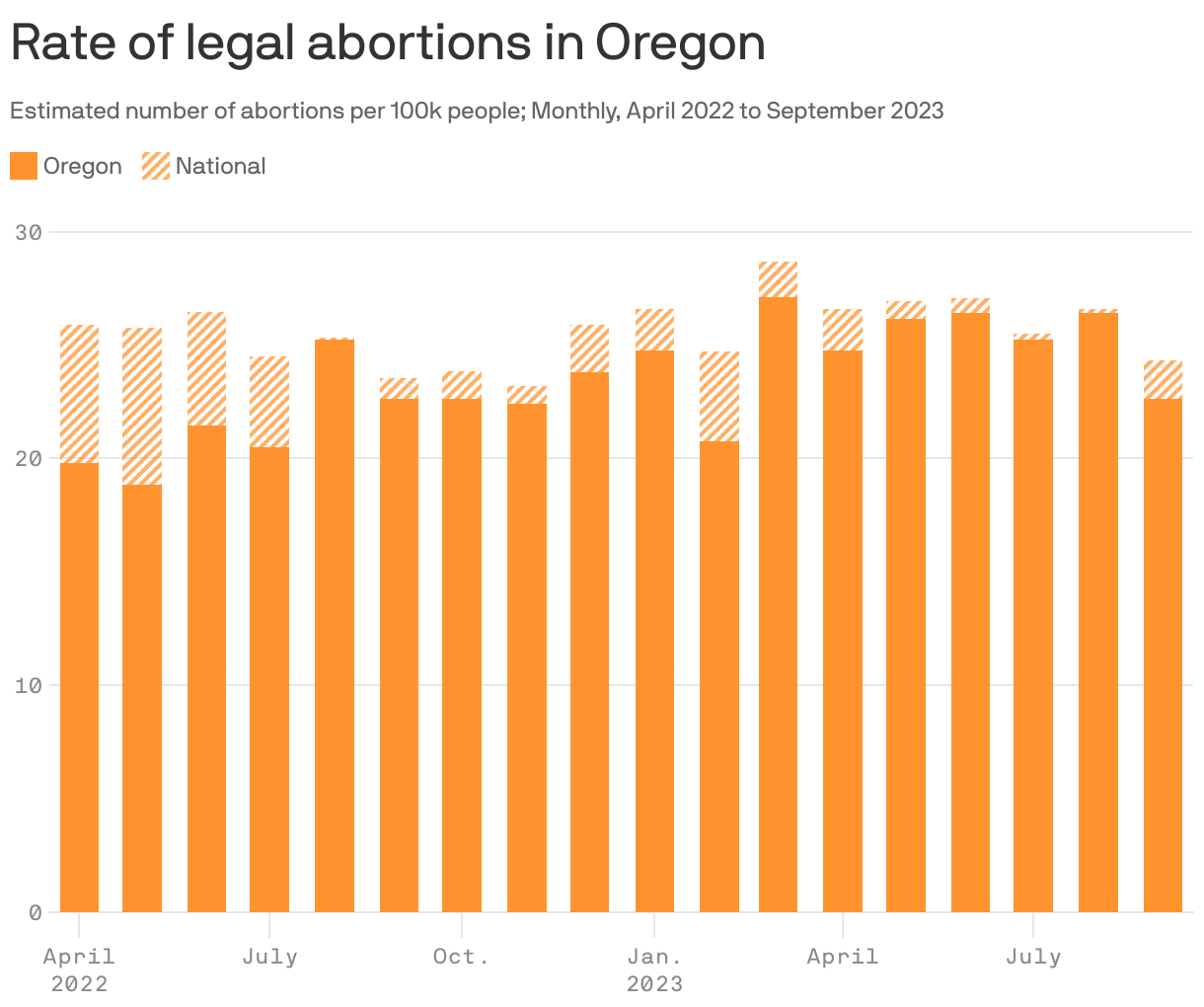
By the numbers: The number of abortions performed in Oregon jumped 14% from April 2022 to September 2023 — 840 to 960, respectively — according to a February report from the Society of Family Planning.
- The Guttmacher Institute, a reproductive research and policy organization, estimates that 11% of abortions performed in Oregon from January to June last year were patients traveling from out of state.
The intrigue: The rising need for reproductive care in Oregon isn't limited to only abortions.
- Jessica Keersemaker, vice president of patient services at Planned Parenthood Columbia Willamette, told Axios that STI testing and treatment and birth control — including vasectomies — "have and remain in high demand" for patients in Oregon and Washington.
Zoom in: Colwill also cited an increase in the number of complex pregnancies she's seen where there have been fetal anomalies or poor prognoses.
- "When people have complicated pregnancies they want to come to a state where all options are discussed."
Of note: Because the number of patients from out of state has risen, staff at OHSU are now responsible for coordinating care, and often connecting patients with community organizations (like the Northwest Abortion Access Fund and the Cascades Abortion Support Collective) to assist with the logistics of travel, lodging and funding.
The bottom line: Several studies show the number of abortions performed in the country has not decreased since the Dobbs decision overturned Roe.
- For Colwill that means "people are still seeking and needing abortions and all of these border states will continue to see large increases in their volume."