Majority of Oregonians don't get enough sleep


Add Axios as your preferred source to
see more of our stories on Google.
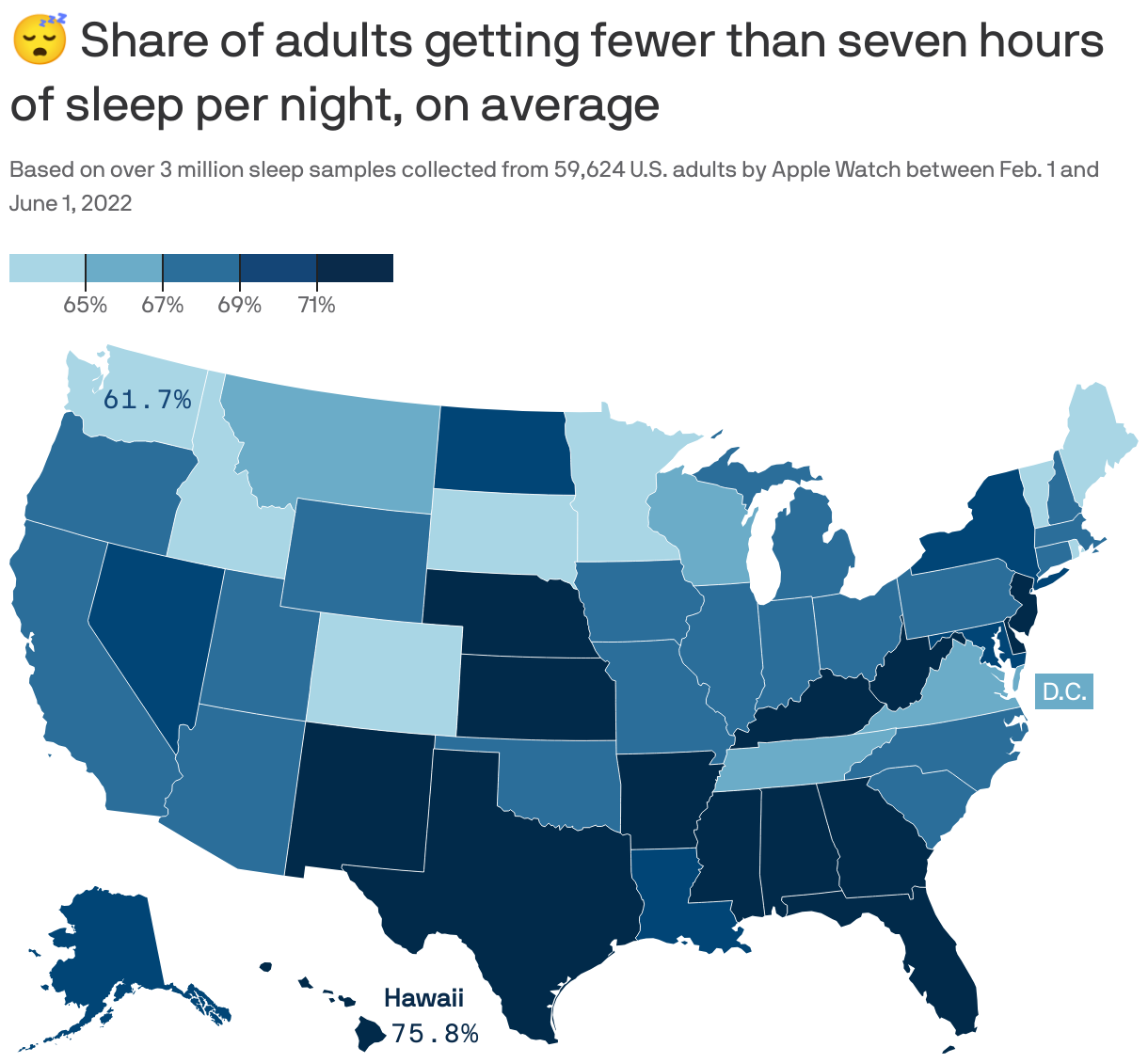
Oregonians are getting more sleep than most, but it's still not enough, according to a study that tracked the sleep of nearly 60,000 Apple Watch users from February to June 2022.
Why it matters: Experts say sleeping seven or more hours is crucial for your health, but many people incorrectly try to fix broken sleep habits.
Driving the news: The study found that 67% of Oregonians slept less than seven hours. On average, Americans logged less than six and a half hours of sleep per night.
- Sleep experts told Axios that people tend to stay up later in places where it stays lighter longer, unlike Portland, which clocks around nine hours of daylight this time of year.
- Although data on Apple users during that period might not reflect the general population, the "fact that we don't get enough sleep [is] clear across the board," Karin Johnson, a sleep medicine specialist and professor of neurology, said.
Be smart: Here are a few tips from Oregon Health & Science University's Brain Institute.
- Find a relaxation technique that works for you — meditation or breathing exercises to reduce muscle tension.
- Go to bed and wake up at the same time every day.
- Introduce a restful activity into your wind-down routine, like taking a warm bath or reading a book.
Plus: Try blackout curtains or an eye mask because light can be disruptive. Also, check out white noise machines and apps.
Between the lines: Although sleep tech has become a big business, Johnson says that using some smart sleep gadgets can lead to stress over the amount of time you're asleep, which could make sleep harder to come by.
- Johnson instead recommends considering "proven" treatments like cognitive behavioral therapy for insomnia or a CPAP for sleep apnea.
The bottom line: The goal for someone trying to improve their sleep should be to create a space where you're calm and relaxed — an environment conducive to sleep, Johnson said.