Parks discount program rises in popularity and cost

Add Axios as your preferred source to
see more of our stories on Google.
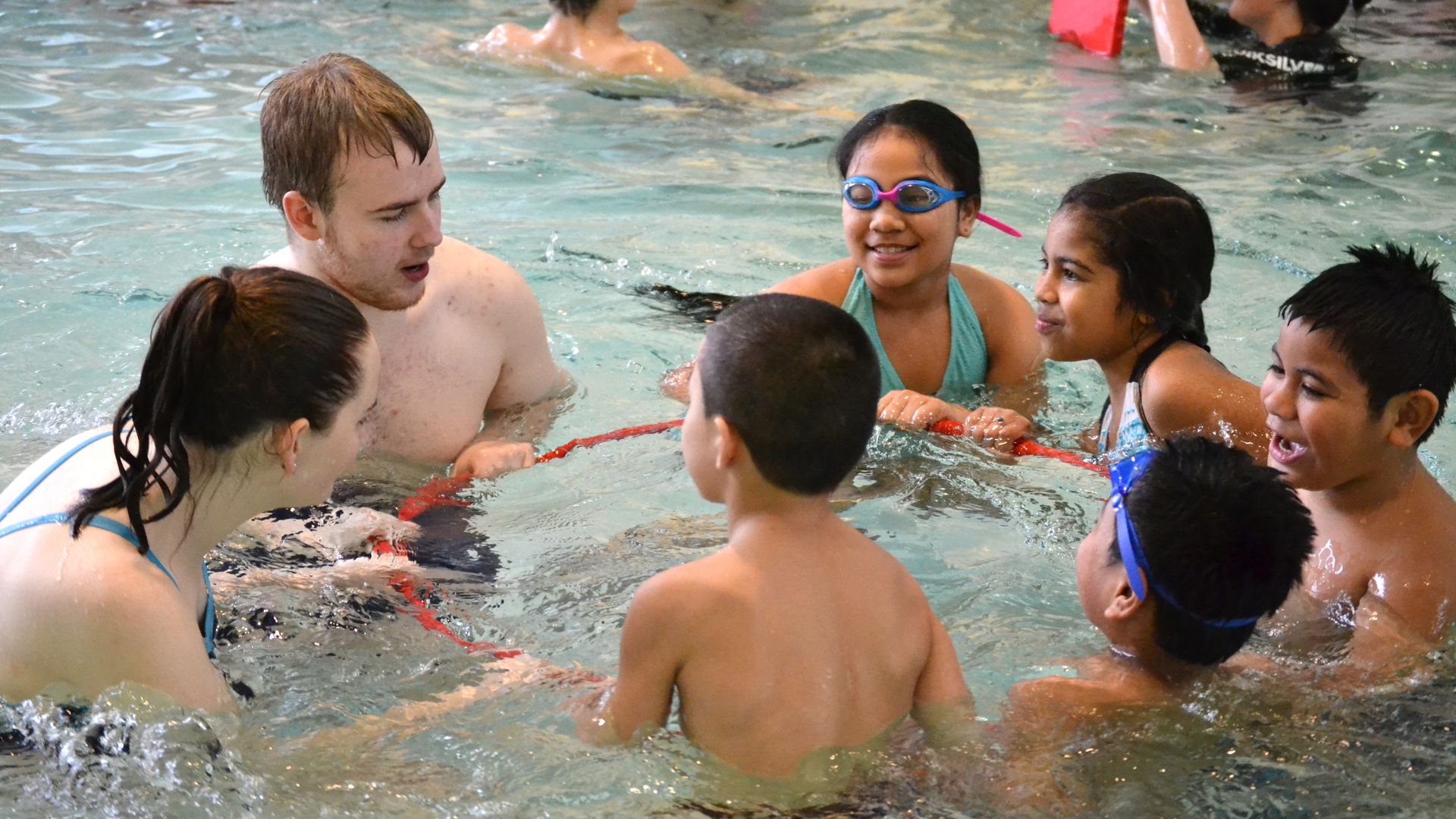
Swim lessons are one of the highest-demand parks' classes. Photo: Courtesy of Portland Parks & Recreation
The vast majority of participants in the first year of Portland Parks & Recreation's self-referral discount program took the maximum — 90% — off the cost of classes, camps or access to community centers.
Why it matters: Understanding who is using the $2.8 million program helps evaluate PP&R's goal of reducing financial barriers and increasing the diversity of people who use the services.
Catch up quick: Three years ago, Portland voters approved a new property tax — 80 cents per $1,000 of assessed home value — for city parks.
- Funding goals included prioritizing communities of color and low-income households — the discount pass is part of that.
How it works: The Access Pass lets any Portland resident take self-determined discounts between 25% and 90% off preschool and after-school programs, pool or gym entry, or personal training.
- It's valid for a year and can be renewed.
- No proof of income is required.
By the numbers: Data provided to Axios by PP&R shows that more than 11,500 Portlanders used the program in fiscal year 2022-23. More than half of the discounts went to community center monthly memberships.
- The vast majority of participants — 79% — chose a 90% discount.
- Nearly 12% took 75% off, and less than 2% took the lowest discount, 25%.
Details: Most discount users are adults under the age of 60, according to PP&R data. Youth make up 30% and older adults 9%.
- By race or ethnicity, 43% said they are white and 39% identified as people of color.
- For 18%, race or ethnicity was unknown.
- By ZIP code, residents of Southeast Portland on either side of 82nd Avenue had the highest percentage of discount users, followed by North Portland from Overlook to St. Johns.
What they're saying: "In the context of reducing costs as a barrier, we're absolutely making a difference," Mara Cogswell, a recreation specialist with PP&R who helped develop the discount programs, tells Axios.
Context: Cogswell says parks officials decided that "it was not our job to determine what people decided they needed as far as help goes."
- "Somebody could make far over the threshold that is deemed poverty level and yet may not be able to put together food for their table and a camp for their kids at a full rate."
Zoom out: Costs have more than doubled since PP&R began experimenting with discount programs funded by the new parks levy in 2021.
- In fiscal year 2021-22, nearly 8,000 people used two pilot programs allowing discounts, at a cost of just over $1 million, per the parks' levy annual report.
- In fiscal year 2022-23, after the current program was established, 11,500 people used it at an overall cost of $2.8 million, according to PP&R.
The big picture: Levy funding also goes to cleaning up parks and natural areas; meanwhile the bureau has a $600 million maintenance backlog.
The bottom line: The voters approved levy has to be renewed every five years.