The seasonal habits of Portland's crow population

Add Axios as your preferred source to
see more of our stories on Google.
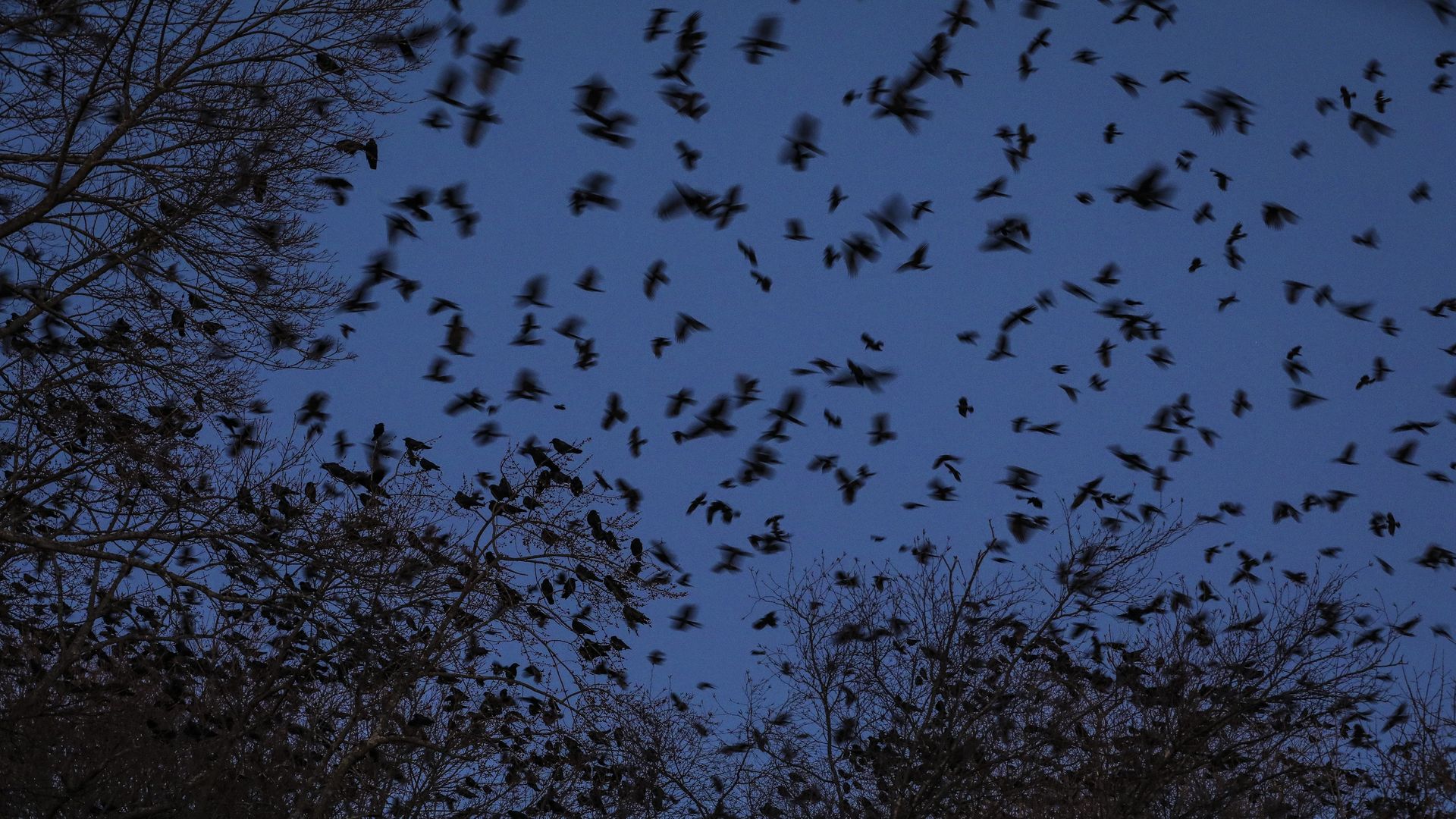
You know "crow happy hour" when you see it. Photo: Erin Clark/The Boston Globe via Getty Images
From late October to March, Portlanders can observe hordes of crows (often in the hundreds) flying above in the evening before flocking to the west side to roost for the night.
State of play: The mass roosting isn't a strictly Portland phenomenon, but a universal, seasonally-dependent migration as a way for the species to ensure its survival when days are short, resources are scarce and threat levels are high.
- That's according to Michael Murphy, a biologist and professor focused on birds at Portland State University who has observed the movement of the city's crow population for nearly two decades.
- He said the tradition we see nightly comes down to one thing: strength in numbers.
What they're saying: "By roosting in large numbers, they can actually dilute the possibility of some predator coming along in the middle of the night," Murphy tells Axios. Their biggest potential nemeses? Raptors like eagles and owls.
- Crows are intelligent and social, Murphy added, meaning the roost also acts as an "information center" where they identify who among them is looking well-fed by taking note of the crop — an enlargement of the esophagus before it gets to the stomach used for food storage.
- "That's how they figure out where they should move the next morning to go foraging," he said — by following the well-fed crow when the sun rises.
The intrigue: Large roosts only happen in the winter months. From April to August, crows breed solitarily and are territorial, mostly because they don't have to rely on others to find meals, Murphy said.
The bottom line: There are still a lot of unknowns — local ornithologists like Murphy don't know why the city's crows are fond of the west side for winter-time roosts or how often roost locations change.
- One hypothesis is that downtown has fewer predators than the east side and may be better protected from coastal winds thanks to the west hills.
- To learn more about the corvid's habits, Murphy is interested in putting radio transmitters on some during this time to "better understand what they're doing and why."